
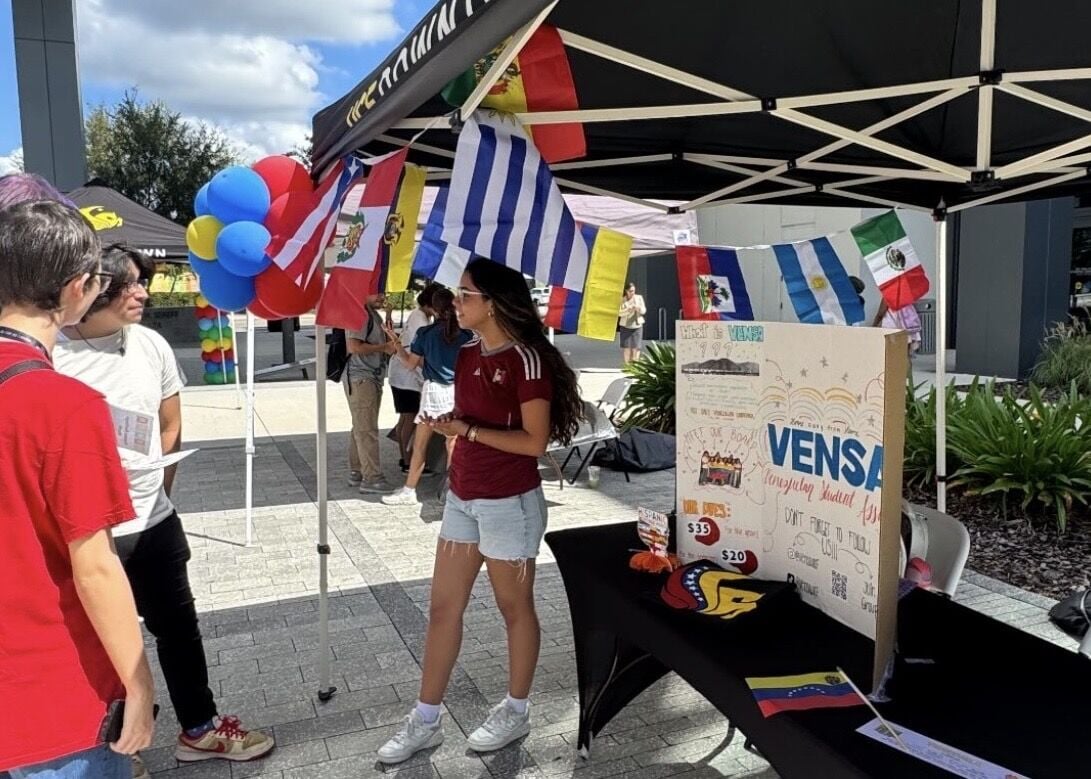

Students gathered at the Venezuelan Student Association tabling on Sept. 25 of last year, during the student organization fair at UCF’s Downtown campus. Members shared information about the club and celebrated Latin American culture.
Courtesy of Venezuelan Student Association
Speaking a different language in public, something that once felt natural, is starting to feel like something Spanish-speaking students at UCF have to think twice about.
As immigration enforcement has been more present and in social media feeds, and Florida leads the nation in detainments by Immigration and Customs Enforcement, some Hispanic students say even casual moments like talking with family or friends in Spanish can suddenly feel tense.
For Juan Quintero, junior mechanical engineering student, that feeling is subtle, but constant. What used to feel like an ordinary part of his daily life now comes with second-guessing glances, shortened conversations, and an awareness of how quickly comfort can change, he said.
“It has been half and half,” Quintero said. “Sometimes people don’t care. Some even try to learn it. However, there have been some people that get weirded out when I speak Spanish in front of them because they think I am speaking bad about them.”
Antach Romero, senior hospitality management major, said conversations and language use often shift depending on who he is with at the time.
“With my friends, we try to be lighthearted and even make jokes about the topic,” Romero said. “When everything started, it was more serious since my friends in Latin America were worried about me. With my family, it is still a serious topic since there are family members that are very scared due to their current migratory status in the country.”
“¡Vamos Knights!” is written across the side of a UCF shuttle bus at the UCF Superstop last October, reminding students about the university’s Hispanic-Serving Institution initiatives. Recently, some Hispanic students have said they have felt less safe on campus.
Felix Rodriguez
While not every interaction is negative, some students said the current political climate has made them more conscious of how they are perceived. Conversations about immigration enforcement, including ICE activity in Central Florida, have added a new layer of tension, even for students who have never had direct encounters with the agency.
“I believe the current state of the world affects me personally,” Quintero said. “There is a common stereotype that Spanish speakers contribute to crime and poverty in the United States, which is not true.”
An analysis by The Marshall Project reviewed more than 12,000 statements by President Donald Trump about immigrants, most commonly referring to immigrants as “migrant criminals,” “illegal monsters,” “killers,” and “gang members.” However, immigrants are less likely to be incarcerated than U.S.-born individuals, according to the American Immigration Council.
In Florida, Gov. Ron DeSantis has also highlighted enforcement operations such as “Operation Tidal Wave,” which has resulted in the arrest of more than 10,400 immigrants without permanent legal status.
Gov. Ron DeSantis speaks at the press conference on April 30 about his concerns with Walt Disney World and the Reedy Creek district. DeSantis recently highlighted enforcement operations that have resulted in the arrest of more than 10,400 immigrants without permanent legal status.
Courtesy of FOX35
Meanwhile, many immigrants say that enforcement pressure has reshaped daily life, including no longer playing Spanish music or displaying flags attached that represent their heritage, according to NPR. These narratives reinforce stereotypes that Quintero says he feels in his everyday interactions.
For many students, the fear is not always direct. It shows up in social media, news headlines and conversations at home. Recently, that fear has felt even closer to home, some students said.
The Orlando Sentinel reported the case of a Valencia College student in east Orange County who said ICE agents were waiting outside as he left for work. According to court records cited in the report, the student is residing in the country lawfully, has a pending asylum application and holds documents allowing him to work.
Josephine Arroyo, a UCF alumna, is an immigration attorney and managing partner at Arroyo Law Firm. She handled the Valencia student’s case as his immigration lawyer.
“We were able to get him back and then get him released within a week,” Arroyo said in a phone call.
Even in a diverse campus environment like UCF, students say the sense of comfort can change depending on where they are.
Attorney Josephine Arroyo speaking in an Orange County Commission meeting in January about the detainment of a Venezuelan high school student. Arroyo recently represented a Valencia College student who was unlawfully detained.
Courtesy of Orange County / Central Florida Public Media
Another student, who requested to go by her initials S.U., for safety reasons regarding her immigration status, said speaking Spanish on campus has generally felt safe, but that changes outside familiar spaces.
“We live in a very diverse area, so speaking Spanish around campus has never really been an issue,” S.U. said. “However, I have definitely seen a change when traveling to more rural areas, where speaking Spanish is not as common or accepted.”
S.U., freshman pre-finance major, recalled one experience that shifted her perspective.
“There was one time when I was speaking Spanish with my mom, and a woman approached us aggressively and told her she should learn English,” she said. “It was a shock for us.”
After that, she started thinking differently about where she felt comfortable.
“I try to avoid areas where Hispanic presence is not as common,” she said. “So. in that aspect, yes, I have resorted to speaking Spanish less frequently in public.”
For many Hispanic students like S.U., their language is deeply tied to identity. It is how they connect with family, culture and community. But when speaking Spanish starts to feel risky, it can create tension between self-expression and safety.
“I will not stop speaking Spanish or change who I fundamentally am,” S.U. said. “Speaking Spanish is a part of my identity. I will not minimize nor betray myself by avoiding my language.”
Still, she said, safety concerns have changed how she presents herself in public.
“I definitely feel like I have to be more careful in how I express myself,” she said. “My safety is first, and that has sadly meant avoiding places I used to go.”
That kind of self-awareness can turn everyday actions into difficult decisions, she said. For some, it is not about stopping entirely, but about adjusting.
Quintero said he has not changed how often he speaks Spanish, but he is more aware of how people react.
“I am still speaking the same,” he said. “And the times I’ve had any problems, I just moved away from that situation.”
Even so, he said conversations about identity feel more limited.
“I feel more censored when I try to speak about what is happening right now in the country,” he said. “You don’t know if you can generate any problems afterwards.”
Student organizations can offer some relief from that pressure, providing spaces where students do not have to question how they speak or present themselves. Valeska Muñoz, junior kinesiology major, is the president of the Venezuelan Student Association and said creating a welcoming space is a major part of her role.
“As president, it’s not just about leadership,” Muñoz said. “It’s about creating a sense of community and friendship. I always tell our members this is their ‘family away from home.’”
Muñoz said many students move away from their families for college, and organizations like VENSA help them stay connected to their culture while building new relationships.
“A close Venezuelan community can help students feel at home, build friendships and just enjoy being part of something,” she said. “And it’s open to everyone, not just Venezuelans.”
UCF’s associate director Josefina Rosario (right center) and members of the different Hispanic student organizations gather at a photo booth set up at the “Colors of Hispanic Heritage Month” event in October 2023.
Deja Sloan
Even with ongoing concerns about immigration enforcement and how students are perceived, Muñoz said the organization continues to provide a consistent place for students to come together and that speaking Spanish has even helped her connect with others on campus.
“I have spoken Spanish in public before and had people come up to me asking questions about campus because they felt more comfortable speaking in Spanish,” she said. “Sometimes I hear people speaking Spanish, and I’ll go up to them, ask where they are from, their major, and if they’ve heard of VENSA or other Latino RSOs.”
Muñoz said Spanish remains the language she naturally uses most and something she continues to speak proudly, saying it has always been her “first and most common language.”
Still, she said, students remain aware of what is happening around them.
That fear extends beyond students themselves and often reaches entire families and communities. Arroyo said she has seen rising anxiety among Hispanic families in Central Florida and that many of the people she works with have become fearful of everyday activities.
“They’re scared to drive because the majority of them have been picked up or stopped by law enforcement while they’re driving,” she said. “They’re scared just because of the way we look, our features, and they’re terrified that they’re going to be next.”
Arroyo said that fear can push people into isolation. She added that many families who once felt secure in the United States no longer feel protected.
“They felt embraced and wanted. They felt secure,” Arroyo said. “Lately, they have felt like, ‘Why am I being targeted? Why am I now in fear in the country that I fled to, to be protected from the fear I was facing from my own country?’”
Arroyo also said many people now try to avoid drawing attention to their identity.
“We are such a proud culture,” she said. “We love to wear our colors and represent our countries. But now people want to minimize those things. They do not want to draw attention to themselves.”
Laura Quintero, an immigration attorney from Quintero Fortich Legal and a UCF alumna, said those concerns reflect a larger sense of uncertainty in Hispanic communities.
“There has been a noticeable increase in concern among Hispanic students and families who feel unsafe or targeted in public spaces, including schools, workplaces and everyday environments,” Quintero said. “Many individuals have expressed fear about leaving their homes due to reports and personal experiences involving stops, questioning or detention.”
She said it is important to distinguish between fear and what the law actually allows.
“Speaking Spanish, by itself, is not a lawful basis for questioning, detention or arrest,” Quintero said. “Language, accent, skin color or perceived ethnicity alone do not meet that standard.”
Arroyo said the consequences can reach attendance, academics and mental health across all levels of education.
“I think it’s going to have an impact all across the board,” Arroyo said. “Parents are scared to take their kids to school, and kids are scared to go to school because they do not know if mom and dad will be there when they get out.”
She said those effects can spread far beyond classrooms.
“We’re just going to see a domino effect across the board,” Arroyo said. “I do not think the leadership realizes how important Latinos and Hispanics are to this country and how much we have done to bring this country to where it is now.”
Across the country, educators and researchers have reported that fear about immigration enforcement is affecting student behavior, including how comfortable students feel in public spaces.
According to ABC News, research has found student absences increased by about 22% during immigration raids, while nearly 64% of principals reported attendance declines among students from immigrant families. On college campuses, those effects are often less visible, but still present.
Studies from the nonprofit organization KFF have found that increased immigration enforcement is linked to higher student absences and anxiety, particularly among students from immigrant families.
UCF students listen to Pedro Turushina, president of the Hispanic Chamber of Metro Orlando, during the POTENCIAL LatinX professional speaker series in September 2024, hosted at the Business Administration II building.
Courtesy of Cyndia Morales Muñiz
For many families, that stress is deeply personal. Carmen Rodriguez, mother of Juan Quintero, said the fear does not stop when students leave home for campus.
“As a Hispanic mother, I live in constant fear,” Rodriguez said. “I worry that my children, even though they are good students and good people, could be judged solely based on their background.”
Rodriguez said the atmosphere in her community has become more anxious as detentions have increased and that it feels “no one is completely safe.”
She added that hearing about students being detained is especially painful.
“It fills me with deep sadness and anguish,” Rodriguez said. “I feel that our children are not safe, even if they do everything right.”
Still, she said, fear has not changed the message she gives her children.
“I teach them to look out for themselves, to know their rights, and to feel proud of being Hispanic,” Rodriguez said.