
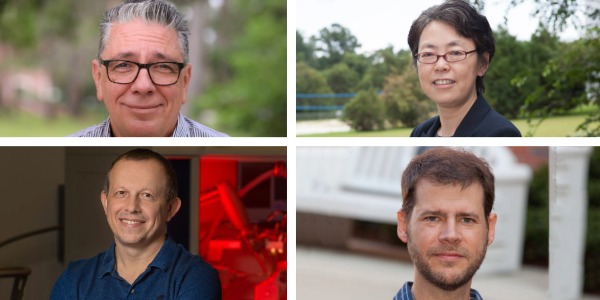
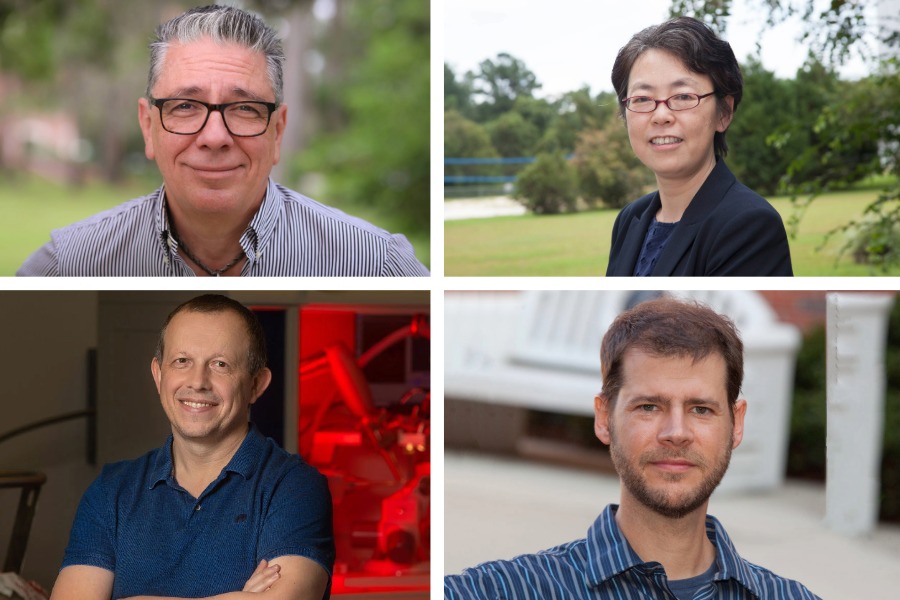
 TOP: Vladimir Dobrosavljevic and Hui Li.
Bottom: Michael Shatruk and Jon Maner
Florida State University has bestowed the title of Distinguished Research Professor on four outstanding faculty members for their exemplary research productivity and contributions to their fields.
“The dedication of these scholars represents the very best of Florida State University,” said Vice President for Research Stacey S. Patterson. “By pushing the boundaries of what we know about everything from quantum materials to human behavior, they are not only advancing their respective disciplines but also inspiring the next generation of innovators on our campus. We are proud to support their continued pursuit of discovery.”
The Distinguished Research Professor award recognizes outstanding research and/or creative activity of eligible Florida State University faculty currently at the rank of full professor. Recipients receive a one-time award of $10,000 and can use the title Distinguished Research Professor throughout their tenure at FSU. The title is only surpassed by that of the Robert O. Lawton Distinguished Professor Award.
This year’s recipients are:
Hui Li, Electrical & Computer Engineering, FAMU-FSU College of Engineering
Hui “Helen” Li is a leading expert in power electronics for grid and transportation electrification. Her research focuses on developing innovative power conversion technologies based on wide-bandgap devices and advanced control to achieve high-performance operation and cost reduction. Li has led power electronics research at the Center for Advanced Power Systems (CAPS) for over two decades. Her work is instrumental in advancing next-generation grid systems to meet the surging power demand from booming AI data centers and widespread transportation electrifications. She is an IEEE Fellow, a Fellow of the National Academy of Inventors (NAI), and a member of the Academy of Science, Engineering, and Medicine of Florida (ASEMFL).
Jon Maner, Psychology, College of Arts & Sciences
Jon Maner is a social psychologist who uses evolutionary theories to understand fundamental human social motives. His research explores the psychological processes underlying social hierarchy, romantic attraction, social affiliation, and self-protective processes like fear and anxiety. Maner received the American Psychological Association’s Distinguished Scientific Award for Early Career Contribution and is widely published for his work on how dominance and prestige influence leadership.
Michael Shatruk, Chemistry & Biochemistry, College of Arts & Sciences
Michael Shatruk is an inorganic materials chemist specializing in solid-state and molecular magnetism and the discovery of new quantum materials. As the founding director of the FSU Quantum Science Initiative, Shatruk works at the boundary between materials chemistry and physics to uncover correlations between crystal structure and magnetic properties of quantum materials. His research, supported by numerous grants, utilizes advanced X-ray and neutron scattering methods to explore intermetallic magnets, stimuli-responsive materials and molecular qubits that could revolutionize optoelectronic devices, quantum technologies, computing and medical sensing. He is a fellow of the American Association for the Advancement of Science.
Vladimir Dobrosavljevic, Physics, College of Arts & Sciences
Vladimir Dobrosavljevic is an internationally recognized leader in theoretical condensed matter physics, whose research has advanced the understanding of strongly correlated and disordered electronic systems, particularly near metal-insulator transitions. His work has introduced and developed powerful extensions of dynamical mean-field theory to explain how electron localization, strong correlations, and disorder interplay to produce emergent phenomena such as non-Fermi-liquid behavior, Griffiths phases, and quantum glassy dynamics, with direct relevance to materials including high-temperature superconductors, low-dimensional electron systems and “bad metals.” He has made seminal contributions to the theory of Anderson localization in correlated systems and to the understanding of non-equilibrium quantum dynamics, helping to establish glassy electronic behavior and quantum criticality as central concepts in modern condensed matter physics, while influencing both experimental directions and the broader field of quantum materials research.
###