
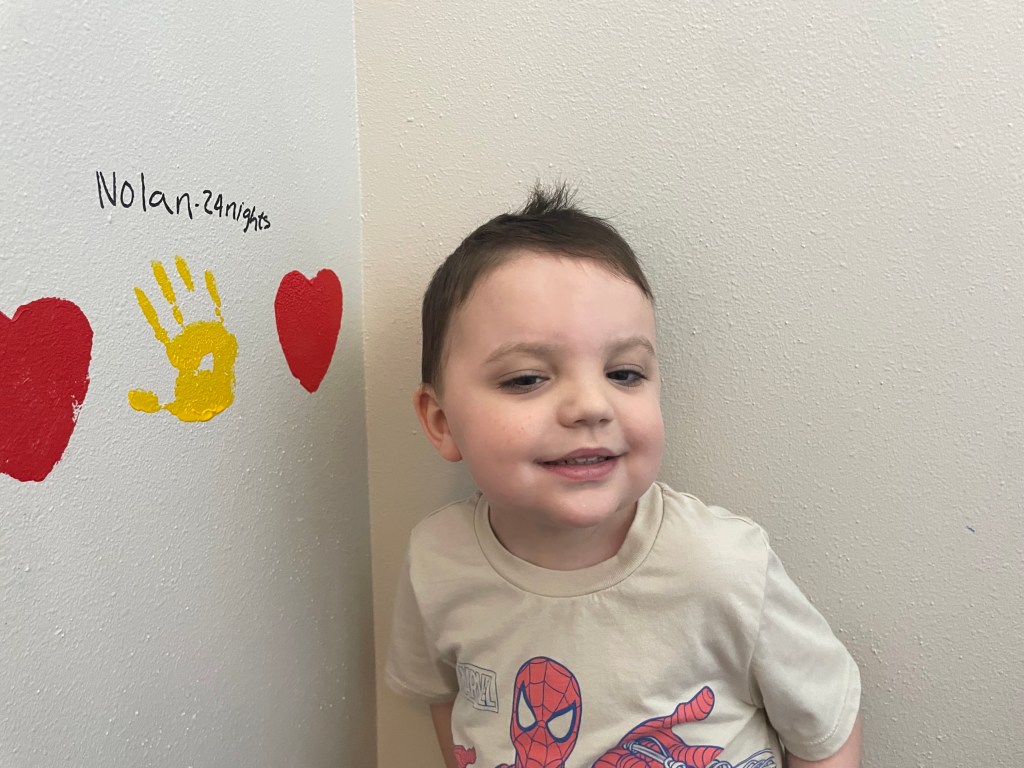
Sophie Byroade was scrolling on Facebook last summer when she stumbled on an unusual post: It was from a mother looking for a liver donor for her sick three-year-old son.
“Nolan needs a liver hero,” it read.
The post described Nolan Smith as a “sweet, dinosaur-loving, music-dancing, water-splashing” child –– all things that reminded Byroade of her five-year-old sister.
The Jacksonville preschooler, who has a rare and serious liver condition, had been on the transplant waiting list since he was six months old.
“I need to do this,” thought Byroade, a second-year law student at Jacksonville University. “After that, it was kind of history.”
Byroade called the transplant coordinator at AdventHealth Transplant Institute in Orlando that same day. She’d later undergo testing to make sure she’d be a fit donor. She was.
In January, Nolan, now 4, got a section of Byroade’s liver to replace his damaged one in the first ever living donor transplant arranged through the Orlando hospital’s new program.
“It’s just really wonderful that somebody would do that out of the goodness of their heart, that they just saw his post and just wanted to do something to help him,” said Danielle Haines, Nolan’s mother.
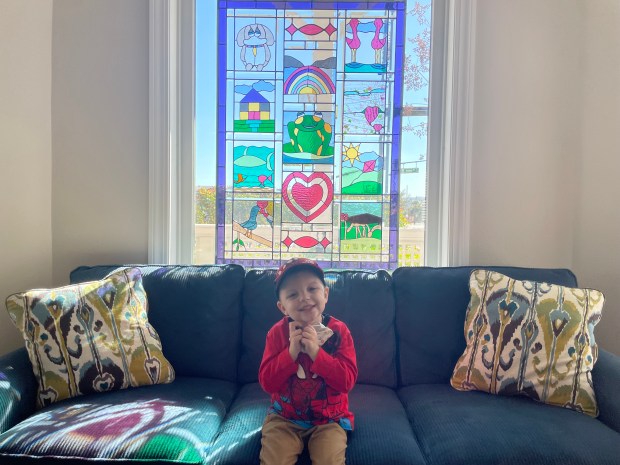 Nolan Smith was diagnosed with biliary atresia when he was less than two months old. Without a liver transplant, Nolan would’ve stopped growing normally, lost the drive to eat and might have needed a feeding tube. (Photo courtesy of Danielle Haines)
Four months after the transplant, Nolan’s recovery is going smoothly, she said. “His energy before and after the transplant is like night and day,” Haines said.
Nolan suffered from biliary atresia, a condition where bile ducts –– which carry the bile the liver makes into the intestines –– don’t develop properly. The disease was discovered when he was an infant.
Without the transplant, Nolan would’ve stopped growing, lost the drive to eat and might’ve even needed a feeding tube. His brain development could’ve also been impacted and he could’ve developed chronic disabilities, said Dr. Ryan Day, director of AdventHealth’s living donor program.
“That’s truly a life-saving organ transplant for children like Nolan,” Day said.
In a living donor liver transplant, the organ is split, with one portion transplanted to the recipient while the donor keeps the remaining section.
Both regenerate over the following 4 to 6 weeks, allowing both patients to have “adequate, full-sized livers” that fulfill their needs, Day said.
The living donor transplant program is the only one like it in Central Florida and one of 11 in the southeastern United States. AdventHealth doctors completed their second living donor transplant in February, Day said.
Though most organ transplants come from deceased donors, living donors offer plenty of advantages, if they can be found. The staff can pick the date and time for the surgery and “optimize” the health of the recipient beforehand.
“With a deceased donor organ transplant, you don’t know when it’s going to happen, and that can make managing a patient who has end-stage liver disease very difficult,” Day said.
Nolan was diagnosed with biliary atresia when he was less than two months old after a visit to a primary care doctor with his ill older brother. The doctor noticed Nolan was jaundiced and ordered some tests.
At 11:30 that night, the physician called, Haines said, with an urgent message: “You need to take Nolan to the emergency room.”
There Haines learned of Nolan’s condition and that most biliary atresia patients ultimately need a transplant. He got on a waitlist a few months later.
When he was 11 months old and had begun to walk, Nolan fractured his femur because of his low vitamin levels caused by the condition. He fractured his shin going down a slide a few months later.
But the biggest challenge came in November 2024. Nolan developed esophageal varices, which are swollen veins in the esophagus that can burst and bleed. He had to have an endoscopy and during the procedure a doctor banded the veins to reduce the chance of bleeding
The strain of watching her child suffer was compounded by the unpredictability of being on the transplant waiting list, Haines said.
“Knowing that there was nothing that we could really do except wait for transplant, that was really difficult… to spend a lot of time just wondering when something may happen, if he may get worse, if he’s going to have another bleed,” Haines said.
She posted on Facebook in July last year, hoping to find a donor on her own.
When Byroade stepped up, she quite simply changed Nolan’s life, Haines said.
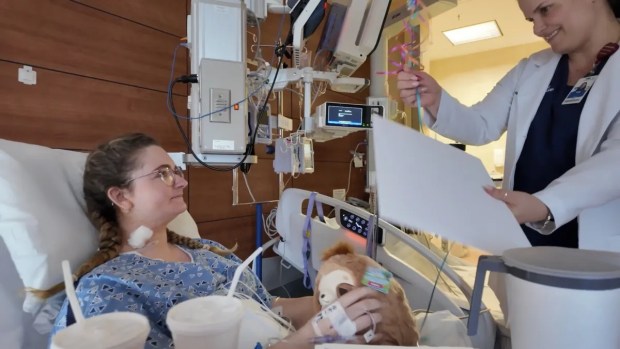 Sophie Byroade, a 23-year-old second-year law student at Jacksonville University, donated a portion of her liver to Nolan Smith earlier this year. She found Nolan’s family through a Facebook post last summer. (Photo courtesy of AdventHealth)
Living donor transplants are relatively rare, both because of the challenges with finding donors and the expertise needed to perform such surgeries, Day said.
In 2025, for example, there were over 49,000 transplants in the country. Only about 7,200 of those were performed with living donors, according to data from the Health Resources and Services Administration.
Byroade said plenty of people asked why she would want to undergo an unnecessary procedure. The hospital staff asked her at every check-in if she wanted to move forward. It just made her even more determined to go through with it.
“I’m young, I’m healthy. So I figured, if I’m going to do something like this, to do it now,” Byroade said.
Her mother was “excited,” Byroade said, but likely more nervous than she was letting on. It was the first time Byroade had surgery, after all.
Byroade’s university allowed her to attend online classes while she recovered. She said she had to play some “catch up” throughout the semester but managed to get it done.
Her professors acknowledged the sacrifice she had made, she said, and one dubbed her his “hero.”
Now, Byroade is back to her regular routine. She can do most of what she used to do physically, barring some stretching and core exercises.
“I didn’t do the hard part. The surgeons did the hard part. I just showed up is kind of how I see it,” she said.
Byroade would be happy to meet Nolan and his family some day but said that will be up to his family.
“I cry every time just to think that this little boy now gets to grow up healthier than he was,” she said. “He just gets to have a normal childhood going forward.”
Haines would like to meet Byroade at some point, though for now they are restricting who Nolan sees to reduce his exposure to diseases.
And she is delighted that Nolan can do more regular little kid activities. In August, he’ll start pre-kindergarten.
“He’s so much happier,” Haines said.