
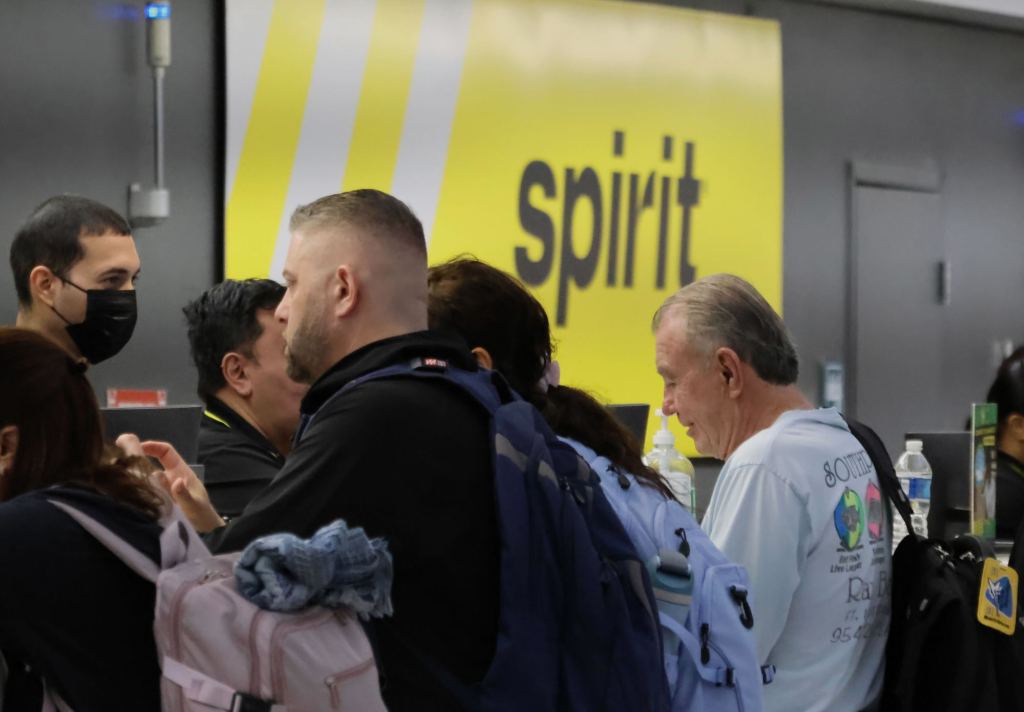
A Spirit Airlines lawyer confirmed to a New York bankruptcy judge Thursday that the troubled Dania Beach-based carrier is in “very advanced discussions” with the federal government on a financing rescue package, and that cash is running short.
Marshall Huebner of the New York law firm Davis Polk, which represents Spirit, told U.S. Bankruptcy Judge Sean Lane that the company has shared details of a Trump administration offer with its three primary creditor groups, and expects it will take a week’s time to discuss it and apply for the court’s approval.
Time is critical, he said, as the company has defaulted on loans that have allowed the airline to fly during its Chapter 11 bankruptcy restructuring case, which was filed last August.
Up until Thursday, Spirit had not acknowledged its critical cash situation.
The lawyer said Spirit wants to be back in court next Thursday to seek its blessing for a government rescue driven at the behest of President Donald Trump, who said in a CNBC interview this week that the airline should receive public financial help.
“We hope these discussions will lead to consensus and support on all sides,” Huebner told Judge Lane in a White Plains, N.Y., courtroom. “The financing would do more than make the reorganization possible; it would create an appropriately capitalized, fierce competitor in the space.”
The proposed package, which was not aired in court, has been reported in the national financial media as a $500 million government loan in exchange for warrants that could lead to a 90% ownership stake in the airline.
The court disclosure came as the Spirit contingent of the Air Line Pilots Association announced its support for a deal, the Association of Flight Attendants-CWA called for its members and the public to call the White House and Congress, and U.S. Rep. Debbie Wasserman-Schultz, whose district encompasses Fort Lauderdale-Hollywood International Airport and Spirit’s headquarters, released a letter to Trump pledging her support for his efforts.
In court, Huebner told Lane that the company had been on a path toward exiting Chapter 11 bankruptcy, but that its reorganization plan was rendered unfeasible in the wake of a major spike in war-driven fuel costs. Fuel is the company’s second-largest expense behind labor.
He said statements from “naysayers” that the airline was on the verge of liquidation within days were untrue. But he acknowledged that cash is tight.
‘Crossroads’
“I think I have been clear, but I want to leave no possibility for confusion: Spirit now definitively stands at the crossroads,” Huebner said. “Several hundred millions of the company’s cash is currently locked away, and inaccessible to us under the terms of the post-petition financing facility.”
He said much of the cash is being held in special accounts “to ensure funding for specific already incurred costs like payroll and taxes.”
“The cash actually available to Spirit to fund ongoing operations is not going to last for very much longer,” Huebner added.
“So either or both of new financing or access to almost $240 million of restricted cash is absolutely essential, about no later than the end of next week,” he said. “The company has left no pebble unturned with respect to cash conservation and generation.”
Lane said he would do whatever he could help expedite the hearing process
“Obviously [you have] a lot of wood to chop and I wish you all the best of luck in that,” Lane said, noting he had presided over the American Airlines bankruptcy case in 2011. “We have a lot of practice and experience in such things.”
The proposed bailout was not before the court Thursday. But the judge did approve the sale of 20 Airbus jetliners operated by Spirit to a California trading firm for more than $500 million.
“I find that this is in fact an appropriate transaction for maximizing value” of the airline’s bankruptcy estate, the judge said.
Skepticism, support
Word that the U.S. Government is moving toward the rescue of a private company stirred outcries of protest in Congress, but predictable support from those whose constituencies have the most to lose through potential layoffs, fewer air service choices and higher prices.
“This is an absolutely TERRIBLE idea,” Sen. Ted Cruz, R-Texas, posted on X. The senator chairs the Senate Committee on Commerce, Science and Transportation.
But in a letter to Trump dated Wednesday, Wasserman-Schultz, D-Weston, said she supports a solution “that will keep Spirit Airlines operating while allowing them a path back to long-term stability.”
The congresswoman noted she represents a part of Broward County that includes the international Airport, Port Everglades, “and a range of additional economic and tourism engines — including the headquarters of Spirit Airlines in Dania Beach.”
“I represent thousands of people who work directly for Spirit, and protecting their financial security and livelihoods is essential for our local and regional economy,” she wrote. “Tens of thousands of American jobs across the country are supported by Spirit’s operations, and drastic changes in those operations would have devastating ripple effects across the aviation industry. When a low-cost airline leaves a market, airfare and related costs skyrocket for all travelers in that market. We have seen this pattern repeatedly in US and global markets. In a time where the cost of airfare has taken off to new heights, low-cost carriers provide a more affordable alternative and increase competition across the marketplace.”
“The work to keep Spirit Airlines operating is critical, and despite our policy disagreements, where we find common ground to save jobs and lower prices, you will have my support,” she told Trump.
On Thursday morning, the Spirit contingent of the Air Line Pilots Association, which represents more than 2,000 active pilots at the airline and contributed to the bulk of a $100 million labor cost-saving package, voiced its backing.
“Spirit is the reason so many Americans can afford to visit family, travel for work, or take a vacation,” said Capt. Ryan P. Muller, chair of the Spirit Master Executive Council. “When Spirit enters a market, fares go down. Losing this airline would not just cost 14,000 jobs, it would cost competition, affordability, and access for passengers who have nowhere else to turn.”
He added that the airline’s survival “is crucial to a competitive, affordable air travel market for all segments of consumers, and the U.S. government must provide support, as it has during other significant shocks to the industry.”