
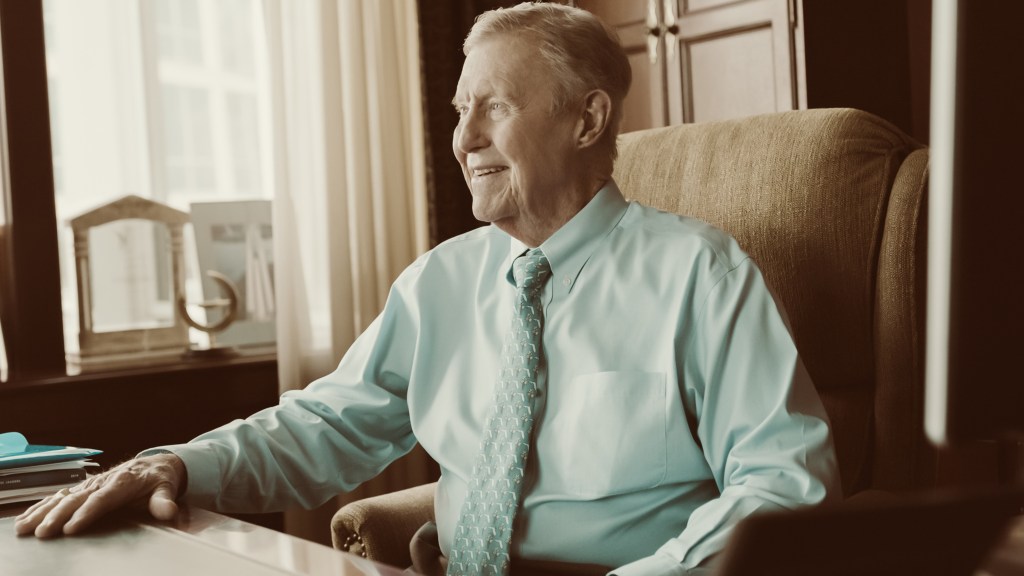
In his 94 years, civic titan J. Charles “Charlie” Gray employed his influence to help persuade Walt Disney to build his tourist kingdom here and state leaders to construct a higher-education institution in Orlando that ultimately became the University of Central Florida.
Gray, a founding member of the law firm that is now GrayRobinson, died Wednesday. He will be remembered not only for his community vision but also for lasting friendships and his virtuous character, friends and colleagues say.
“Simply, Charlie’s ‘fingerprints’ are everywhere in Central Florida and there will never be another like him,” a statement on the GrayRobinson web site said, announcing his passing. “To know Charlie, and to speak of his accomplishments, is to unlock a portal into the rich and vibrant history of our region and the transformational moments, projects, people, and decisions that have shaped it.”
His legacy cannot be overstated, said former U.S. Sen. Bill Nelson, who considered Gray among his most trusted friends.
“Charlie, first of all, was someone who did not let partisan politics rule the day. He would support Republicans or Democrats and ideas he thought were the best, most capable,” said Nelson, a Democrat, of Gray, a longtime Republican until recently. “As a result of that and his position as head of a law firm — a prestigious law firm — he became one of the most substantial leaders in the history of Central Florida.”
The law firm Gray started in 1970 with three other young lawyers — Richard Adams, Gordon “Stumpy” Harris and Richard “Robie” Robinson — today serves clients nationally from 16 offices in Florida and Washington, D.C. The firm’s 300 professionals provide legal, lobbying and regulatory services to businesses, entrepreneurs and local governments with particular expertise at the intersection of business, law, and politics.
Its president and CEO, Dean Cannon, who served as Speaker of the Florida House from 2010-2012, described Gray as his personal mentor and “an industry lion, a champion of progress and people, who cared deeply about the communities in our Sunshine State.”
Gray served in a variety of consequential positions over the years and wielded influence deftly to the benefit of the community, said Dick Batchelor, who represented Central Florida in the Legislature from 1974 to 1982 and regarded Gray as a sage confidant.
“I always found Charlie to be extraordinarily forthcoming, honest and a straight shooter who would even tell you when you were wrong, in a polite way, but directly. He was such an incredible person,” Batchelor said. “I wonder today in our community who are going to be the ‘Charlie Grays’ of the future who want to do things not for political purpose but because they’re the right things to do.”
As Orange County Attorney, Gray helped develop a tourist development plan, which funded the Orange County Convention Center to boost the region’s visitor numbers year-round. He had a friend in the hotel business who went bankrupt because of the seasonal fluctuation of visitors.
“It was feast or famine,” Gray said in an oral history recorded in 2014. “I knew that the convention center would even things out. The hotel industry would not be just a yo-yo.”
Gray also forged a partnership to build the Orlando Arena and help the community land an NBA franchise, the Orlando Magic.
He chaired the Florida State Turnpike Authority, where he was instrumental in securing an interchange between Florida’s Turnpike and Interstate 4 – a key factor in the site selection for Walt Disney World.
His relationships with leaders across the state helped gain funding and a commitment to locate the new Florida Technological University in Orange County in 1963 to support the space program. The school’s name was changed in 1978 to the University of Central Florida as its mission and curriculum expanded.
It is now the nation’s second-largest university by campus enrollment.
An obituary provided by the law firm describes Gray as “a trusted counselor to governors, mayors, county and city commissioners and legislators, while also providing the same passionate support to his clients, his colleagues, his friends and his family.”
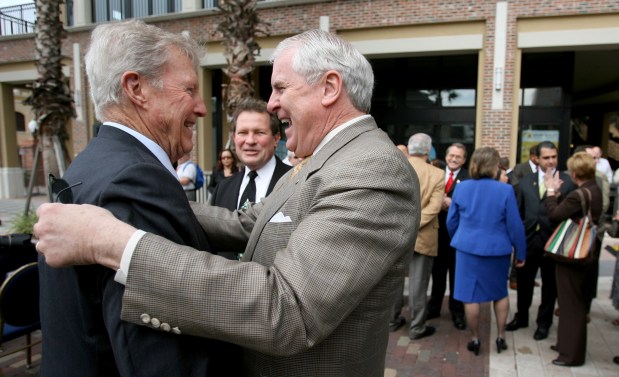 Orlando Chamber of Commerce president Jacob Stuart (right) celebrates with Charles Gray (left) and Fred Leonhardt (background) as Governor Charlie Crist prepares to sign the Sunrail bill during a ceremony at Church Street Station in downtown Orlando, Wednesday, December 16, 2009. The ceremony in Orlando was one of four during Crist’s statewide fly-around, Wednesday, with similar signings in Tallahassee, Tampa and Fort Lauderdale. (Joe Burbank/Orlando Sentinel file)
Gray and the firm were honored in 2020 by Orlando Mayor Buddy Dyer for their role over half a century in building the city.
“Charlie was a true legal giant,” Dyer said in homage to Gray, whose decades of service coincided with the city’s rise. “His immense impact on transformative civic, legal, and political issues in Central Florida was eclipsed only by his humility, honor, and integrity.”
Linda Chapin, elected chair of the Orange County Board of Commissioners in 1990, a post now known as county mayor, learned of Gray’s passing while in Paris. She returned a call from a Sentinel reporter to talk about her friend and his wife, Saundra, also a friend.
“When I was younger, I was very much in awe of Charlie, amazed by his accomplishments, a little wary of his influence,” Chapin, 84, confided. But over the years as she got to know him and Saundra better, she said her admiration and awe of the couple only grew.
“I’m sure I’m not the first to say this, but this must be the end of an era,” she said.
Hector “Tico” Perez, a Central Florida attorney who served as National Commissioner of the Boy Scouts of America from 2008 to 2016, lionized Gray’s service.
“He was the guy in a different time when politics weren’t transactional. You just did the right thing because it was the right thing,” he said. “He was absolutely one of the most impactful humans ever in Central Florida. He only wanted what was best for the community.”
Born in 1932 in Leesburg, Gray was a grade-schooler when his family moved to Orlando.
“It was a nice place. Everybody knew everybody,” he said in his oral history.
Gray recounted that he had been born Charles Stinson, but his father died after returning home from World War II. His mother then remarried, wedding a local attorney, G. Wayne Gray, who adopted him prior to high school.
As a youth, he sold copies of the Orlando Sentinel morning paper and the Orlando Sentinel Star evening paper in an area now known as Baldwin Park. During World War II, the area served as a training base for the U.S. Army Air Corps, predecessor to the U.S. Air Force.
Gray also recalled his paperboy memories in the oral history, posted online at Orlando Memory.
He said he often stopped at a bakery, drawn by a promise of free donuts. “If you went by in the back alley and knocked on the door, they would let you in and they took pity on little paper boys and they’d give me the most wonderful donuts — glazed donuts, hot, warm,” he recalled.
Of all his life successes, Gray considered his greatest achievement to be marrying Saundra, his wife of 70 years.
In the oral history, Gray said he said he met Saundra at a Christmas party in 1954 when a friend — who was on a date with her — “made the mistake of introducing her to me.”
He was smitten.
They began dating the following summer, though he had to juggle a correspondence course required to graduate from UF, a summer job with a municipal utility that required he wake up at 5 a.m., and her father’s demand that she be home no later than midnight.
She was just 17.
As summer’s end neared, they decided to elope.
They drove to Georgia where a justice-of-the-peace hitched them.
“My family was very upset,” said Saundra, now 87. “But they didn’t try to turn it upside down or anything…They just accepted what had happened and my husband told my mother she’d learn to love him, which she did.”
They had three children, a daughter Terese (Tommy Vincent), and two sons Lee and John Charles McNeil Gray Jr.. They also were blessed with four grandchildren and four great-grandchildren.
Son John, 64, died last month after a difficult battle with Alzheimer’s disease.
In 1969, the Grays bought a 212-acre ranch in Volusia County they called Gemini Springs where they raised beef cattle.
They lived on the ranch for 25 years.
They renovated the original Cracker farmhouse and resisted an urge to build a modern home, the Sentinel reported in 1996.
“We felt like we were custodians of that land the entire time we lived there,” Saundra Gray said.
They sold the ranch to Volusia County which converted into a passive park.
The couple also shared a passion for sailing, traveling to the Bahamas and Mexico in their 54-foot boat, “Sea Gem.”
They were part of a group that sailed around the world and retraced Columbus’ historic voyage.
Saundra said her husband had recently switched political parties, becoming a Democrat. “He went down and changed his registration. He got so upset with what’s going on,” she said.
Asked what she will miss most about her lifelong partner, she took a deep breath to gather herself.
“Oh, everything,” she finally said. “We were blessedly close.”
shudak@orlandosentinel.com