
TALLAHASSEE – Gov. Ron DeSantis on Monday unveiled a plan to add four Republican-leaning seats to Florida’s congressional delegation, responding to President Donald Trump’s demand that states redistrict to ensure a GOP majority in the U.S. House.
DeSantis revealed his map to Fox News on the eve of a special legislative session he called to redo the state’s congressional district map, which must be approved by the Legislature.
His plan would leave only four Democratic-leaning seats in Florida — three in South Florida and one in Orlando. It would eliminate a Hispanic majority seat in Central Florida now held by Democrat Rep. Darren Soto and any Democratic-leaning seats in the Tampa Bay area.
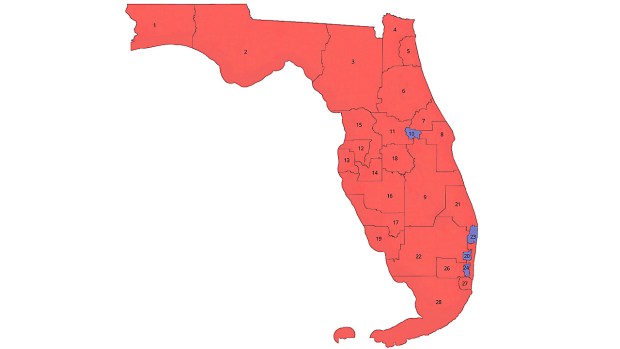 A congressional redistricting map unveiled by Gov. Ron DeSantis on Monday would give Florida Republicans four new seats, making the count 24-4. (Executive Office of the Governor)
Florida’s 28 congressional seats are currently held by 20 Republicans and eight Democrats. The change, based on voter registrations, would make the outcome likely 24 to four.
The governor’s justification for redistricting is that Florida’s population has grown dramatically since the last congressional map was adopted in 2022 using 2020 census data.
To offset any criticism of drawing a map that appears to diminish minority voting power, the office’s general counsel, in a memo to lawmakers, said the governor’s map “does not take race into consideration at all” because doing so is unconstitutional. The memo also said the governor ignored Florida’s Fair District Amendments, which prohibit political gerrymandering, because those rules also take race into consideration.
“Florida got shortchanged in the 2020 Census, and we’ve been fighting for fair representation ever since,” DeSantis told Fox News Digital in explaining his map. “Our population has since grown dramatically, and we have moved from a Democrat majority to a 1.5 million Republican advantage.”
But Democrats called DeSantis’ planned mid-decade redistricting unconstitutional, especially because of the Fair Districts constitutional amendment, which voters approved in 2010 and specifically prohibits partisan gerrymandering.
“The lawsuits have already been drafted,” Florida Democratic Party Chair Nikki Fried said. “It’s just a matter of how much more evidence they’re going to give us before the lawsuits are filed.”
Trump made it clear from the start that this was a partisan attempt to take control of the mid-terms, she said. DeSantis proved that when he provided a red-and-blue color-coded map and mentioned the 1.5 million voter registration advantage Republicans have over Democrats in Florida.
“This is all partisan, completely illegal and unconstitutional,” Fried said. “It’s one more example of the overreaching corruption by DeSantis that started with this war Trump started in Texas.”
More than an hour after Fox News broke the story of DeSantis map, the Florida Legislature received a copy, along with population data for each new district. His office refused to say what population data was used for the new map.
The map and data must be drafted into a bill that state lawmakers will get their first chance Tuesday to review, debate and offer amendments, following a presentation by the governor’s staff.
A full hearing of both chambers on the map is scheduled for Wednesday.
Civil rights advocates and Democrats criticized the timing of the map’s release, saying it leaves the public little time to examine and comment on it, greatly curtailing any sense of transparency for a process that will have a huge impact on voters.
“We are 24 hours from the first vote in the Florida Senate on a secretly drawn congressional map that we’ve not even seen,” Sen. Carlos Guillermo Smith, D-Orlando, said Monday before the map was released. “We’ve not even seen them. The public has never seen the maps. This is not a legal or legitimate process and everyone knows it, and they should vote accordingly.”
Responding to a demand from Trump to help maintain GOP control of Congress, DeSantis spent months urging the Legislature to take up a rare mid-decade redistricting process leading up to the 2026 midterm elections. He called a special session in January, after Texas and other states already went through a similar process. He moved the session back a week from April 20 to this Tuesday after Virginia voters approved a map that added four Democratic-leaning seats to their congressional delegation.
Several Florida congressmen warned that an aggressive redistricting plan could hurt them, because it would wind up diluting GOP strength in their districts, making them potentially vulnerable.
“Don’t do it,” said veteran lawmaker Rep. Daniel Webster of Clermont. “I’ve said it from the beginning. I’ve been around enough reapportionments to know it’s a slippery slope.”
Veteran GOP strategist Karl Rove warned on Fox & Friends that there is a risk because “they’re going to have to take Republican votes out of Republican districts and put them into Democrat districts, and that’s going to lower the numbers for some incumbent Republicans, and they may lose a seat or two.”
House Democratic Leader Hakeem Jeffries pledged “maximum warfare, everywhere, all the time,” if Republicans in Florida go ahead with their redistricting efforts, calling their plan a “dummymander” that could backfire.
The House Majority PAC has pledged $20 million to defeat Republican incumbents in Florida. That includes $9 million for Miami, $6.6 million for Tampa, and $3.9 million for Orlando.
“Our message to Florida Republicans is, ‘F around and find out,’” Jeffries said last week.
DeSantis replied that he welcomed Jeffries to come and try and even offered to put him up at the governor’s mansion and take him fishing. “Go ahead, make my day. Bring it on,” DeSantis said. “There’s nothing that could be better for Republicans in Florida than to see Jeffries everywhere around this state”.
Florida has added roughly 2 million people since the last congressional map was approved, with most of that growth occurring in the Orlando, Tampa and Miami metro areas. That map was submitted by DeSantis — with the help of several top GOP redistricting consultants — after he vetoed a map the Legislature had approved that would have given Republicans a 18-12 advantage and preserved districts with large enough Black populations that a Black congressman was a strong possibility.
His 2022 map eliminated about half of Florida’s mainly Black congressional districts and gave Republicans its current 20 to eight advantage. It faced several legal challenges but was ultimately upheld by the Florida Supreme Court.
The new map appears to push most Democrats in Central Florida into the seat currently held by Rep. Maxwell Frost, D-Orlando, one of the most progressive members of Congress and an outspoken critic of the Trump administration policies on immigration and other policies.
It eliminates the majority Hispanic district anchored by Osceola County and currently held by Soto. That change could bring rise to the strongest legal challenge that could jeopardize the governor’s map, if approved by the Florida Legislature, some say.
“That district is still protected by the part of the voting rights act that protects minority districts,” said Matt Isbell, a Democratic consultant and election analyst. “And even if the U.S. Supreme Court strikes down the Voting Rights Act protections, the Florida Fair Districts amendment still applies.”
In the heavily Democrat South Florida, the governor’s map targets two wildly popular Democrats — Debbie Wasserman Schultz of Weston and Jared Moskowitz of Coral Springs — while leaving Lois Frankel of West Palm Beach relatively safe.