
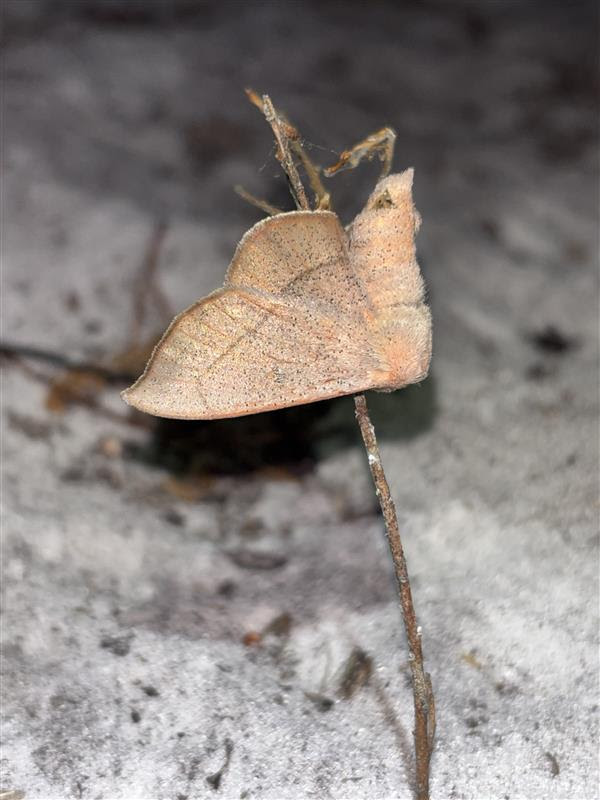
CU Boulder entomologist confirms living populations of Cicinnus albarenicolus, a Florida‑only moth considered possibly extinct as recently as 2025 and only formally described and named in April 2026.
Discovery highlights conservation importance of Florida’s increasingly rare white‑sand scrub ecosystems.
Read the story | See the paper
Download: Photo Attached
Newswise — April 27, 2026—A moth species believed extinct for decades has been rediscovered in Florida by a University of Colorado Boulder researcher, confirming that the insect survives in small, isolated pockets of the state.
Ryan St Laurent, assistant professor of ecology and evolutionary biology at CU Boulder and curator of entomology at the CU Museum of Natural History, spotted multiple live specimens of Cicinnus albarenicolus during nighttime fieldwork in central Florida’s scrub habitat – a rare, white‑sand ecosystem with open canopies and low‑growing vegetation. Until late 2025, the species was known only from decades‑old museum specimens and had not been observed in the wild since the 1960s.
“This was a species I had only ever seen pinned in museum drawers,” St Laurent said. “Seeing it alive in its natural habitat, after thinking it may already be gone, was extraordinary.”
St Laurent recently published the scientific description of C. albarenicolus after identifying it as a new species through DNA barcoding of preserved specimens. Based on the lack of recent sightings and the moth’s extremely limited range, he initially concluded it might be extinct. That changed after learning that a collector had found a specimen in Florida scrub habitat last fall, prompting St Laurent to travel to the state to search for additional populations.
Over two nights of surveys in April 2026, using specialized light traps in scrub ecosystems near Cassia and Seminole State Forest, St Laurent encountered three live female moths shortly after sunset – confirming that the species persists in the wild.
C. albarenicolus belongs to the Mimallonidae family, an ancient lineage of moths more than 100 million years old that is largely found in Central and South America. Only a handful of species occur in North America, and C. albarenicolus is the only member of the family known to be endemic to the United States.
The moth appears restricted to Florida scrub, a habitat of which scientists estimate only about 10% of the state’s original acreage remains.
“Florida scrub is one of the most threatened habitats in the country,” St Laurent said. “We don’t yet know what this moth’s caterpillars feed on, how long it lives, or how sensitive it is to habitat disturbance.”
St Laurent transported live females to collaborators at the University of Florida in Gainesville to attempt rearing offspring, which could provide crucial insight into the moth’s life cycle and conservation needs.
“This moth is part of Florida’s natural heritage,” he said. “It exists nowhere else on Earth. Rediscovering it alive gives us a chance to protect it – if we act on that knowledge.”
The University of Colorado Boulder is Colorado’s leading public research university, transforming lives since 1876. As the state’s flagship university and one of only 38 U.S. public research institutions in the Association of American Universities (AAU), CU Boulder has proudly served Coloradans since the state’s founding. Home to five Nobel Laureates since 1989 and the only university to send space instruments to every planet in the solar system, CU Boulder provides a strong return on investment by aligning efforts to achieve research and creative excellence, global sustainability impact and the success of all students, faculty and staff. Learn more at colorado.edu/about.
###
Contact:
CU Boulder Media Relations
cunews@colorado.edu
Find more media resources | Find more story ideas at CU Boulder Today