
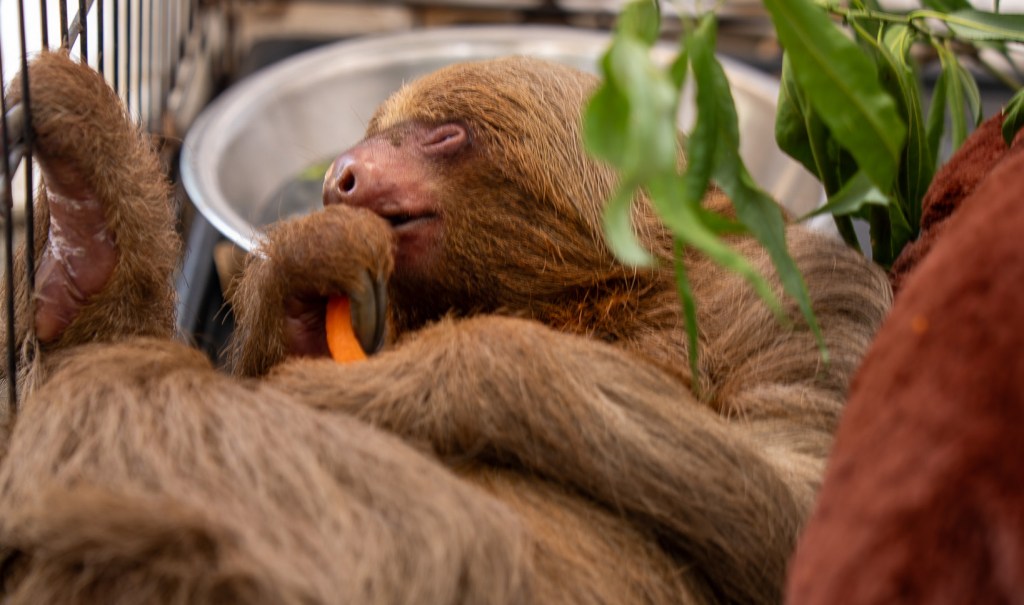
The Central Florida Zoo has some precious and fragile new residents: 13 sloths transferred there from the ownership of Sloth World.
The planned International Drive attraction, which has never opened, came under fire after state reports of 31 sloth deaths in a warehouse facility more than a year ago.
The animals, which moved to the zoo in Sanford on Friday, are currently in a 30-day quarantine before the next steps are determined.
Dr. Haley Straub, an associate veterinarian at the zoo, spoke with Orlando Sentinel reporter Dewayne Bevil about the sloths’ health care experience so far.
QUESTION: What do you look for in a possibly ailing sloth? Would there be visible signs of distress?
ANSWER: Sloths are very unique animals, and I think the public perception is that they’re slow and they don’t move a lot, and so it can be challenging to determine whether a sloth is sick or not. They definitely do show us signs when they are feeling ill.
In a sloth, things that we’re looking for are very similar to those of any other exotic animal. We’re looking at their vitals, their heart rate, respiratory rate, temperature, their behavior, their normal interactions with the environment, their appetite, their thirst, how hydrated they are. All of those things can help tell us how stable an animal is. For these guys in particular, when they arrived, of course, as with any animal, our job as a veterinary staff is to triage and determine the stability of these animals. There were definitely several that did require some level of intensive care and pretty aggressive supportive care for us, which is what we’ve been doing in our care.
Q: It’s not so much that they’re laid back as they just sort of shut down because they’re stressed, and this seems like a stressful situation?
A: They are definitely quiet animals, for sure, but they are also very sensitive animals, and so any kind of change in their normal environment and their kind of daily structure can be considered a stressful event by definite means.
It’s hard to tell … to define the level of stress that an animal is under. But I would say that this scenario does change their daily activity, and I would probably classify it as a pretty stressful scenario, with all the chaos that’s been going on.
Since they’ve been with us, our goal is to make them as comfortable as possible and allow them the time and space to acclimate to a healthy environment, and that’s one of our main priorities here with our animal care and veterinary team working together to make sure these animals feel comfortable, feel safe, feel at home, here with us, make sure they have access to fresh and healthy food and water and sunlight, and they’ve all responded very, very well to all of those changes.
Q: How would you describe them as a group when they came in medically?
A: I think there was definitely a spectrum from what we were seeing clinically. There were a few animals that did require intensive, critical care. The vast majority of the 13 animals that came into our care, thankfully, were well enough to be able to transition to their own space, and did well with access to food and water, and didn’t require a whole lot of extra supportive care from us from a veterinary aspect.
But there definitely, as I said, was a spectrum, and there were four-ish cases that did require more intensive treatments and diagnostics initially.
Q: There were reports of a virus going around some of the other sloths. Do you test for that?
A: Viruses are something that are commonly species-specific. Of course, there’s a long list of different viruses out there that animals and humans can be susceptible. These guys in particular — not these animals, but sloths as a species — it’s very common for them to be diagnosed with a sloth-specific herpes virus.
That, I know, has been reported as having a previous positive with this group for that virus in particular. That is extremely common in this species, and whether or not that’s what’s leading to their clinical signs is difficult to determine.
Herpes viruses are one of those viral classes that is present. We’re never really going to be able to get rid of it, but it can wax and wane in severity and in times of immunosuppression and stress. So it’s possible it could be contributing to some signs of illness. However, I think that there are other things going on with these animals that are probably more realistic, in their causes of illness – things like dehydration, nutritional and electrolyte imbalances and just GI [gastrointestinal] dysbiosis, we call it.
Q: Is one of your 13 sloths pregnant?
A: Honestly, it’s difficult for us to tell at this point. There is a possibility for sure. We do have males and females of two different species here with us, and prior to their time with us, I can’t say, you know, if there was a possibility for breeding. It is in the plan for us, as part of their routine quarantine intake examinations, to take X-rays on all of these guys to check for that possibility. But as of right now, our priority is to get them time and space to relax and reduce their stress and handling.
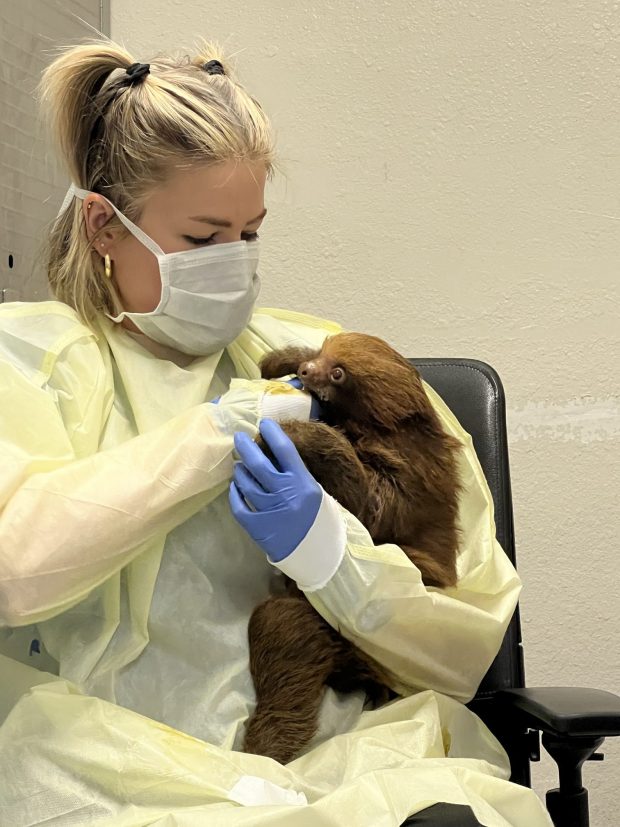 Dr. Haley Straub, an associate veterinarian at the Central Florida Zoo, bottle-feeds a small sloth named Ginger, one of 13 animals originally imported for use in a Sloth World attraction on Orlando’s International Drive. (Courtesy Central Florida Zoo & Botanical Gardens)
Q: In this 30-day quarantine, are there many people around? Other animals? What precautions do you take?
A: With this type of large-scale animal intake of 13 animals, we do have to be very strict with our quarantine protocols to protect our collection, our staff, and, of course, these new guys as well. So we have a team of dedicated, very knowledgeable animal care and veterinary staff who are working solely with these new sloths and really keeping things separate from the animals who are already under our care here at Central Florida Zoo. So it is really around the clock here for this new collection that we’re working with here in the quarantine space.
Having animals in quarantine does add a lot of extra time for very careful personal protective equipment and being very strict with our protocols to make sure that everything is under wraps and safe for everyone, all the animals and people involved, from the veterinary team. We currently have three to four people on any given day. And then from the animal care side, there is a dedicated, selective group of animal keepers and curators, and that is about, I would say four to five additional people. …
We are also in coordination with multiple veterinarian nutritionists, as well as the veterinary and species advisor for sloths. So the Species Survival Program [from the Association of Zoos and Aquariums] has selected veterinarians and zoological professionals for the species that are extremely knowledgeable on the care and nutrition that these guys need, so we are regularly in contact with those important individuals to make sure that we are getting these guys on the most adequate diet that we possibly can.
Q: Do sloths show individual personalities?
A: Oh my gosh, absolutely, yeah. It’s been so fun to have a group of this number, to really start to see their personality show. I will say they are slow and they are quiet, but they absolutely have individual personalities.
Within this group, there are several that are a lot more mobile, a lot more friendly, and are always kind of up at the gate door whenever their food is coming. Some may be perceived as a little bit lazier and just like to sleep.
Q: Are we seeing improvement in the group?
A: I would say so, definitely, from a medical aspect, a lot of these guys have absolutely perked up with adequate nutrition, water and sunlight and some much-needed TLC, more than anything. All of these animals have shown improvements since they’ve arrived.
Even our most critical case, it’s a delicate one, and we are working every day to do everything we can for that guy, but even he has shown improvements.
It is going to be a little bit of time before I think anyone on our team can confidently say these animals are 100% healthy, but we are all feeling very optimistic and really proud of the progress that they’ve made. We are continuing to be very strict in monitoring to be able to jump as soon as we see any changes in their clinical status at any point.
Q: The zoo shared a photo of you bottle-feeding a sloth? Is that an everyday occurrence for you, or is that special?
A: That’s a little glimpse of what we do as zoological veterinarians and animal caretakers that kind of reminds us how special our jobs are, and that is definitely one of them within this group of new animals.
We do have one pediatric animal. He is a roughly 3-month-old sloth, which is very young and very much an animal that’s going to need a lot of support from our end for the next couple of months, with periodic bottle feedings throughout the day. I’m thankful to say he is doing really, really well, and is responding great and has an awesome appetite.
Sloth World will not open following dozens of animal deaths: report
One of the most important things that we can do in caring for them is providing adequate temperature and humidity. They are so sensitive to changes in the environment, and they do require the ability to self-regulate temperature. Luckily, we live in Florida, and it’s summer, and so outside is the perfect environment for them.
But for these little guys, we have to be a little bit more careful, making sure that they do remain in a warm and humid environment. So right now, our little friend is in an incubator. He’s actually moved outside today to get a little bit of sunlight for a few hours, but most of his time is spent in an incubator so that we can ensure he has the appropriate temperature and humidity.
Q: This has turned into an international story. Are you feeling that? Are people reaching out to you?
A: It’s been absolutely crazy seeing the attention that this has gotten. It’s, I think, well-deserved. And I’m so proud of my team here and everyone here for stepping up and doing what we are doing. I think it’s been inspiring, not only for everybody here, but it’s inspiring the community and seeming to inspire the world.