

South Florida’s job market showed a clear split in the latest metro unemployment report from the Bureau of Labor Statistics: the Miami-Fort Lauderdale-West Palm Beach area remained stronger than the national average, while Port St. Lucie and the Sebastian-Vero Beach area posted noticeably higher jobless rates in February. The national unemployment rate was 4.7 percent, not seasonally adjusted.
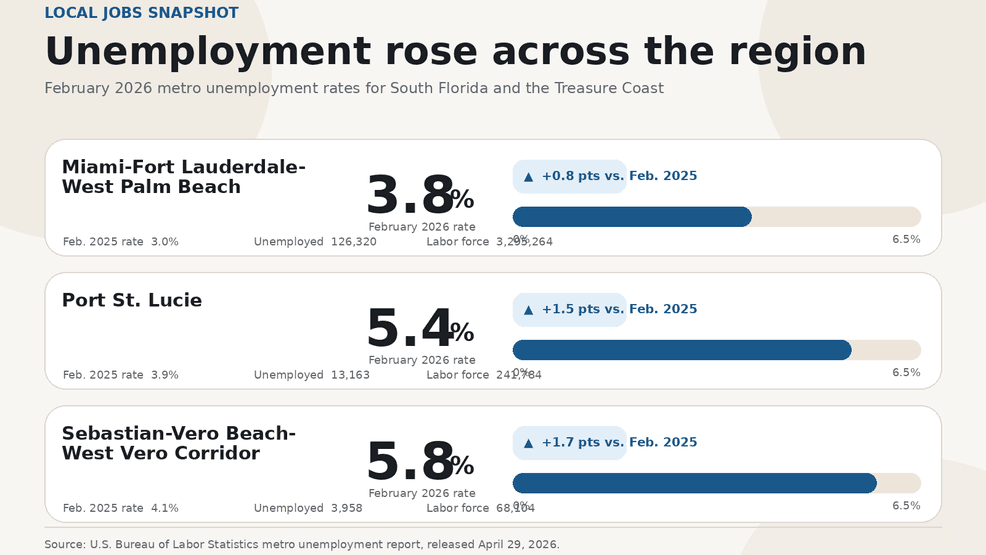
The Miami-Fort Lauderdale-West Palm Beach metro area posted a 3.8 percent unemployment rate in February 2026, up from 3.0 percent a year earlier. That means the region is still below the U.S. rate, but the labor market has cooled compared with last February. BLS said unemployment rates were higher than a year earlier in 236 of 387 metro areas nationwide, and South Florida’s largest metro was part of that broader trend.
North of the tri-county area, the picture was weaker. Port St. Lucie’s unemployment rate rose to 5.4 percent in February from 3.9 percent a year earlier. The Sebastian-Vero Beach-West Vero Corridor metro area climbed to 5.8 percent from 4.1 percent a year earlier. Both markets were above the national rate and well above the Miami-area figure, signaling more strain along the Treasure Coast than in the broader South Florida metro.
Payroll data told a similar story. In the Miami-Fort Lauderdale-West Palm Beach metro, non-farm employment fell by 21,100 jobs over the year, a 0.7 percent decline. Port St. Lucie lost 2,500 jobs, down 1.4 percent, while Sebastian-Vero Beach-West Vero Corridor lost 1,500 jobs, a 2.5 percent drop. That makes Sebastian-Vero Beach the weakest of the three South Florida-area metros in this report on a percentage basis.
There were still some bright spots inside the broader South Florida region. In the release narrative, BLS said the Miami-Miami Beach-Kendall division had the lowest February unemployment rate among the nation’s metropolitan divisions at 2.8 percent. At the same time, BLS said the West Palm Beach-Boca Raton-Delray Beach division was among those with the largest year-over-year unemployment-rate increases, up 1.4 percentage points.
According to the latest data from BLS, West Palm Beach-Boca Raton-Delray Beach, Port St. Lucie, and Sebastian-Vero Beach all saw higher unemployment in February. (Getty Images)
See also: Florida House advances map eliminating District 20, once held by Cherfilus-McCormick
Nationally, the broader trend was softer. BLS reported unemployment rates were higher than a year earlier in 236 of 387 metro areas, lower in 110, and unchanged in 41. Just 10 metro areas had jobless rates below 3.0 percent, while 13 posted rates of at least 8.0 percent. Across the country, 218 metro areas were below the U.S. unemployment rate, 155 were above it, and 14 matched it.
The extremes around the country show how uneven the labor market remains. Urban Honolulu had the lowest metro unemployment rate in February at 2.2 percent, while El Centro, California, had the highest at 17.6 percent. Among metro areas with at least 1 million people, Urban Honolulu again had the lowest rate at 2.2 percent, while Fresno, California, had the highest at 9.1 percent.
Florida also showed up prominently in the national comparison for worsening unemployment. BLS said the largest year-over-year unemployment-rate increase among all metro areas occurred in Wildwood-The Villages, up 2.5 percentage points. Among the nation’s largest metro areas, Jacksonville posted one of the biggest increases, up 1.4 points.
Taken together, the report suggests South Florida is not moving as one economy. Miami-Fort Lauderdale-West Palm Beach is still outperforming the nation on unemployment, but joblessness is rising there too. Farther north, Port St. Lucie and Sebastian-Vero Beach are dealing with both higher unemployment and steeper payroll losses, a sign the slowdown is hitting those labor markets harder.