
By Matthew Cimitile, University Communications and Marketing
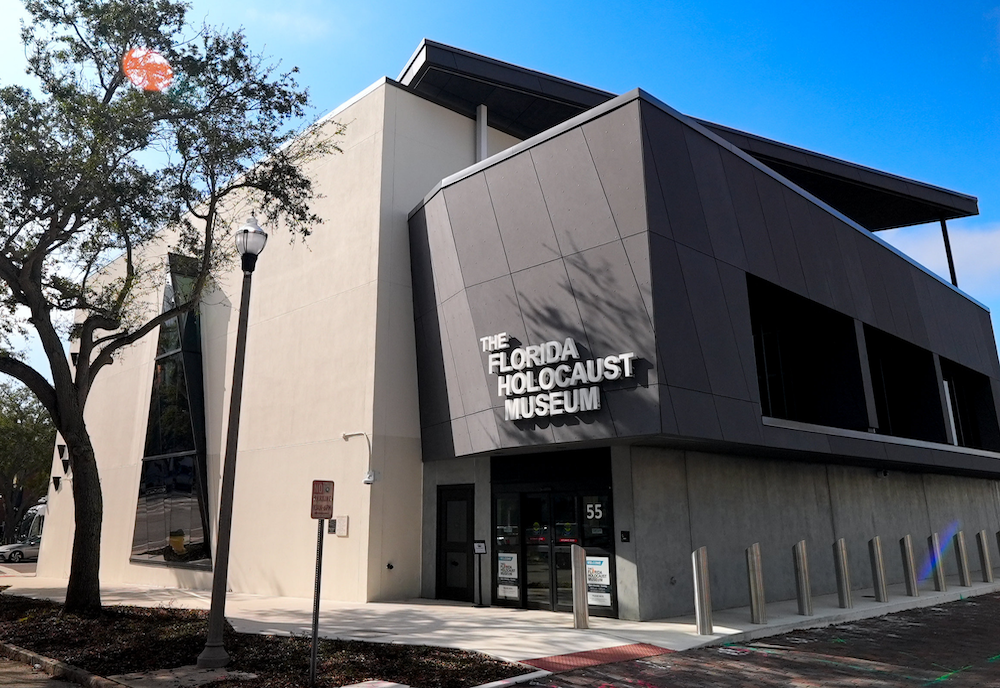
In 2024, the Elie Wiesel Foundation for Humanity named the Florida Holocaust Museum (FHM) as the permanent home of the papers and artifacts of Elie Wiesel, a Holocaust
survivor who became an esteemed humanitarian and writer.
Now several USF students are interning at the museum to catalogue artifacts, correspondence,
photographs and other material from the Nobel Peace Prize winner, who passed away
in 2016. The effort will one day lead to a permanent exhibition at FHM on the life,
works and teachings of Wiesel.
“I’m constantly aware of how important this work is, the weight of it really, and
that it could be one of the most important things I do,” said Sophia Ruiz de Vivar
Iddon, a USF St. Petersburg history major who has interned at the museum for nine
months. “That you get to contribute to something that holds such significant meaning
to so many people is very humbling.”
The team of FHM staff and student interns are going through and organizing 1,000 boxes
of content pertaining to Wiesel’s life to determine what could be used for a future,
interactive exhibit. They will then start to develop displays, narratives, multimedia
content and more to showcase to the public.
The final exhibit, which will be the world’s only collection of original source material
from the Nobel Laureate, will contain Wiesel’s physical and digitized papers, including
correspondence with world leaders, unfinished manuscripts, photographs, and video
and audio recordings. Artifacts from his collection, including his Nobel Prize, the
contents of his personal office and library, and a variety of artwork will also be
included.
“This work is very important because it will lead to an exhibition that will provide
an intimate understanding of Elie Wiesel and his wife Marion, who contributed to his
works, and the world they inhabited,” said Clayton Richards, Registrar at FHM and
a USF St. Petersburg alum. “It is vitally important to have this collection for future
generations to have a greater understanding of such a pivotal individual and moment
in history. And to have student interns be a part of this process has been special.”
Digital access to Wiesel’s papers will be available through a searchable database
built by Gratz College, which has the world’s largest online graduate-level Holocaust
and Genocide Studies Degree Program. The digital archive will feature advanced search
and filter tools, high standard cybersecurity protections and a user-friendly dashboard.
“This internship has given me a whole range of experiences, from drilling displays
into walls to taking care of artifacts to engaging with the public. Doing the fun
work, the hard work, the dirty work has been foundational for my career path into
this field.”
Sophia Ruiz de Vivar Iddon, USF history major
Researchers and educators will be able to delve deeper into the Holocaust and apply
Wiesel’s teachings to contemporary genocides, crimes against humanity and assaults
on human rights. With access to this trove of historical documents and research materials,
USF plans to elevate Holocaust education.
“There are many throughout USF whose work touches on and overlaps with the life and
teachings of Elie Wiesel,” said Thomas Smith, interim regional chancellor at USF St.
Petersburg and a former Florida Holocaust Museum board member. “We hope to bring together
faculty from a number of fields to collaborate and develop major research initiatives
around his life and his work.”
For Ruiz de Vivar Iddon, the internship has given her a complete picture of what it
is like working at a museum. In addition to cataloguing, she has helped to install
artifacts for current exhibits, shadow exhibition designers and even helped the museum
reopen after being closed for more than a year for a major renovation and expansion.
“This internship has given me a whole range of experiences, from drilling displays
into walls to taking care of artifacts to engaging with the public,” she said. “Doing
the fun work, the hard work, the dirty work has been foundational for my career path
into this field.”
The internship program further strengthens the enduring partnership between USF and
FHM. For nearly 15 years, they worked together to create the Debbie and Brent Sembler
Florida Holocaust Museum Lecture Series at USF St. Petersburg, which brought speakers
from around the world for talks on the Holocaust and lessons that came out of one
of the darkest periods in history.
The museum also helped support the curriculum for a study abroad class offered by
USF, Confronting the Holocaust. In 2023, 18 students traveled to Poland, the Czech Republic and Germany where they
explored tragic scenes at concentration and extermination camps while witnessing touching
tributes and instances of humanity at museums and memorials. The goal of the class
is to provide a deeper understanding of one of the worst mass murders in human history.
Another 15 students will take part in the study abroad class this summer.