
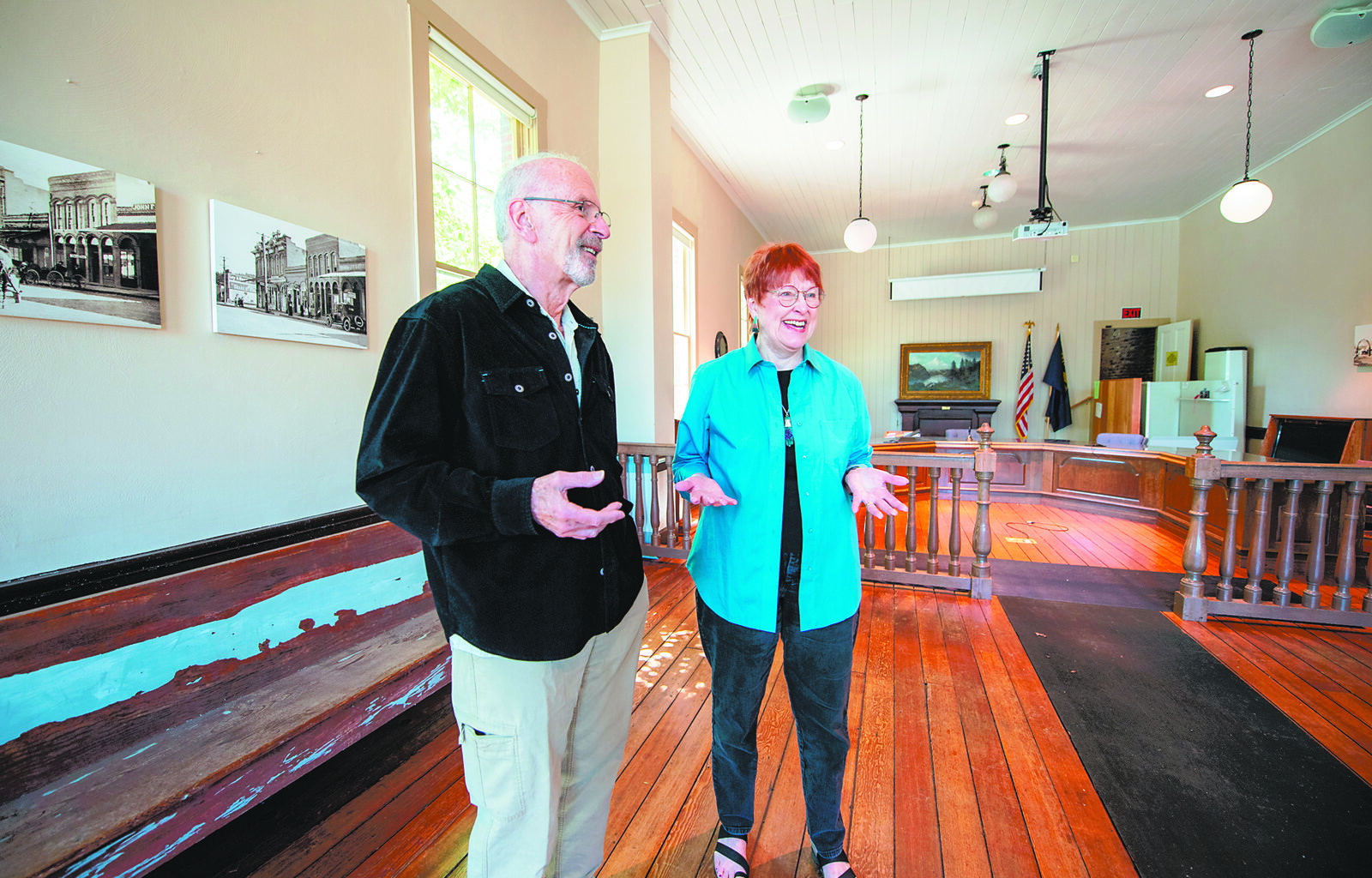
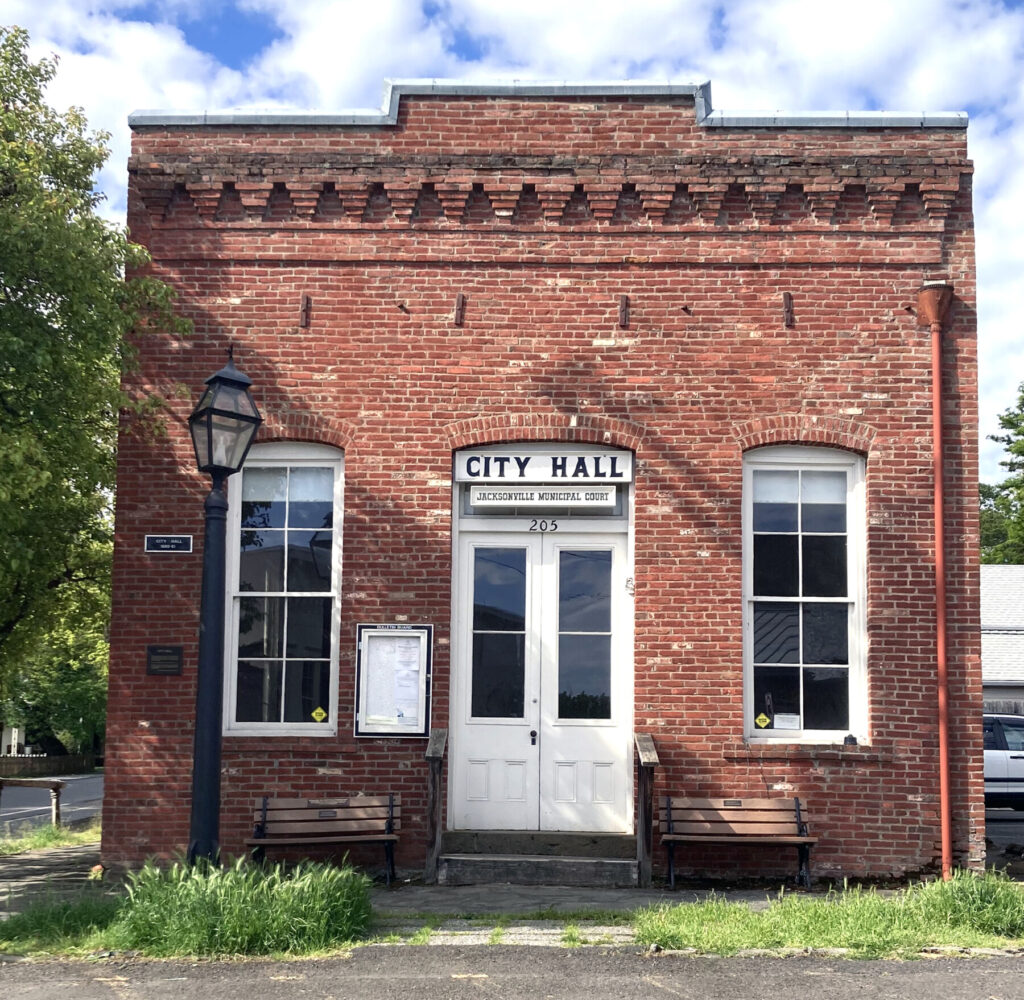
 Completed in 1881, Jacksonville’s Old City Hall at 205 W. Main St. was Oregon’s oldest government building in continuous use until it ceased serving as the primary city government headquarters in 2020. Built on the site of an 1874 fire-gutted brick store, it was constructed using recycled bricks, incorporating a town hall, recorder’s office, jail (calaboose), and fire station. It will become the Jacksonville History Center, slated for a soft opening July 4, with a grand opening expected to follow in September. Photo: Jim Flint.
In Jacksonville, history doesn’t just sit quietly behind glass. It shows up out on the street in its well-preserved downtown buildings along sidewalks that were once boardwalks. It’s visible in the Southern Oregon town’s historic homes and landmarks throughout the community. You hear it in the stories that pass from one building to the next — all part of a town that has long been both artifact and storyteller.
Now, as the nation approaches the 250th anniversary of the United States Declaration of Independence, Jacksonville, located five miles west of Medford, is reframing how that story gets told — not in a single building, but across an entire town.
They call it a “Museum without Walls.”
While elements are already in place — from walking tours to digital storytelling — project leaders are preparing to open the central hub.
The Jacksonville History Center, housed in the 1881 Old City Hall, is slated for a soft opening July 4 as part of the town’s celebration of the nation’s 250th anniversary. Plans for the day include initial tours of the space, with organizers also considering a community picnic and a historically themed musical presentation, though details remain in development.
A formal grand opening is expected to follow in September, with a preview event planned in advance for sponsors, foundations, and major donors.
The History Center will serve as the physical anchor for the broader citywide museum, offering visitors an entry point into Jacksonville’s layered past. Outside, a wayfinding marker will trace the site’s evolution — from the Maury & David store, the town’s first brick building, to its later role as Old City Hall — reinforcing the idea that, here, history is not contained within walls but embedded in the landscape itself.

A museum reborn — without walls
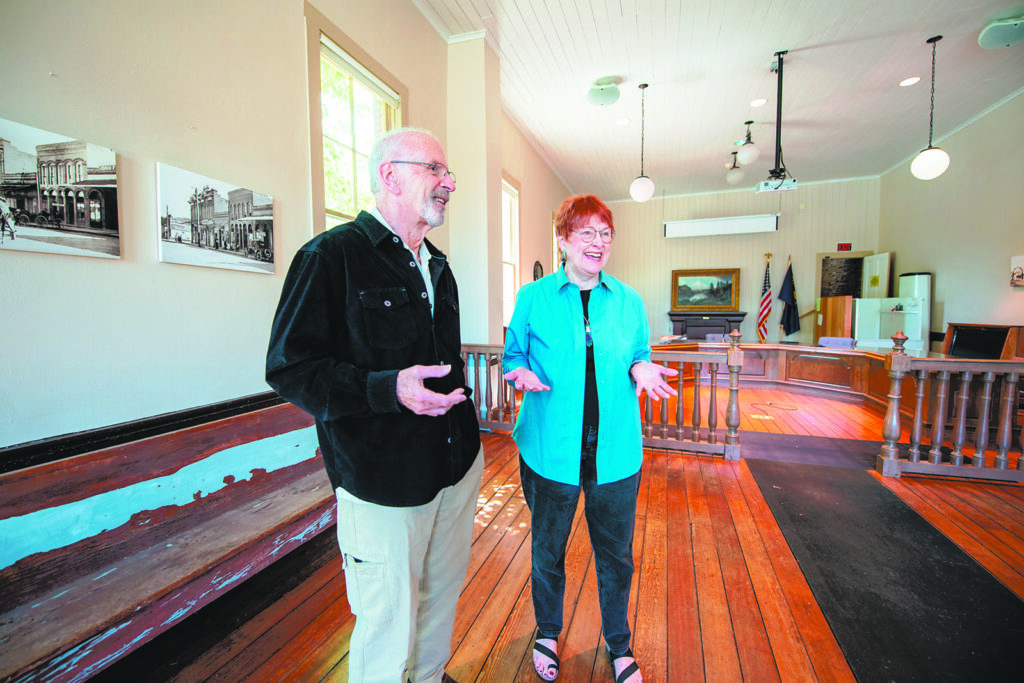 Jacksonville City Councilor Ken Gregg and Carolyn Kingsnorth, president of Historic Jacksonville, show the main room of the Old City Hall, formerly used for city meetings. It is being transformed into a physical anchor for the town’s “Museum without Walls” project as the Jacksonville History Center. Photo: Julie Anderson, Grants Pass Daily Courier.
The idea emerged not from a grand institutional plan, but from a simple question — one that had lingered for years. Jacksonville City Councilor Ken Gregg explains:
“Ever since the Southern Oregon Historical Society closed its Jacksonville Museum in 2010 due to loss of county funding, visitors and residents alike have been asking, ‘Where’s the museum?’” he said.
The answer, it turned out, was everywhere.
At a routine city council meeting four years ago, Gregg proposed reviving a museum. The conversation quickly shifted from where to what. Then came a moment that reshaped the entire effort.
“It was councilor Andrea Thompson who pointed out that the whole town is a city-wide museum, a ‘museum without walls.’ That was such a clear revelation right at the start of my mentioning a museum that led to how the museum idea would be developed,” Gregg said.
The concept stuck. Instead of recreating a traditional museum — artifacts in cases, placards on walls — Jacksonville would treat its most valuable resource as the exhibit itself: a remarkably intact 19th-century town. And the “Citywide Museum” project was launched.
A town preserved by being passed over
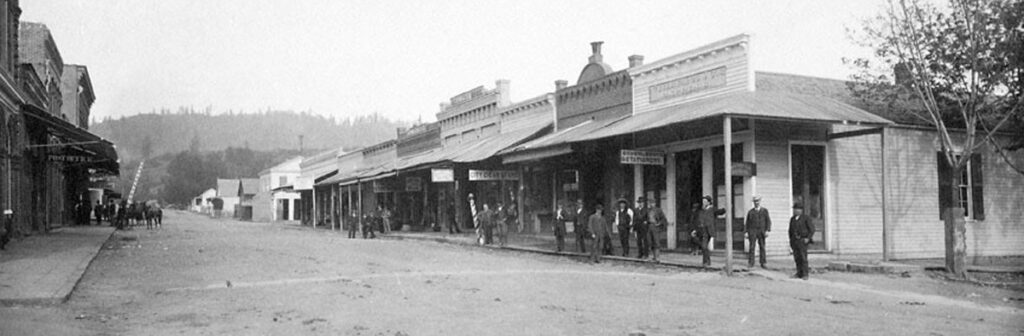 A dusty stretch of California Street in Jacksonville, where wooden storefronts, hitching posts, and a scattering of townspeople capture the rhythm of a late-1800s gold rush community settling into everyday life. Photo: Historic Jacksonville.
Jacksonville’s history tracks closely with the American story of expansion — ambition, upheaval, reinvention.

Founded in the early 1850s during the Rogue Valley gold rush, the town quickly grew into the largest inland trade center in Oregon. When the state entered the Union in 1859, Jacksonville and its residents played an outsized role in shaping early statehood.
Then came the railroad.
When the line bypassed Jacksonville in the 1880s, the town’s fortunes declined. Commerce shifted. Growth stalled. Jacksonville, once central, drifted toward obscurity.
But that decline became preservation.
Without the pressures of modernization, buildings remained. Streets held their original lines. Commercial structures, homes, churches — dozens of them — survived largely intact.
Today, the town is recognized as a 326-acre National Historic Landmark District, designated in 1966, the first such district on the West Coast.
“It is recognized as Oregon’s most complete late-19th-century inland gold mining town,” Gregg said.

That unusual level of preservation is what makes the town itself the centerpiece of the museum concept.
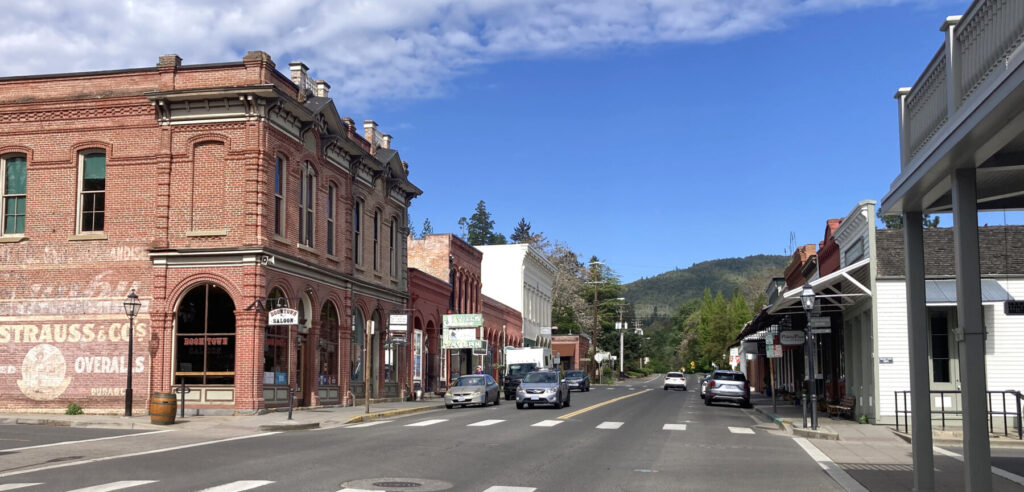 Just five miles west of Medford, Jacksonville is a designated National Historic Landmark. Originally founded during the 1851 gold rush, the town is celebrated today for its beautifully preserved 19th-century architecture, showcased here in the heart of downtown. Photo: Jim Flint.
Walking through history, not past it
The “Museum without Walls” builds on that foundation by shifting how visitors engage with the past.
Traditional museums, Gregg noted, often isolate objects from their context.
“Artifacts in a museum are usually physical objects used in the daily lives of peoples of a certain period. Unless they are of some historic significance, they don’t tell a story about a specific person,” he said.
Jacksonville’s approach flips that model. Instead of focusing on objects, it centers people — and places them where their lives unfolded.
“Walking the streets and experiencing the buildings, visitors can read or listen to a narration on their smart phones about the specific people who built and inhabited them,” Gregg said.
A dry goods store becomes a story of divided loyalties during the Civil War. A church reveals its unlikely origins in gambling profits. A residential street traces the ambitions and setbacks of families who came west chasing fortune.
“In a sense, the entire town becomes the artifact,” Gregg said.
Curating something that large requires structure. Organizers have divided Jacksonville’s story into five thematic threads: the Gold Rush, Merchants and Makers, Town Life, Government, and the Land. Each offers a lens through which visitors can explore both individual stories and broader historical forces.
The hub: Old City Hall reimagined
Even a museum without walls needs a doorway.
In Jacksonville, that doorway is the 1881 Old City Hall — a brick building that once served as the center of civic life and, until 2020, was the oldest government building in Oregon still in continuous use.
Now it is being transformed into the project’s physical anchor: the Jacksonville History Center.
Within months of forming a planning committee, Gregg and his colleagues established criteria for a museum site: city-owned, centrally located, at least 1,000 square feet, and ideally within the National Historic Landmark District.
Old City Hall checked every box.
“When the city moved the council and other committee meetings to New City Hall, Old City Hall had sat empty for several years, waiting as it were for a renewal. The museum was a perfect fit,” Gregg said.
Inside, visitors will encounter an overview of the town’s five historical themes, designed as a launching point for deeper exploration.
“The first exhibit visitors will see is a brief overview of the museum’s five areas of interest, from which they can go explore a deeper dive into each subject,” Gregg said. “There will be artifacts that people can actually touch, stories they can listen to, and images brought to life by AI.”
The building itself, however, remains largely unchanged — a delicate balance between preservation and adaptation.
“You do it with care and consideration,” Gregg said. “For it to remain historic, the exterior of Old City Hall cannot be altered, nor can the interior ceiling, walls and floor.”
Instead, the exhibits carry the weight of innovation, blending period design with modern tools.
Accessibility as a historical challenge
One of the project’s less visible — but significant — goals is accessibility.
Jacksonville’s historic architecture, shaped by geography as much as design, presents challenges for modern visitors.
“Most of the historic structures around town do not have proper ADA access, primarily because creeks run under most of the town,” Gregg said. Elevated buildings, narrow entries, and alleyway back access complicate mobility.
The History Center aims to address that gap, offering an ADA-accessible entry point to a district where many buildings cannot be easily adapted.
In that sense, the project doesn’t just interpret history, it reshapes how people can experience it.
Filling in the missing stories
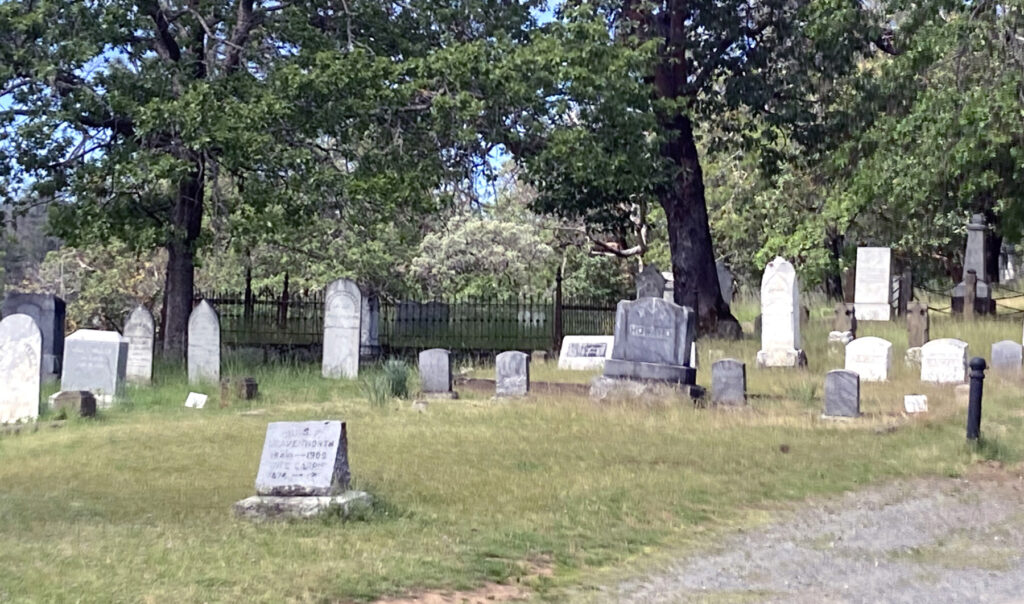 Jacksonville’s Historic Cemetery is one of the oldest cemeteries in the Pacific Northwest and one of the few that has remained in continuous use since being dedicated in 1860. Its 32 acres contain more than 5,600 grave sites, dividing into different sections. Photo: Jim Flint.
Carolyn Kingsnorth, president of Historic Jacksonville Inc., says the project is also about correcting the historical record.
“Traditional history accounts have often been based on oral histories, usually memories 30 to 50 years after the fact, and told from the white male settler perspective,” she said.
New research, drawing from contemporary documents, is expanding that narrative.
“We now have access to contemporary documents that provide insight into the significant roles played by women and marginalized cultures whose contributions have been under-represented in traditional versions of that history,” Kingsnorth said.
That includes Indigenous communities, Chinese immigrants, Black pioneers, and women — groups whose stories were often minimized or omitted.
“Both museum exhibits and tours will recognize these individuals and cultures, acknowledge their roles, and will include links to additional resources,” Kingsnorth said.
The effort aligns closely with the broader goals of the America 250 initiative, which encourages communities to grapple with both inspiring and difficult aspects of their past.
“Like all history, Oregon’s and Jacksonville’s stories include the good, the bad, and the ugly,” Kingsnorth said.
When history gets corrected
As researchers revisit Jacksonville’s past, not every revelation lands easily.
“New information is always emerging to clarify, explain, and enlighten,” Kingsnorth said. “That does not necessarily mean that longtime residents accept the newer info, since it may contradict or correct the stories they grew up with.”
Some myths persist because they are simply too good to let go.
The Nunan House, long believed to be a Sears catalog home shipped in by rail, turns out to predate Sears’ catalog housing business. Its materials were sourced locally.
A marker proclaiming “Gold First Found Here” points not to the original discovery site, but to a later one.
Even foundational figures like Cornelius Beekman require reconsideration, with new evidence shifting timelines of when he actually settled in the town.
“Sometimes folks don’t want to let the facts get in the way of a good story,” Kingsnorth said.
The museum doesn’t seek to erase those stories, but to place them in context, part of a living conversation between memory and evidence.
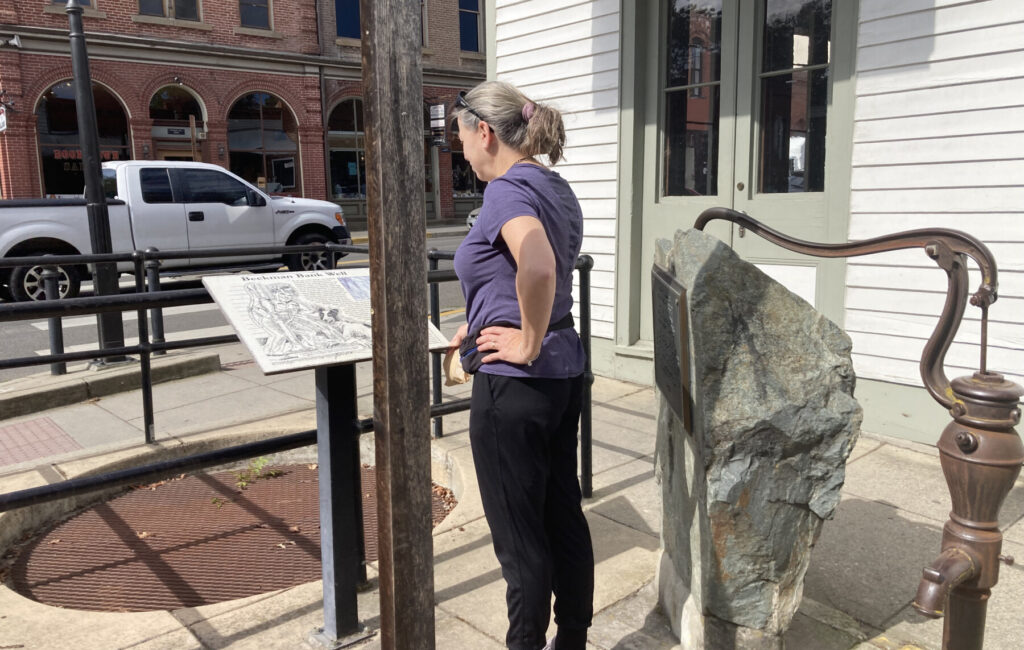 An East Coast visitor pauses in downtown Jacksonville to read one of the town’s interpretive storyboards— part of its “Museum without Walls,” where history unfolds not inside a single building, but along the streets themselves. Photo: Jim Flint.
Technology as storyteller
Technology plays a central role in that conversation.
QR codes, GPS-guided tours, and digital content allow the museum to layer information onto the physical landscape without altering it.
“Except for interpretive signage around town, the structures present to the public primarily as old buildings with names and dates on them. They do not tell the stories of the occupants,” Kingsnorth said.
The new system changes that.
“Each stop begins with historical highlights and images, then offers links to further information, photos, and even videos,” Kingsnorth said.
Visitors can choose how deeply to engage with a quick overview or a deep dive into archival material.
Technology also allows for multiple perspectives.
“Technology provides an opportunity to do what we already do with many of our tours; i.e., provide different lenses through which to view the same image,” Kingsnorth said.
But the project resists letting screens replace experience.
“In this case, the water — digital and tactile — will be there, but it’s up to the horse (to drink),” she said.
A community curating itself
Unlike many museums, Jacksonville’s is largely volunteer-driven. The motivation, Kingsnorth says, is rooted in attachment.
“There’s a common phrase you often hear from individuals who choose to move to Jacksonville: ‘There’s something about this town,’” Kingsnorth said.
That connection often leads to stewardship.
“I believe that when you love something, you want to care for it,” she said.
Residents contribute stories, artifacts, and research, shaping the narrative even as it evolves.
“The town itself is the museum,” Kingsnorth said, echoing Gregg’s point. “The History Center is the Executive Summary and Table of Contents.”
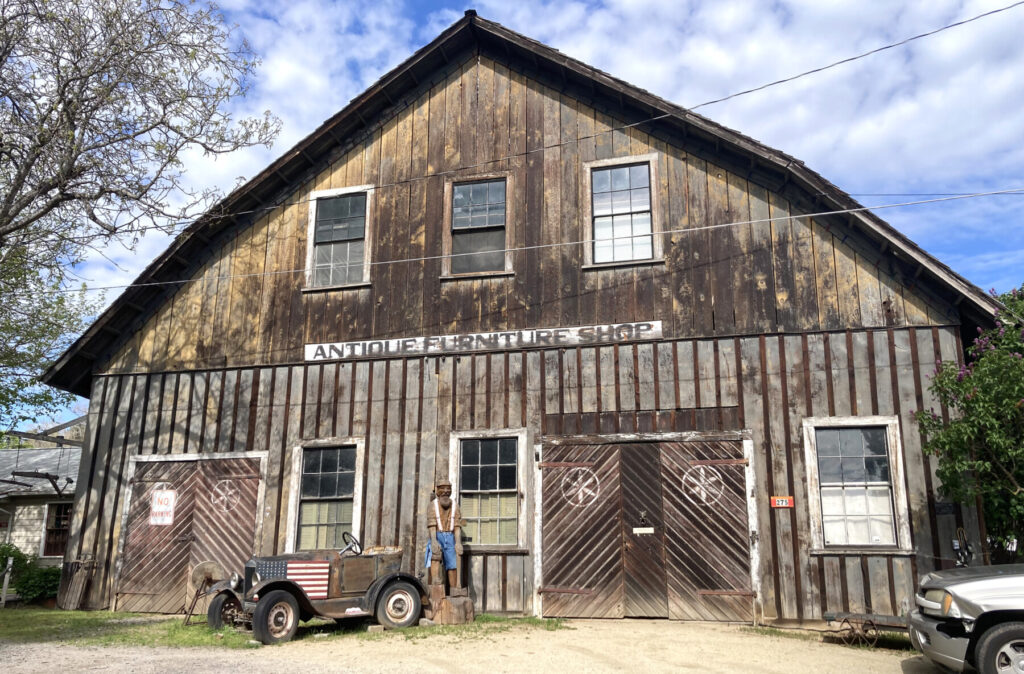 Weathered boards and hand-hewn doors tell a quieter chapter of Jacksonville’s past at the Antique Furniture Shop — also known as the B. and B. Barn — where the town’s early milling trades once helped shape a gold rush community better known for its brick-lined streets. Photo: Jim Flint.
Tourism, but not a theme park
Jacksonville already draws visitors for events like the Britt Music & Arts Festival, as well as wine tourism and dining.
The museum project aims to deepen that experience without flattening it into spectacle.
“Jacksonville will never be Williamsburg (Virginia),” Kingsnorth said. “It is not a town frozen in time.”
Instead, the goal is to highlight continuity, how a 19th-century mining town became a modern community while retaining its character.
“Guests can learn the stories of the historic buildings, but their experience is also one of adaptive reuse of historic structures featuring goods and services that reflect contemporary needs,” she said.
At the same time, the project addresses a practical challenge: seasonality.
By offering year-round access — through the History Center and digital tours — organizers hope to smooth the peaks and valleys of tourism, making Jacksonville a more consistent destination.
Oregon’s story within the American story
As part of America 250, Jacksonville offers a microcosm of the national narrative.
“Jacksonville’s story is part of the story of the nation’s westward expansion — the promise of riches, free land, and other opportunities that brought people here,” Kingsnorth said.
That story includes opportunity and exploitation, prosperity and decline, reinvention and resilience.
Interactive exhibits will trace those threads — from the gold rush and land claims to the arrival of the railroad, the town’s decline, and its eventual revival.
It is, in many ways, a story of cycles.
And it is distinctly Oregonian.
While settlers came seeking opportunity, Kingsnorth noted, “they also brought their values and prejudices with them.”
Understanding that complexity is part of the project’s purpose.
“We hope to give people a better understanding of how it intertwined, and that who we were is who we are,” she said.
Looking ahead
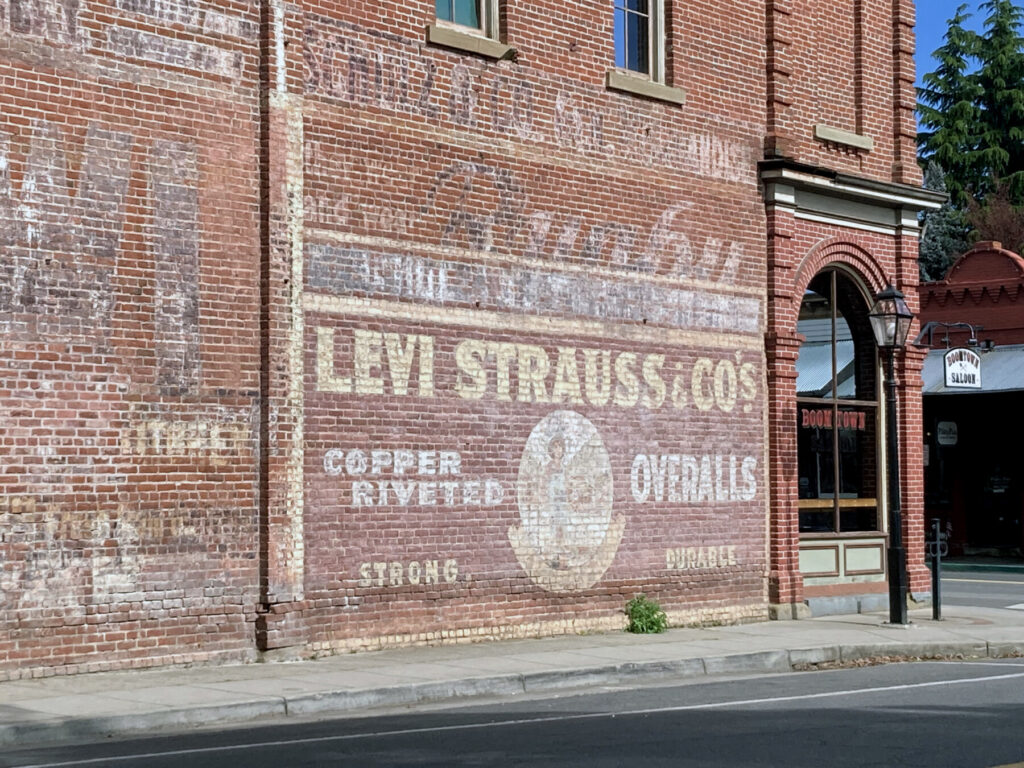 This Levi Strauss & Co. “ghost” sign on a weathered brick wall in downtown Jacksonville reflects the town’s roots as a bustling commercial hub for Southern Oregon during the gold rush era. The sign was hand-painted by itinerant painters known as “wall dogs.” The paint’s survival is due to the high lead content, which made it durable but shortened the painters’ lifespans. Photo: Jim Flint.
Five or 10 years from now, success will be measured not just in visitor numbers, but in impact.
Organizers envision a more stable year-round economy, increased off-season tourism, and a revitalized Old City Hall serving once again as a community hub.
They also hope to expand programming — new tours, living history events, educational partnerships — and to continue refining the historical narrative.
“The project will help spread visitation throughout the year, creating a more predictable and stable cash flow for local businesses,” Kingsnorth said.
Just as important, it will make history more accessible.
“Both the History Center and tours will be ADA accessible, and both will be free to the public,” she said.
Seeing differently
In the end, the success of Jacksonville’s “Museum without Walls” may come down to a simple shift in perception.
“They will have a much greater level of appreciation and understanding of the town’s history,” Gregg said of future visitors. “They will see it as not just a collection of old buildings. They will have the remarkable stories of the people who built them.”
Kingsnorth put it another way:
“We would hope that the History Center exhibits would have provided a context for the buildings they are seeing, that they would have gained an appreciation for the town’s history, and that the buildings are no longer only a backdrop, but have stories to tell if they take the time to listen.”
In Jacksonville, the walls are still there — brick and wood, worn by time.
But the museum has moved beyond them. And the stories, once contained, are back out on the streets.
For more information, calendars of events and updates, visit historicjacksonville.org.
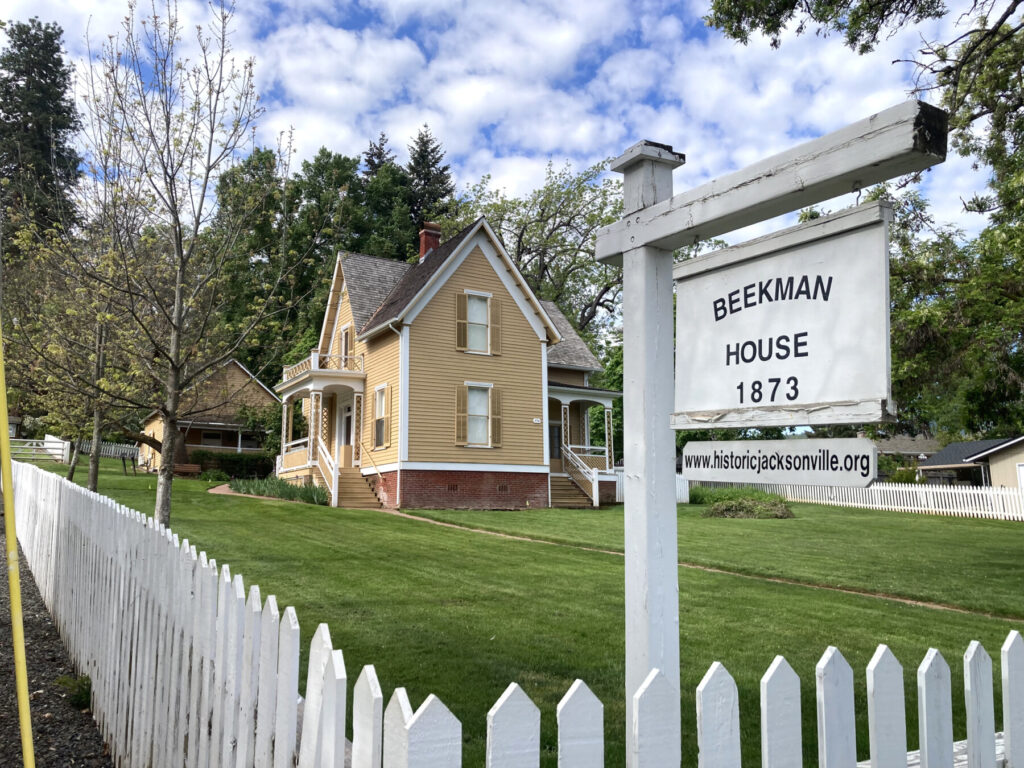 The Beekman House, at 470 E. California St. in Jacksonville, is preserved as a Victorian Carpenter Gothic home, featuring original furnishings from the prominent pioneer Beekman family. Now a historic museum, it offers tours from May through October, typically on Saturdays and Sundays. Photo: Jim Flint.
This series, which marks America’s 250th anniversary of its founding, is supported by funds from the Oregon Arts Commission through a grant from the National Endowment for the Arts. It is also made possible by the America 250 Oregon Commission.