
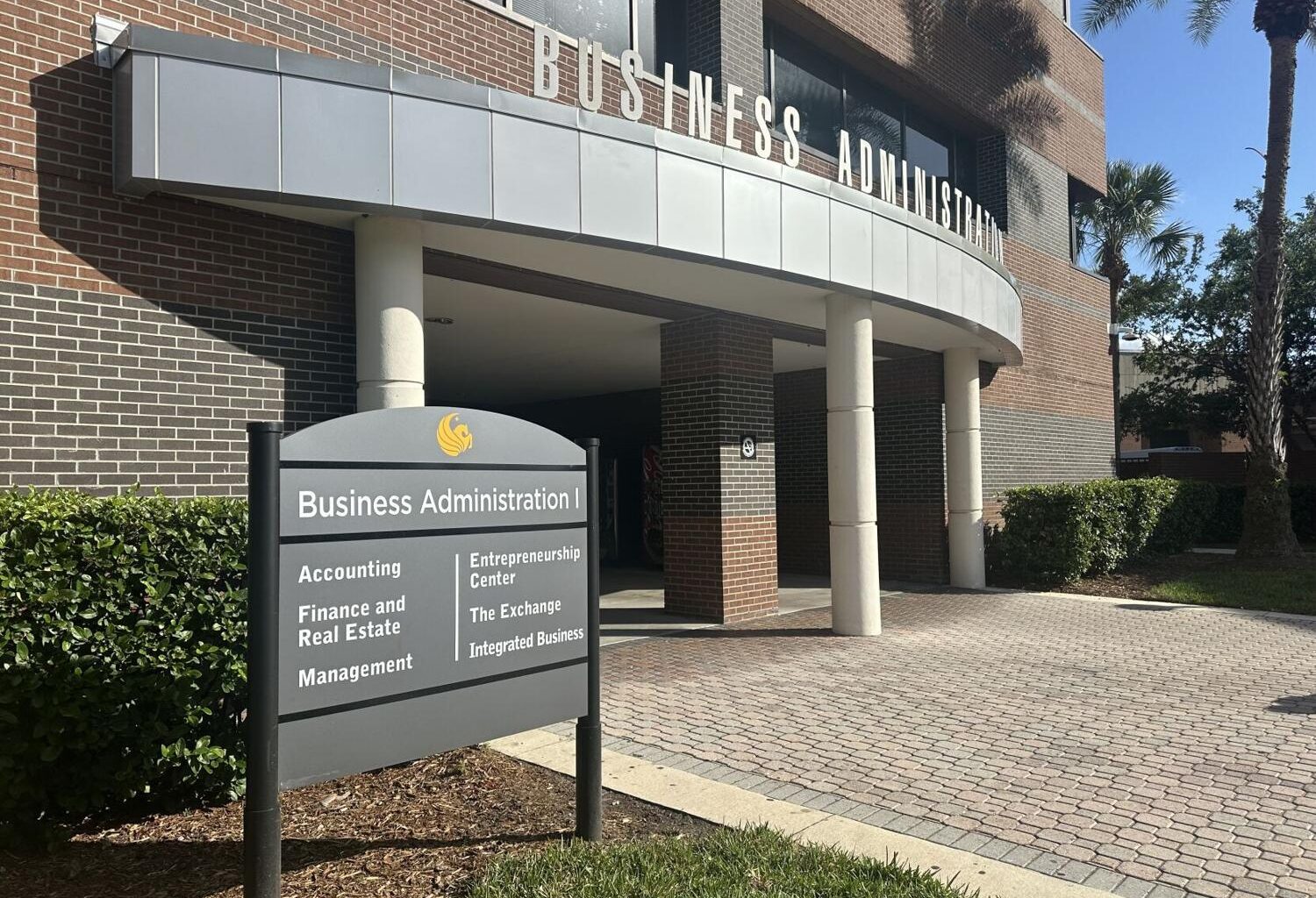

The Business Administration I building houses both traditional business courses and classes taught through CF’s Relevant, Engaged, Active Learning model. Under the REAL model, students attend class in person five to six times a semester, with most instruction happening online and through group-based activity.
Austin Lamanna
The university’s shift to the Relevant, Engaged, Active Learning format has become more than just a change in schedule – it has redefined how and when students interact with course material.
At UCF’s College of Business, many lower-level courses require students to attend class only five to six times per semester, with most coursework completed online. This REAL format, implemented eight years ago, limits in-person meetings and emphasizes online preparation.
Andrew Johnson, an associate lecturer in supply chain and operations management at the College of Business, explained how the REAL format is used to replace traditional instruction with self-learning.
“This hybrid approach combines faculty-led online videos for mastering core content with face-to-face Active Learning Labs, where students apply concepts through collaborative group work and discussion,” Johnson said.
While the format is intended to accommodate different learning styles, many students reported mixed experiences with it.
AJ Phillips, senior accounting major, found that his experience with REAL classes changed as he advanced to higher-level courses, which are more in-person and less REAL-format.
“At first, I kind of liked it because I had a lot of free time. But then, as you get deeper into it, you realize that you’re just teaching yourself multiple classes at a time, which does get old, and it kind of gets demoralizing at times because you’re just like, going to class for no reason at that point,” he said.
While some students, like Phillips, found the format discouraging over time, Liam McCuskey, senior integrated business major, highlighted how the format prioritizes group activities as a key benefit.
“It definitely prepared me for my major because integrated business involves lots of group projects, which is really helpful,” McCuskey said. “It helps you learn what to do and what not to do when you’re in a group and how to be a good group mate.”
Likewise, Akhil Patel, junior finance major, said he preferred the REAL format as he felt more engaged.
“I was more locked in [in] REAL classes because the in-person sessions were mandatory,” Patel said. “I feel like regular, traditional formats are nice too, because we’re learning every week, and if I have questions, I can ask them directly instead of having to wait for a response or an email.”
The shift in classroom dynamics was echoed by Anthony Simonetti, junior accounting major, who noted a loss of connection with his instructors.
“In high school, you have teachers working with you directly all the time, but here, there are a thousand kids in the class, and you only see the professor once for an hour,” Simonetti said. “I miss that personal relationship with the teacher.”
Simonetti said the courses often required watching online videos, which he felt could sometimes be insufficient.
“They basically rely on you to either watch their videos. If their videos don’t explain it well enough for you, then you kind of have to go to the textbook and figure it out yourself.”
Simonetti also acknowledged that he would miss many assignment deadlines because of the lack of in-person classes.
“I mean, pretty much every week I’d push the assignments off until Sunday at 11:59 p.m.,” Simonetti said. “You’re supposed to do a lot of work, like, prior to showing up for the real class, and I just wasn’t doing that.
While experiences vary, the REAL format continues to shape how students interact with coursework, blending flexibility with a higher expectation of independent learning.