
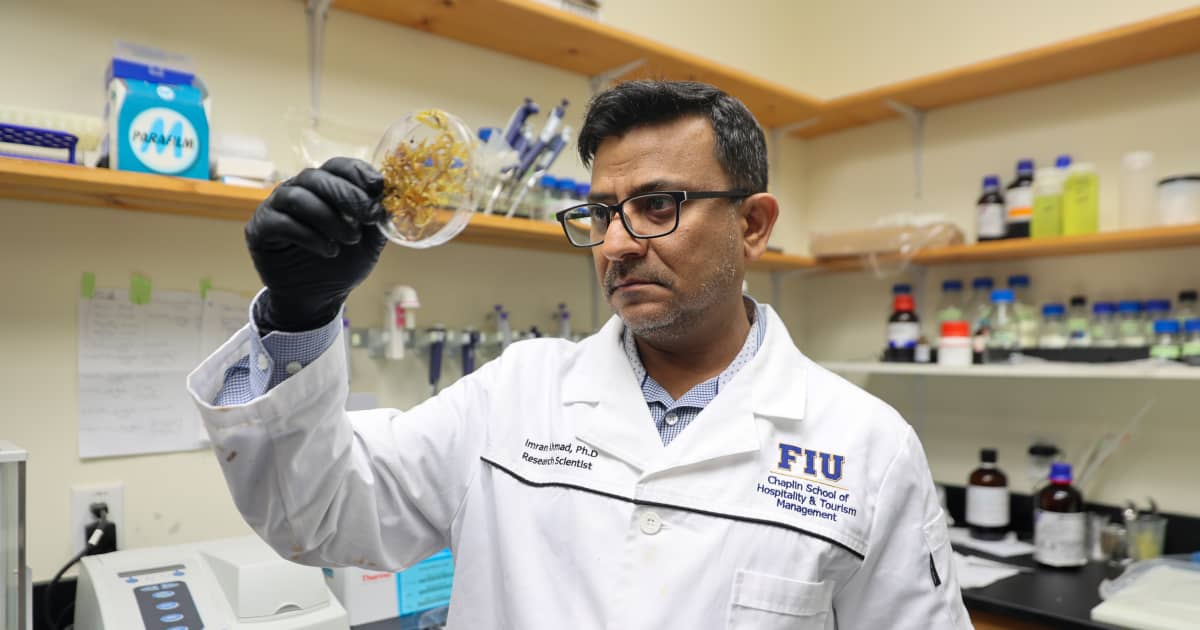
Why is sargassum such a problem in South Florida?
Sargassum is a type of brown algae that appears in large blooms, especially along the Atlantic coast. Every summer, we see it wash ashore in large amounts. It’s generally treated as waste because it smells, affects tourism and can carry contaminants or bacteria. On top of this, it is costly to remove.
What inspired your team to study it?
The usual approach has been, “How do we get rid of it?” We wanted to ask a different question: “Can we use it for something valuable?” For example, we extract high-fructose syrup from corn to make things sweet, and we extract agar from macroalgae to turn things into jellies. Since sargassum is a type of algae, we thought it might contain useful compounds, even if it’s not traditionally used as food.
What did your research find?
We found that sargassum contains compounds like alginate, that can be extracted at relatively high levels, roughly 45% of yield. Alginate is widely used in the food industry as a natural ingredient that helps stabilize and thicken foods. You’ll find it in products like ice cream and other dairy or dairy-like products.
Alginate is a complex carbohydrate which means it is slow burning and can help give athletes the energy they need when they need it, not like sugars which give you energy now, but lead to a crash later. This is why alginate is a popular ingredient in sport nutrition products.
But sargassum isn’t considered safe to use, right?
That’s correct. It’s not currently classified as a food source, and it can carry harmful bacteria or contaminants. There are also regulations about how it can be collected, by Florida law it must wash ashore naturally before it can be handled. So, before anything else, we had to figure out how to make it safe.