
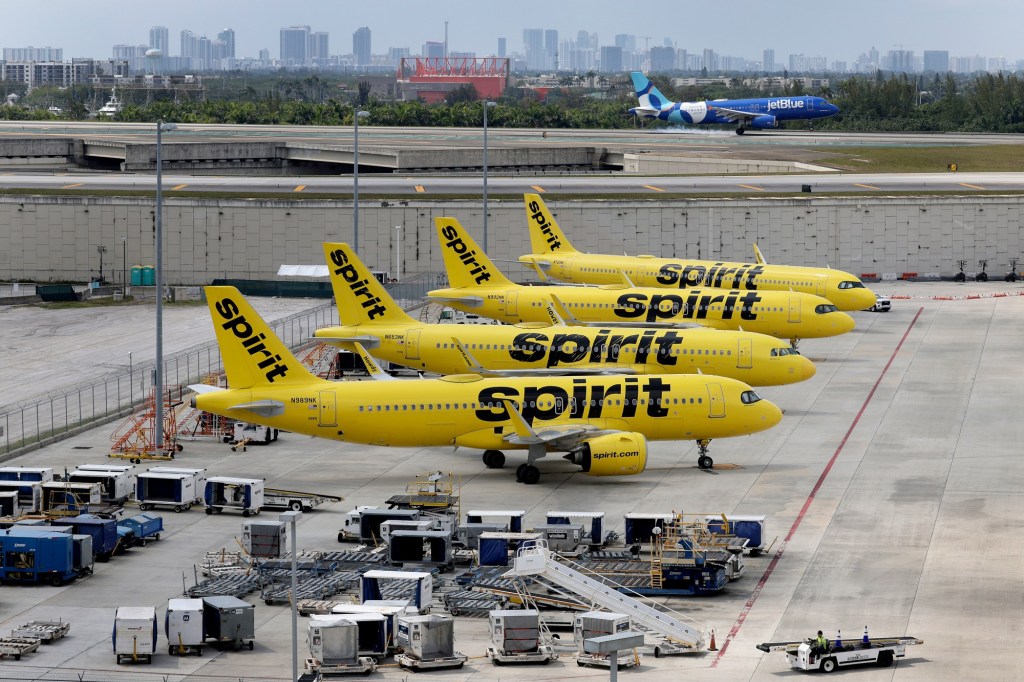
Defunct Spirit Airlines has reported the impact on Florida’s aviation labor market after its weekend shutdown.
In a filing with the State of Florida, the now bankrupt company that called itself Greater Fort Lauderdale’s “hometown airline” said it eliminated more than 4,800 jobs in South and Central Florida, with the job losses concentrated at Fort Lauderdale-Hollywood International Airport, the company’s headquarters in Dania Beach, Miami International Airport, and two sites at Orlando International Airport.
The locations and eliminations reported by the company to FloridaCommerce in multiple Worker Adjustment and Retraining Notification Act Notices include:
Fort Lauderdale-Hollywood International: 2,529.
Spirit Support Center, Dania Beach: 551.
Miami International: 151.
Orlando International, including inflght operations center: Approximately 1,600.
There was no mention of Palm Beach International Airport, where Spirit had a nominal presence.
The airline has quickly asked U.S. Bankruptcy Court Judge Sean Lane in New York to approve its extensive plan for an orderly wind-down of its operations, which will include the sale of aircraft, engines and equipment it owns, as well as real estate including its company headquarters.
At a hearing Tuesday, he heard from lawyers who among other things outlined plans to return grounded leased jetliners and their engines to their owners, as well as a plan to retain and pay a cadre of employees to help close out the business.
Spirit asked for expedited approval of the proposed wind-down plan, arguing that speed would benefit Spirit’s creditors and customers.
“Any delay will cause chaos, confusion and cost the estate significant time and money,” one motion stated, noting the airline was “not generating any revenue.”
Spirit attorney Marshall Huebner said rising jet fuel costs since the U.S. and Israel launched strikes on Iran “engulfed Spirit entirely.” He added that the airline’s fuel expenses grew by roughly $100 million “in March and April alone,” and rapidly drained Spirit’s liquidity and derailed its restructuring efforts.
He apologized directly to Spirit’s employees and customers, especially passengers who he said may now be completely “priced out” of certain routes without the ultra low-cost carrier.
$10.7 million for retentions
As part of the wind-down plan, the airline has asked for approval of $10.7 million in retention payments for 130 management and non-management employees to help with the closeout of the business.
The cost averages out at “approximately $76,000 per participant, which is comprised of approximately $9.9 million for one-time retention payments, approximately $900,000 for medical stipends, and $500,000 … the Debtors may allocate in their discretion to eligible employees based on future needs,” the filing says.
As a rationale for keeping the employees, the company added that “due to the regrettable radical downsizing the Wind-Down Plan contemplates, non-senior management employees will face increased workloads that further increase retention concerns.”
The retained employees gradually would be phased out:
Short-term execution and operational close: Up to three months (95).
Mid-term regulatory and financial close: three to six months (25).
Long-term custodial and litigation: Greater than six months (10).
The company said the success of the wind-down depends on Spirit’s ability “to incentivize the three senior management employees who will need to take on many additional job responsibilities to ensure timely completion and achievement of many of the tasks and goals associated with the wind-down plan.”
That group would include CEO Dave Davis and two other senior executives.
Mass firings, re-employment
Overall, Spirit has said 17,000 direct and indirect jobs were cut starting last Saturday, the day of the carrier’s final flight. Other affected locations listed were Atlanta, Baltimore, Dallas, Detroit, Houston, Las Vegas, New York, and Newark, N.J.
The dramatic job loss numbers for Florida prompted U.S. Rep. Debbie Wasserman-Schultz on Tuesday to write to President Donald Trump and ask that he direct the Departments of Justice, Transportation and Labor to move to help Spirit’s jobless workers.
In late April, she supported his idea for a government bailout, which failed to materialize. Now, she said in her letter, “we must turn our attention to the people these developments will harm.”
Her requests include:
Through the Department of Justice, ask the bankruptcy court “to prioritize the full and timely payment of employee compensation and benefits, including medical, dental, and related benefits.”
Maintain healthcare plans for Spirit flight attendants, pilots, “and other groups of workers where possible, through the 2026 plan year, and help facilitate the transition to affordable health care and dental insurance for affected employees.”
Direct the Department of Transportation to assist with the preferential hiring of Spirit employees for new opportunities with other air carriers.
“Extend Flexible Spending Account (FSA) usage periods and provision of emergency childcare subsidies.”
“Provide a temporary supplement to state employment benefits for those laid-off staffers who are attempting to find new employment for a period of six months.”
“Have the Department of Labor surge resources to those whose jobs are eliminated” to help them find new aviation jobs.
The list is among several items aired by labor union leaders shortly after the airline’s collapse. But the wind-down plan includes provisions to close out employee benefit programs.
On Monday, FloridaCommerce, in conjunction with CareerSource Broward, which is part of a network of state supported job search agencies, conducted counseling sessions for Spirit employees in Hollywood. A repeat session was scheduled for Tuesday, with others occurring in Orlando on Tuesday and Wednesday.
In August 2025, for the second time in a year, Spirit descended into Chapter 11 bankruptcy proceedings to completely revamp its finances, cutting cities in its expansive network, which included destinations in the U.S., Caribbean and Latin America.
But the airline, which started flying more than three decades ago as a discount carrier appealing to budget travelers, was unable to follow through on its recovery plan after the U.S. war against Iran caused an unmanageable spike in jet fuel prices.
“The need to cease operations and abandon our efforts to reorganize was a result of the recent dramatic and sustained deterioration in business conditions — primarily the material and sustained run up in fuel prices — resulting from geopolitical events of the last few weeks,” the airline said in its state layoff notice, which was filed late Monday. “These conditions — including war in the Middle East and a massive run up in fuel prices that will cost U.S. airlines billions of dollars this year — were not foreseeable by the company.”
This article was supplemented by information from The Associated Press.