
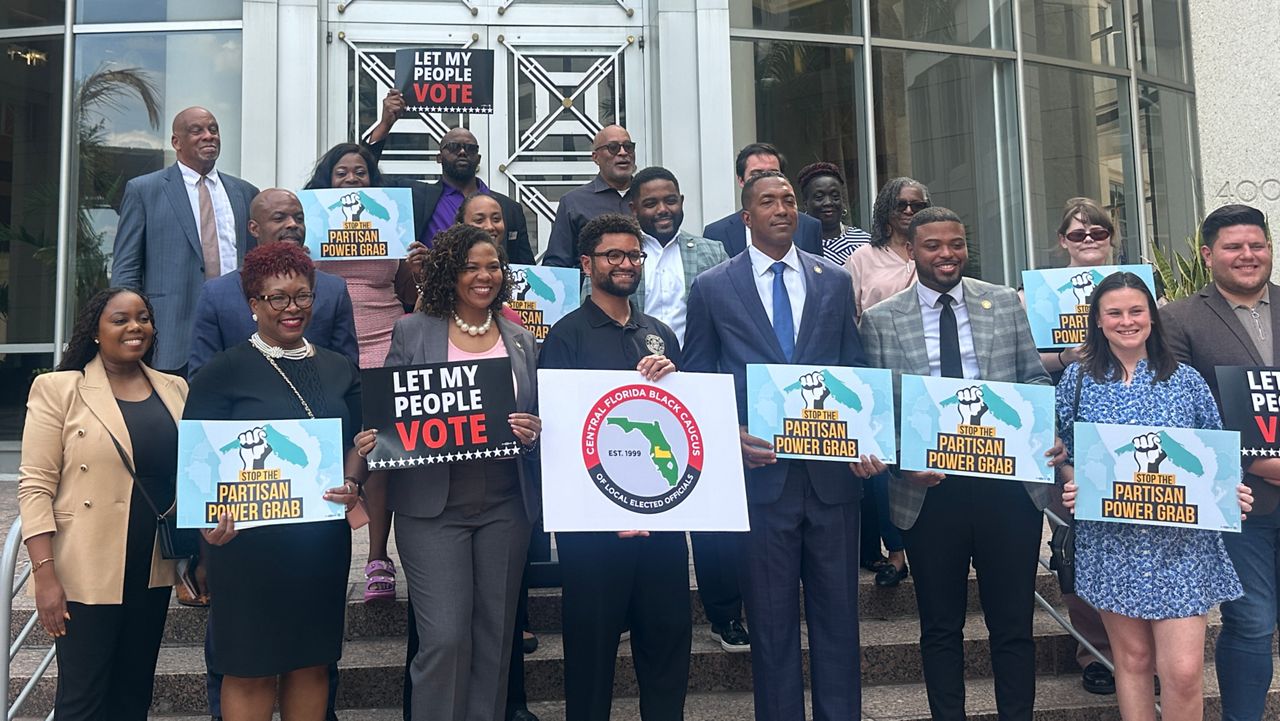
ORLANDO, Fla. — Florida’s new congressional map was under attack again Tuesday as the Orange County Black Democratic Caucus criticized the map, saying it would weaken minority voting power ahead of the 2026 midterms.
But Gov. Ron DeSantis has said be believes that last week’s Supreme Court ruling involving Louisiana’s “racially gerrymandered districts” supports the new map he signed into law Monday.
The new map was challenged in court shortly after DeSantis signed it into law, and now, both Democrats and Republicans are waiting for litigation to play out.
DeSantis has defended the newly drawn congressional map, saying he believes it removes any districts in the state that were created using racial considerations. Critics say the new map is partisan gerrymandering in action that will silence minority voters and reshape political power across several districts.
In the last week, the governor has made several social media posts about redistricting, saying he believes that the newly approved map could give Republicans a chance to will four additional districts across the state. This would give the GOP an advantage in the 2026 midterms.
DeSantis argued that redrawing the congressional map was necessary because of growth in the state.
“Just look at how the population has shifted in different parts of the state over a four, five-year period,” DeSantis said last year. “It’s been really significant.”
Opponents say the map weakens minority representation and violates Florida’s Fair Districts Amendment.
In response, Equal Ground Orlando filed a lawsuit challenging the new map.
“The Fair Districts Amendments were passed by Florida voters to ensure that politicians cannot rig maps for their own power. And yet, that is exactly what happened,” said Equal Ground Founder and Consulting Director Jasmine Burney-Clark. “So, we’re challenging them. We’re challenging them not because it’s just a bad map, we’re challenging them because it’s an illegal one.”
But DeSantis disagrees, saying the U.S. Supreme Court’s recent ruling about Louisiana’s congressional map now makes the Fair Districts Amendment, as a whole, void because of the language about race.
Rollins College Assistant Professor of Political Science Patrick Rickett said he doesn’t believe the governor’s statement is entirely accurate.
“When the Supreme Court made the decision in Louisiana v. Callais, they chose not to declare Section 2 of the Voting Rights Act unconstitutional,” Rickett said. “They just added additional barriers on how to prove that a district was drawn to dilute minority representation.”
Rickett also said that this puts the supervisor of election offices in a bit of a bind, because they may not have prepared or budgeted for these changes and now have to inform voters who are now in a new congressional district.