
The north Florida drought persists – and it’s offering a look at what lies beneath some familiar Tallahassee landmarks.
As summer inches closer and closer, rainfall in the Big Bend has been a rare sight. And despite a heavy rainstorm over the weekend, it wasn’t enough to really make a dent in what’s being called the worst drought on record.
In northern parts of Tallahassee, Lake Jackson continues to dry up, leaving lily pads laying on top of mud and sludge as dragonflies flutter and snowy egrets stand near any puddle hoping to catch a fish.
Lake Jackson left with puddles, sludge during severe drought
1 of 14
Lake Jackson, seen from Millers Landing, is almost completely dried up as a severe drought continues to impact the region Monday, April 20, 2026.
From Millers Landing in the northeast and across to the northwest, Lake Jackson has turned otherworldly. Porter Sink drained in late November 2025, and since then there hasn’t been enough rain to remotely begin refilling what can look more like a moon crater than lakebed.
Over the past few months, green foliage filled the crater, changing the scene from a brown and orange valley into a lush leafy hillscape.
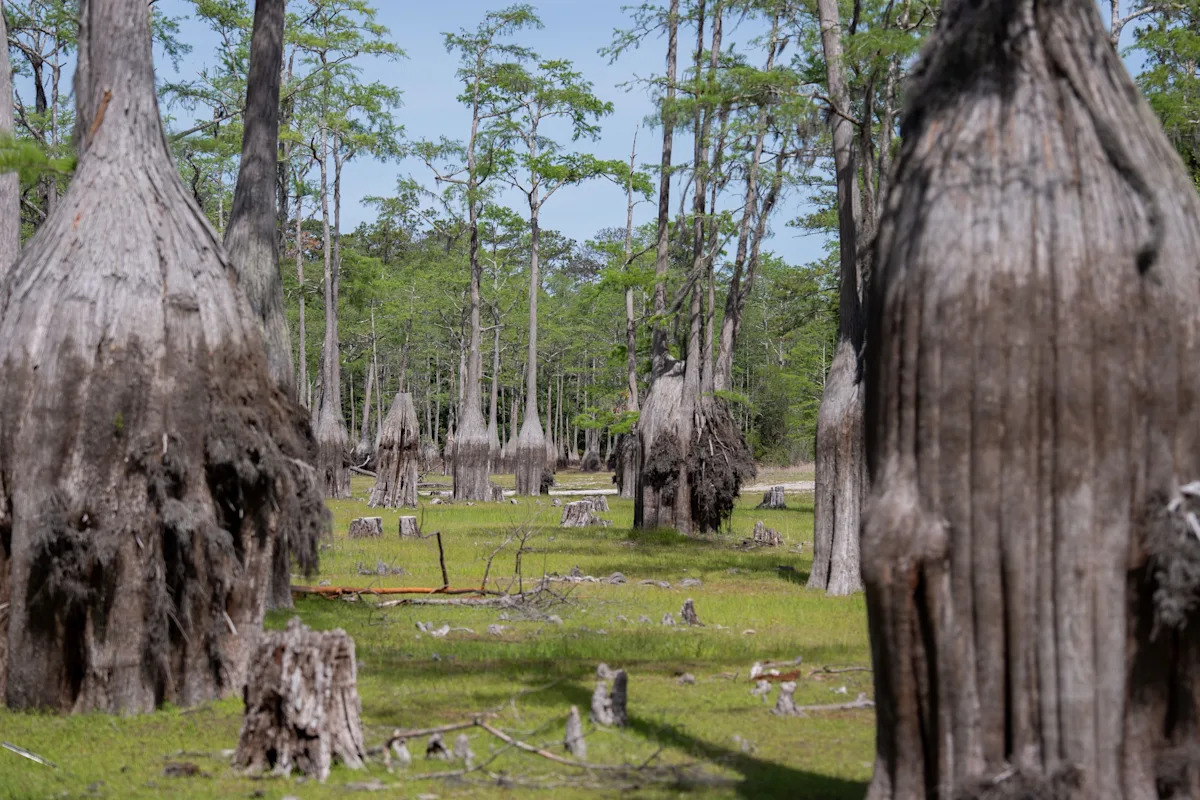
South of I-10, near the Tallahassee International Airport, Cascade Lake looks like a scene out of Jurassic Park. There, cypress trees tower overhead with gargantuan exposed root systems. Nearly 10 feet up, the bark shifts from dark to light gray sharply, marking a previous water line.
Porter Sink, Lake Jackson flourishing with greenery as drought rages on
1 of 11
Matt Lisenby searches for fossils in Porter Sink at Lake Jackson on Monday, May 4, 2026.
Now people can walk among what some have called an “enchanted forest” and explore a world that is typically under water. There are paths that wind between the trees and into areas previously only accessible by small watercraft.
Why are the lakes empty?
Both lakes have lost their water because of sinkholes. They’re just two of about ten in the area where the water level ebbs and flows as sinkholes control the height of the water.
Water from the lakes drain into an underground aquifer when the sinkholes open, but they do not stay open forever. Periodically, they will naturally clog.
Cypress tree trunks exposed in Cascade Lake during severe drought
1 of 18
Cypress tree trunks that were once submerged in water at Cascade Lake, are now fully exposed as a severe drought in the region continues to dry out local lakes Monday, April 20, 2026.
City and county reports over the years have noted the “active sinkhole” at Cascade Lake and said the body of water is affected by drought conditions more than either nearby Lakes Bradford or Hiawatha.
Despite the common misconception of Lake Jackson draining every few decades, a drought is the true determining factor in the disappearing lake phenomenon.
These sinkholes that bring life to each lake’s ecosystem are not new. In fact, Sean McGlynn, who has studied and written about the Cascade sinkhole, said some of them have been around for thousands of years.
This could happen several times a year, or they could stay full for years. The water levels are largely dependent on rainfall, McGlynn noted.
It takes several consistent three to six inch rainfalls to keep the bottom of the lakes from showing. With smaller rainfalls of more like a half inch or so, the water evaporates before the next rain can add to it.
As rainfall remains inconsistent, the cycles of draining and refilling that have defined these water bodies for centuries are likely to become more noticeable – and, at times, more extreme.
Elena Barrera contributed reporting.
This article originally appeared on Tallahassee Democrat: Tallahassee drought remakes Lake Jackson, Cascade Lake