
Storytelling is an essential part of heritage and cultural memory.
For members of the Haitian diaspora, it’s more than that: It’s an opportunity to tell their stories in a world where their history is being manipulated and erased.
The Little Haiti Book Festival—an annual celebration of story, rhythm, and community held every year during Haitian Heritage Month—offers a platform for Miami’s Haitian population to tell their stories on their terms.

Kids make crafts in the Little Haiti Book Festival’s Children’s Alley.
(Elisabeth Campbell for The Miami Times)
Co-presented by Miami Book Fair and Sosyete Koukouy of Miami, this celebration rooted in Haitian culture carried forward history, seeking to connect “past and future, homeland and diaspora, and imagination and action,” according to program coordinator Michele Jessica Fievre Logan.
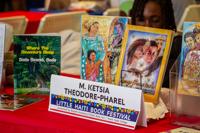
M. Ketsia Theodore-Pharel had several books on sale during the event.
(Elisabeth Campbell for The Miami Times)
This year’s program was centered around culture in motion, reflecting the many ways Haitian identity is expressed, studied, and lived. The festival expands beyond traditional literary forms into oral history, playwriting, nontraditional publishing, and more. It serves as a vibrant hub for honoring ancestors, preserving oral traditions, and fostering creative expression across generations and cultures.
M. Ketsia Theodore-Pharel is a Haitian storyteller, educator, and children’s author whose work is deeply rooted in Haitian traditions, creating spaces that bridge generations.
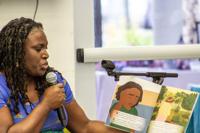
M. Ketsia Theodore-Pharel reads her book, ‘I’ll Make Tea,’ to the kids in the Children’s Alley.
(Elisabeth Campbell for The Miami Times)
“I am an oral storyteller, trained thanks to the Florida Folklife Program,” said Theodore-Pharel. “It is a Haitian pastime, the story, and I was used to storytelling, but I didn’t know it was an art form.”
Following the 2010 earthquake in Haiti, Theodore-Pharel suffered a severe depression that prompted her to explore her cultural history.

M. Ketsia Theodore-Pharel tells a traditional Haitian story in the Children’s Alley.
(Elisabeth Campbell for The Miami Times)
“I couldn’t go to Haiti to do anything, so I decided that I was going to be a cultural ambassador with my stories,” she said.
Theodore-Pharel is committed to fostering literacy and cultural pride, whether in classrooms, libraries, or community gatherings. She explains how storytelling in Haitian culture is often led by grandmothers and older relatives, who adapt stories to address emergent issues, likening the role of a family storyteller to that of a griot, or West African oral historian.

The festival featured a live DJ.
(Elisabeth Campbell for The Miami Times)
“Usually it is the older parent, the grandmother, the great-grand-aunt, who tells the stories, and she’s like the family griot,” said Theodore-Pharel.
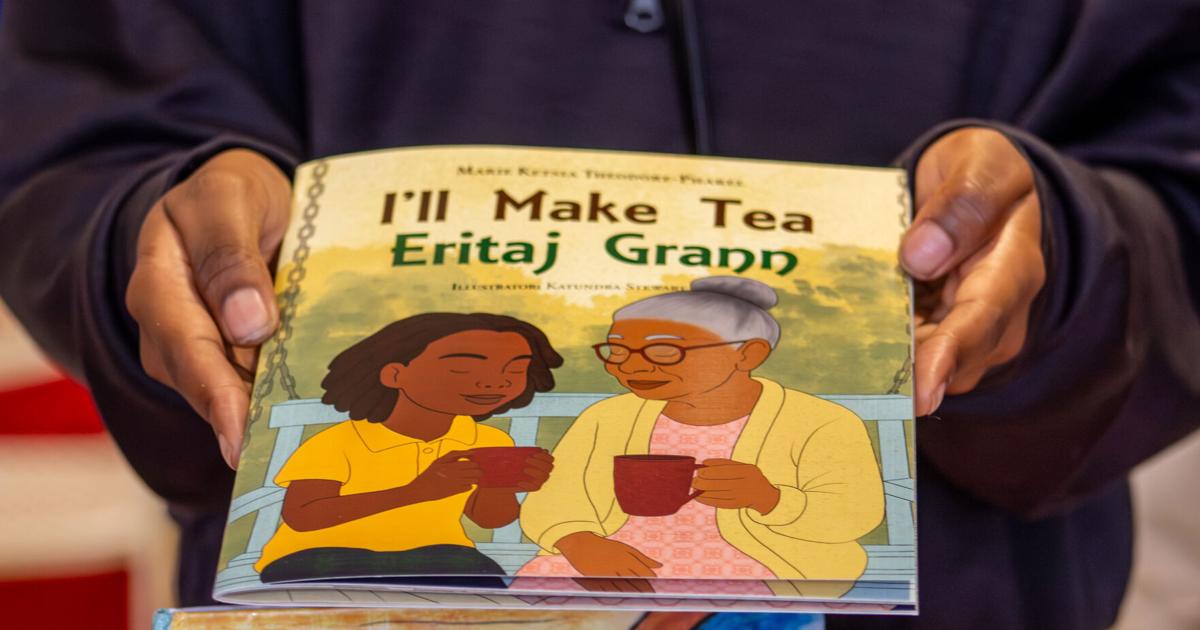
Theodore-Pharel’s own work, including her book I’ll Make Tea about a grandmother and granddaughter, underscores the importance of intergenerational bonds and the role of oral tradition in sustaining cultural heritage. She also spoke about the Little Haiti Book Festival as a vital space for Haitian art, speaking to how storytelling lives beyond the page and continues to shape community, memory, and identity.

Materials were provided for the Teen Zine Workshop.
(Elisabeth Campbell for The Miami Times)
In additional to the oral form, playwrighting also plays a big part in the storytelling tradition at the Little Haiti Book Festival.
Celeste Landeros’ original play, The Last Songs of My Mother and Tonton, is rooted in caregiving, memory, and music. The intertwined lives of Landeros’ mother, Jean Fraser, and Haitian percussionist Catelus “Tonton” Laguerre encourage cultural preservation without flattening the story to fit the expected narrative.
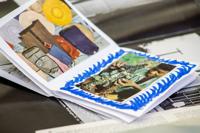
Edny Jean Joseph brought sample zines for the Teen Zine Workshop.
(Elisabeth Campbell for The Miami Times)
“Tonton was about as important a culture bearer as you could find for Haitian music,” said Landeros. “He was an original founding member of the National Folklore Troupe of Haiti. The folk music of Haiti tells the history of the people who were enslaved and brought to Haiti and the people who were their descendants in ways that official history doesn’t record.”
Landeros herself has roots in Ireland, but when she was growing up in Miami, Tonton was her teacher and mentor. For the last seven years of his life, she hosted him in her own home.

Inez Barlatier and Ti Wes prepare to perform together in The Last Songs of My Mother and Tonton.
(Celeste Landeros)
Inez Barlatier played one of the lead characters in The Last Songs of My Mother and Tonton. She knew Tonton, calling him “a legend in our community.”
As an artist who makes children’s music, Barlatier incorporates multicultural rhythms into her songs, inspired by her childhood in Miami. She emphasized music as a universal language and an integral part of Landeros’ play.
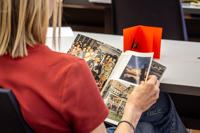
Amanda Keeley, founder of Exile Books, flips through a magazine.
(Elisabeth Campbell for The Miami Times)
“Haitian culture is based in remembrance, reverence for our ancestors,” said Barlatier. “In my work, I am honoring my ancestors by way of my father, by way of my great-grandmother. Celeste, in her own way, is practicing that reverence for ancestors. She wrote a story for one of her greatest mentors, and we get to bring that story to life and share it with people.”
With eyes on the next generation, the festival also had several opportunities for teens and youth to get involved.
One such opportunity was the Teen Zine Workshop, which created space for youth expression, independent publishing, and visual storytelling within the festival.

Materials were provided for the Teen Zine Workshop.
(Elisabeth Campbell for The Miami Times)
Materials were provided to create these zines—or self-published, DIY magazines. The workshop was led by local Haitian American artist, Edny Jean Joseph, in conjunction with Exile Books, an experimental community project space in Little Haiti.
“I just love zines because they’re open to everybody,” said Amanda Keeley, founder of Exile Books. “Anyone can make a zine. They’re accessible, and I think particularly for a younger audience, it gives them a voice.”
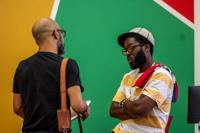
Edny Jean Joseph speaks with a festival attendee.
(Elisabeth Campbell for The Miami Times)
Keeley and Joseph are both passionate about the community of artists in Miami and hope to spread that connection to a younger generation.
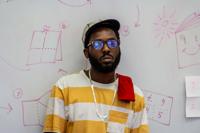
Edny Jean Joseph explains how to fold a zine with a series of drawings on the white board.
(Elisabeth Campbell for The Miami Times)
“Miami is, like, soupy,” said Joseph. “There are so many different elements in Miami that make it Miami. You can just come up with epiphany after epiphany after epiphany.”
Joseph credits Little Haiti with being the place where his adulthood began. The opportunity to lead a workshop at the Little Haiti Book Festival felt like a full circle moment.
“It’s a beautiful thing to not only participate passively as a citizen of the city, but now give something back, actively,” said Joseph. “This will definitely be a trend of mine to give back to Little Haiti as much as I can.”
The Little Haiti Book Festival continues with an online program, held on May 17. Find out more about that program at https://miamibookfair.com/program/little-haiti-book-festival/.