

Michael Stillion
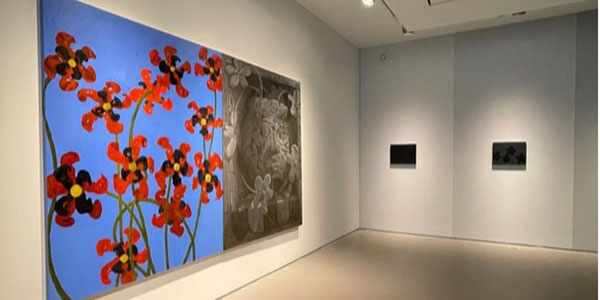
Stillion’s shift in color palettes was an intentional change, as his artwork is a reflection of him. Many pieces have been created in the last six years with a grey scale, but there is a room dedicated to Stillion’s pre-COVID art that showcases his change in technique from a bright color palette to a grey-scale, also known as a grisaille palette. The change in tone not only reflects a personal transformation but also shaped how Stillion approached the layout of the exhibition.
Because of the unique architecture of the Contemporary Art Center, designed by Zaha Hadid, Stillion had to face the challenge of working for or against the building. The main space itself is fluid and immersive, as it lacks the traditional 90-degree angles one is typically used to. With concrete pillars dividing the space, Stillion ultimately decided to use the architecture to his advantage by utilizing the lighting and strategic placement of artwork. One wall of the exhibition features a graduation painted on the wall with a series of seven paintings shifting from day to night time.
While the physical layout of the exhibition impacts viewers’ thoughts on the show, personal imagery adds another layer to the experience. Stillion describes his work as a balance between humor and seriousness. Throughout all of the pieces displayed at the exhibition, one will notice a pattern of poppy flowers. The poppy is a symbol of the opioid epidemic that is occurring in Stillion’s hometown and many rural communities throughout the United States..
“It’s an honor … and pretty humbling to be trusted with a space like this,” Stillion said.
After reflecting on the exhibition, Stillion said his inspiration comes from multiple sources but specifically his students. While being a professor of Art at Miami University, Stillion says practicing what he preaches and interacting with his students has helped him become a better artist.
Stillion’s goal with the exhibition is for people to come into the show and be entertained. While he has his own understanding of his artwork, he wants people to have their own depictions and feelings when walking through the show. The exhibition is open until Aug. 30 at the Cincinnati Contemporary Arts Center.