
The Brief
Florida high school student-athletes will soon be required to undergo heart screenings under the newly enacted “Second Chance Act,” a measure designed to identify undiagnosed cardiac conditions before they lead to tragedy.
The law was inspired by survivors like UCF student Riley Broadhurst and advocates like Martha Lopez-Anderson, who lost her son to sudden cardiac arrest after he appeared to be perfectly healthy.
To help families meet this new requirement starting in July, the nonprofit “Who We Play For” is offering $20 electrocardiograms (EKGs) in partnership with Orlando Health to ensure every student has access to these life-saving tests.
ORLANDO, Fla. – For UCF student Riley Broadhurst, life changed in the time it takes to “flip a light switch.”
At age 17, the lifelong competitive athlete collapsed while on a routine run. He was suffering from sudden cardiac arrest—the result of an undiagnosed heart condition he never knew he had.
Broadhurst is part of a staggering statistic: one out of every 300 young people has an undiagnosed heart condition. However, unlike 90% of young people who suffer a sudden cardiac arrest, Broadhurst survived.
“Three neighbors kept me alive until EMS arrived… they brought me back,” Broadhurst recalled.
The ‘Second Chance Act’
What we know
Starting this July, Florida is taking a major step to ensure other students don’t become “grim statistics.”
Under the newly passed “Second Chance Act,” all new high school student-athletes in Florida must complete a successful heart screening before they are allowed to participate in sports tryouts, conditioning, or practice for the upcoming school year.
The push for this legislation was fueled by parents like Martha Lopez-Anderson, who lost her 10-year-old son, Sean, when he collapsed while rollerblading.
“He appeared to be seemingly healthy,” Lopez-Anderson said. “I found out that there were ways to prevent it, such as an EKG… learning that was like losing him all over again.”
How to get screened
What you can do
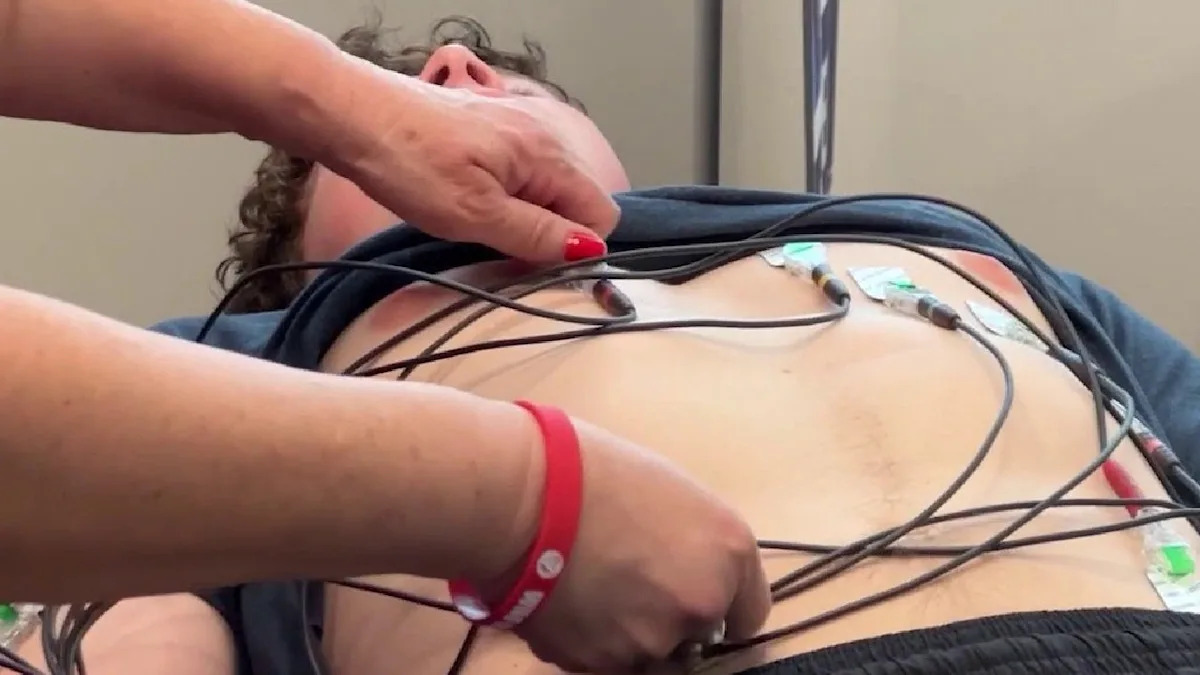
The screenings typically involve an electrocardiogram (EKG), a non-invasive test that records the electrical signal from the heart to check for different heart conditions.
Cost-effective care
The nonprofit group “Who We Play For” is partnering with Orlando Health this month to provide these mandatory heart screenings for just $20.
Broadhurst said, “I guarantee you, if you live in Florida, you will find a heart screening in your area. And you should go”.
By catching these “silent” conditions early, officials hope to provide more Florida students with the same second chance at life that Riley Broadhurst received.
The Source
Information in this story was gathered from the Florida Senate Bill 1070 and reporting from FOX 35’s Matt Trezza.