
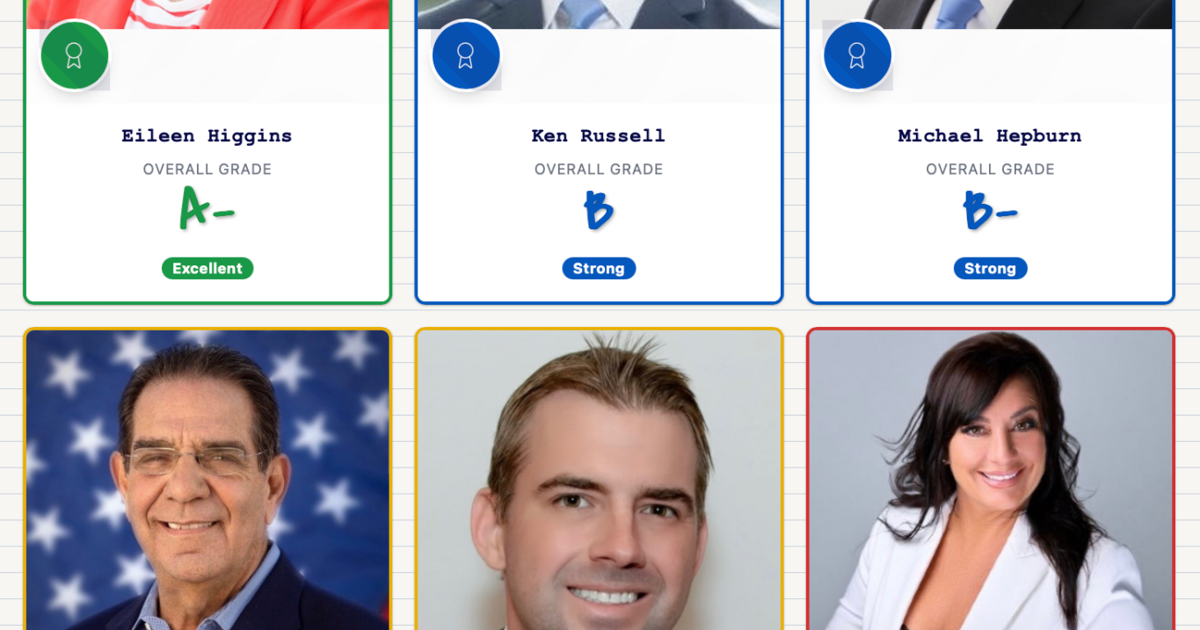
Eileen Higgins
Age: 61
Education: B.S. Mechanical Engineering – University of New Mexico; MBA – Cornell University
Current Role: Miami-Dade County Commissioner, District 5
Experience: 7 years in public office
Website: eileen.miami
Funds Raised: $1,300,000
Overall Rating: A- (Excellent)
Strengths
• Only candidate with operational programs already delivering results.
• Strong record on affordable housing, small business support, and equity-minded resilience.
• Understands climate gentrification and its impact on Black neighborhoods.
Areas for Growth
• Civic engagement could include more formal, standing advisory structures.
Signature Policy / Big Idea
Climate Gentrification Framework – explicitly aligns resiliency, anti-displacement, and development so adaptation does not become a driver of displacement.
Scores
Qualifications: A
Policy Vision & Feasibility: A
Community Impact: B+
Implementation Feasibility: B+
Equity & Leadership: A+
Top 3 Priorities
1. Building Generational Wealth / Building Businesses
2. Foster an Affordable & Prosperous Miami
3. Enhance Transit Experience, Connected Community
First-Year Plan
Eileen Higgins’s first-year plan builds on her existing county-level programs — expanding ELEVATE-style small business support citywide, accelerating permitting tied to mixed-income housing, and embedding climate/anti-displacement protections in neighborhoods like Liberty City, Overtown, and Little Haiti.
In Their Words – Affordable Housing
Collaborating with neighborhoods is essential to understanding development needs, promoting anti-displacement policies, and rebuilding trust in City Hall. Mixed-income developments help ensure lower-income residents live in dignified housing within economically vibrant neighborhoods with access to jobs and groceries.
In Overtown, new developments now allow residents to walk to a grocery store in a neighborhood long recognized as a food desert. In Little Haiti, we must offset gentrification by expanding rental assistance and protecting longtime homeowners.
Citywide, we need workforce housing to retain young residents and prevent brain drain as part of complete neighborhoods—supported by faster permitting, green spaces, climate-mitigating trees, and better transit access. Climate gentrification also affects Liberty City, Overtown, and Little Haiti. The city must deliver equitable resiliency planning, strengthen protections in lower-elevation neighborhoods to offset speculative migration, and invest in safeguards to keep vulnerable residents in their homes.
This dual approach strengthens all neighborhoods equally and ensures climate adaptation doesn’t become a tool for displacement.
In Their Words – Economic Empowerment
Miami is a community of small businesses, and the city’s budget is large. Black businesses of all sizes should have access to procurements and contracts for city services and projects. However, small businesses often need technical support and access to capital to seize these opportunities.
That’s why I launched ELEVATE District 5 to support small businesses in a district with stark inequality. Through ELEVATE, we’ve trained over 1,000 businesses, including more than 100 small businesses in Little Havana to successfully access county contracts. We’ve provided training in AI, online marketing, and financial management, while creating the $25 million RISE Miami-Dade Fund to ensure minority-owned businesses have access to capital.
As Mayor, I’ll bring this proven program citywide, ensuring Black businesses across Miami can compete for and win city contracts. Access to government contracts is a key topic at the upcoming ELEVATE Small Business Conference on October 24th, where we’ll continue equipping entrepreneurs with the tools they need to build generational wealth through business ownership and government procurement opportunities.
In Their Words – Civic Engagement
To truly understand community concerns and priorities, you must be present. I regularly attend neighborhood and homeowners association meetings, and connect with neighborhood chambers of commerce to listen firsthand to each area’s unique needs.
Churches are often where people first seek advice, making relationships with church leaders essential to understanding the deep needs of both neighborhoods and families. I visit vibrant local parks in Miami’s African-American communities where families gather, attend services at neighborhood churches with passionate congregations, and dine at restaurants that serve as social hubs.
These interactions enable meaningful conversations with neighbors about their experiences and priorities. I stay informed by reading the Miami Times and other African-American media outlets that provide valuable perspectives on local issues. Recently, I participated in a meeting hosted by the Black Owned Media Alliance (BOMA), bringing together influential community voices. It was an opportunity to learn about pressing issues that matter to them while introducing myself and fostering mutual understanding.
Ken Russell
Age: 52
Education: B.S. Business Administration – University of North Carolina at Chapel Hill; Additional studies in International Business at Kwansei Gakuin University, Japan
Current Role: Self-employed consultant
Experience: 7 years in public office
Website: kenrussellformayor.com
Funds Raised: $231,000
Overall Rating: B (Strong)
Strengths
• Proven track record: created Florida’s only managed mangrove park and pushed housing affordability tools.
• Champion of inclusionary zoning in Florida.
• Understands West Grove, District 5 dynamics, and anti-displacement needs.
Areas for Growth
• Several priorities depend on county or state cooperation.
Signature Policy / Big Idea
Mandatory Inclusionary Zoning – only Florida legislator to implement a mandatory IZ that requires affordability in new towers, with a version adaptable to District 5.
Scores
Qualifications: B
Policy Vision & Feasibility: B+
Community Impact: B
Implementation Feasibility: C+
Equity & Leadership: B+
Top 3 Priorities
1. Helping People Stay in Their Homes
2. Expansion of Community Redevelopment Agencies
3. Reform Corruption in City Hall
First-Year Plan
Ken Russell’s first-year agenda centers on immediate housing stabilization, reopening NET offices with mayoral hours in underserved Black neighborhoods, and codifying local/minority hiring in city deals despite state-level headwinds.
In Their Words – Affordable Housing
Preservation of housing is most important and helps existing residents stay in their homes through funded improvements and lowered taxes. Creation of new housing is more complicated than just allowing builders to build more.
I am the champion of Inclusionary Zoning and the only legislator to have created a mandatory IZ in the state of FL. This mandates a percentage of affordability in all new towers in that zone. There is a version that would apply to District 5 that would allow for investment in the community without displacement.
In Their Words – Economic Empowerment
The City can implement requirements on its land and in all its contracts and development deals to prioritize local hiring and contracting with minority applicants. This should be codified for all deals rather than negotiated on a piecemeal basis.
The impediment is the state and federal push against inclusionary policies and DEI. Miami needs a leader that will stand up to these discriminatory policies and level the playing field in our city.
In Their Words – Civic Engagement
I would reopen the NET offices and include Mayoral office hours in those locations that are located in communities like D5 that are farther from City Hall and often underserved.
As Commissioner, I mandated an Environmental Justice seat on the Climate Resilience Committee so that Black voices would be at the table to address Climate Gentrification. Appointing more social justice specific members to boards will ensure Black representation in decision-making.
Michael Hepburn
Age: 43
Education: Master of Science – Florida International University
Current Role: Director – Hornets Sports & Entertainment
Experience: 20 years of community and civic engagement
Website: michaelhepburn.com
Funds Raised: $100,000
Overall Rating: B- (Strong)
Strengths
• Most structurally innovative proposals in the field.
• Excellent civic empowerment and resident-education concepts (Citizen Miami Academy, Initiative).
• Detailed affordable housing production and preservation agenda.
Areas for Growth
• Needs to specify the nature of 20 years of service.
• Many reforms will require strong administrative follow-through.
Signature Policy / Big Idea
Triple Structural Reform – (1) Activating Charter powers, (2) empowering voters directly, and (3) building economic innovation capacity inside city government.
Scores
Qualifications: C+
Policy Vision & Feasibility: B
Community Impact: C+
Implementation Feasibility: A-
Equity & Leadership: B+
Top 3 Priorities
1. Rehab, Develop & Preserve Affordable Housing
2. Enhance our Neighborhoods & Public Safety Measures!
3. Uplift our Children and Seniors!
First-Year Plan
Michael Hepburn’s first-year priorities focus on passing a Miami Affordable Housing Master Plan, standing up the Miami Legacy Business Project, and activating Section 5 of the Charter so residents can move stalled public-interest policy.
In Their Words – Affordable Housing
Pass a Miami Affordable Housing Master Plan {which includes} Rehabbing and Developing 9,000 Affordable Housing units and mutually beneficial Community Benefit Agreements. That work for both our communities and developers to create low-income rentals, workforce housing and Rent-to-Own mixed-use units. Funding homeowners preservation initiatives to assist with exterior & interior repairs to help our homeowners stay in their homes.
Utilizing city owned land to develop high-quality affordable housing projects that cover residents from all income levels. Community Land Trust concepts to build new developments and to keep our current subsidized housing units affordable for years to come.
Securing state, county, and municipal First Time Home-buyer initiatives to help residents with covering cost. Protecting naturally occurring affordable housing (NOAH) through financing the acquisition and preservation of such units to save them from market pressures and poor management.
In Their Words – Economic Empowerment
Launch “The Miami Legacy Business Project” to invest in our small businesses that have helped shape Miami’s culture for the last 25 years or longer. The program will provide financial and technical assistance to qualifying businesses, with grants ranging from $15,000 to $50,000. Our project will also provide an Online Miami Legacy Business Registry to recognize, track and support our businesses that have operated in the City of Miami for 25 years or more.
Empower innovation, advance businesses growth (large & small), and build talent through the newly-created Department of Economic Innovation & Development. Including developing Public-Private Partnerships, focusing on reskilling, and upskilling our residents with the tools needed to start great tech and high skilled jobs.
In Their Words – Civic Engagement
I will Activate Section 5 of our Charter called “The Initiative” to put the POWER back into the hands of our Voters, to directly adopt ordinances. We will NO LONGER WAIT for our City Commissioners to pass or implement the public policy initiatives that our residents urgently want and need.
Create CITIZEN MIAMI Academy to reduce the major civic empowerment gap in our city. Through our Miami Civics comprehensive curriculum — residents will learn about the inner-workings of our municipal government, paired with behind the scenes insights and education on how to advocate for the issues they care about. “305 Academy Grads” will finally understand how government actually works throughout our city.
BAN lobbyists, City of Miami vendors, and real estate developers from donating to candidates for Mayor or Commissioner. This ban will include making contributions directly or indirectly, including through political committees (PCs) or electioneering communications organizations (ECOs). Our campaign finance rule will be similar to the City of Miami Beach law.
Xavier Suarez
Age: 76
Education: B.S. – Villanova University; M.P.P. & J.D. – Harvard University
Experience: 40 years+ in public service (former Mayor; County Commissioner)
Website: xavierlsuarezformayor.miami
Funds Raised: $350,000
Overall Rating: C+ (Adequate)
Strengths
• Impressive credentials: Harvard MPP & JD; decades of executive experience.
• Long history of appointing Black leaders in public safety and administration.
• Attention to Liberty City, Overtown, West Grove projects.
Areas for Growth
• Many priorities require state action beyond mayor’s authority.
• Housing, transit, and insurance proposals need clearer city-level mechanisms.
Signature Policy / Big Idea
State Catastrophic Insurance Transfer – proposes state-provided catastrophic insurance for government-subsidized housing to lower costs and improve feasibility.
Scores
Qualifications: B+
Policy Vision & Feasibility: C
Community Impact: C
Implementation Feasibility: C
Equity & Leadership: C+
Top 3 Priorities
1. Increase the homestead exemption to $500,000.
2. Extend all trolley services to the corners of the City, and make metro/mover free.
3. All government-subsidized housing has the catastrophic insurance provided by the state.
First-Year Plan
Xavier Suarez’s year-one agenda is unusually specific on housing, transit, and insurance — but will require strong intergovernmental relationships to execute, especially at the state level.
In Their Words – Affordable Housing
Continue emphasis on SE/Overtown Park West and remove all impediments to the building of the 4,000 units being built and rehab. In the West Grove, continue working with churches and the Gibson Memorial Fund to add approximately 300 units on existing lots close to the corner of Grand and Douglas. In Liberty City, ensure the second phase completion of Liberty Square, ensure quality construction methods, and add amenities like a basketball court proposed by former commissioner Spence Jones and NBA star Billy Johnson.
In Their Words – Economic Empowerment
As I did in the County, the minority and small business program should increase the self-insurance threshold to allow small firms to have the bonding requirements waived. As I did in the City (i.e., Bayside & Miami Arena), set a 50% goal of minority participation in all building projects.
In Their Words – Civic Engagement
The most important thing is for high-level managerial appointments to be inclusive as they were when I was Mayor, with three black police chiefs (Clarence Dixon, Perry Anderson, and Calvin Ross), as well as with my own staff in the County, who were majority people of color. The above record of inclusion caused the National Association of Black Public Administrators to give me their highest award in the 1990s.
James DeSantis
Age: 35
Education: University of Richmond School of Law, J.D.; Vanderbilt University, B.A.
Current Role: Associate Attorney at Cole, Scott & Kissane
Experience: 1 year in public service
Website: desantisformiami.com
Funds Raised: $5,000
Overall Rating: C (Adequate)
Strengths
• Innovative proposals: racial-impact reviews, community-led planning, equitable procurement.
• Strong, clear emphasis on Black economic empowerment.
• Embraces multiple engagement channels — councils, mobile office hours, digital tools.
Areas for Growth
• Only 1 year of public service — minimal experience for executive role.
Signature Policy / Big Idea
Racial-Impact Reviews – requires racial-impact analysis for major city decisions to prevent disproportionate harm to Black communities.
Scores
Qualifications: D+
Policy Vision & Feasibility: C+
Community Impact: C
Implementation Feasibility: B
Equity & Leadership: C+
Top 3 Priorities
1. Economic Opportunity
2. Equity in Services, Health & Safety
3. Housing Security & Anti-Displacement
First-Year Plan
James DeSantis’s first-year plan emphasizes creating standing neighborhood advisory councils, launching an inclusive procurement program for Black and small businesses, and embedding anti-displacement in new development.
In Their Words – Affordable Housing
I would prioritize community-led, anti-displacement strategies. This includes adopting inclusionary zoning to ensure new developments include truly affordable units, strengthening rental assistance and eviction-prevention programs to help families stay in their homes, and requiring community input and benefits agreements so that major projects directly create local jobs, housing, and investment.
My goal is to keep residents rooted in their communities while promoting growth that uplifts, rather than displaces, the people who built them.
In Their Words – Economic Empowerment
Black economic empowerment in Miami begins with equitable access to opportunity. Too often, Black-owned businesses face barriers like limited access to capital, lack of awareness of contracting opportunities, and complex bid requirements that favor larger firms. As Mayor, I would implement inclusive procurement policies and set measurable goals for contracting with small businesses, expand technical assistance and mentorship programs to help them compete for bids, and create a small business accelerator focused on access to financing and capacity-building.
I’d also partner with local institutions like Florida Memorial University to develop entrepreneurship pipelines, apprenticeships, and job training that lead directly to city-backed contracts and private-sector opportunities—ensuring that Miami’s growth creates wealth within the communities that have too often been left out of it.
In Their Words – Civic Engagement
True leadership means listening before deciding. I would create permanent, neighborhood advisory councils in all communities, made up of residents, business owners, faith leaders, and youth voices, to provide direct input on city priorities year-round. I’d hold monthly “Mayor in the Community” meetings and launch a digital feedback platform and mobile office hours so residents can reach City Hall easily. I’d also partner with trusted community organizations and Black-owned media to share updates and invite dialogue. My goal is to make City Hall present, accountable, and responsive—every day, not just at election time.
June E. Savage
Age: 58
Education: Some College
Current Role: Real Estate Agent (25 years)
Experience: 15 years of community involvement
Website: miamimayorsavage.com
Funds Raised: $3,555
Overall Rating: D- (Weak)
Strengths
• Commitment to full-time accessibility.
• 15 years as a real estate agent gives her exposure to local housing pressures.
Areas for Growth
• Severe policy depth deficiencies.
• Fundamental governance gaps, especially around housing finance and transit.
Signature Policy / Big Idea
AI-Expedited Permitting – proposes using AI to move permitting along for businesses and construction.
Scores
Qualifications: D-
Policy Vision & Feasibility: D-
Community Impact: D
Implementation Feasibility: F
Equity & Leadership: D
Top 3 Priorities
1. Housing
2. Transportation
3. Historic Preservation
First-Year Plan
June Savage’s first-year plan focuses on keeping Miami affordable by pushing developers to lower costs, modernizing permitting with AI, and maintaining an open-door, full-time mayor’s office.
In Their Words – Affordable Housing
Quality of life is important. I would source new developers who source out economic materials, and no govt substadies to developers. Cost of construction needs to come down to evolve affordability. COVID doubled costs and it hasnt decreased since.
In Their Words – Economic Empowerment
Regarding permitting we al need to upgrade or be left behind, using AI expeditors for permitting office would help move the process along for opening businesses and construction. Our youth need to see a pathway to success such as Ygamin has brought to his yound kids its a program that works. Mentoring our men such as the 100 Black Men programs, we need to help just like we do the Lotus House. There is no magic potion. We must all work together.
In Their Words – Civic Engagement
I will have an open door policy. I will be a full time mayor so I can be directly reached. I will also be boots on the ground being full time. No excuses with me. We are “One Miami”.