
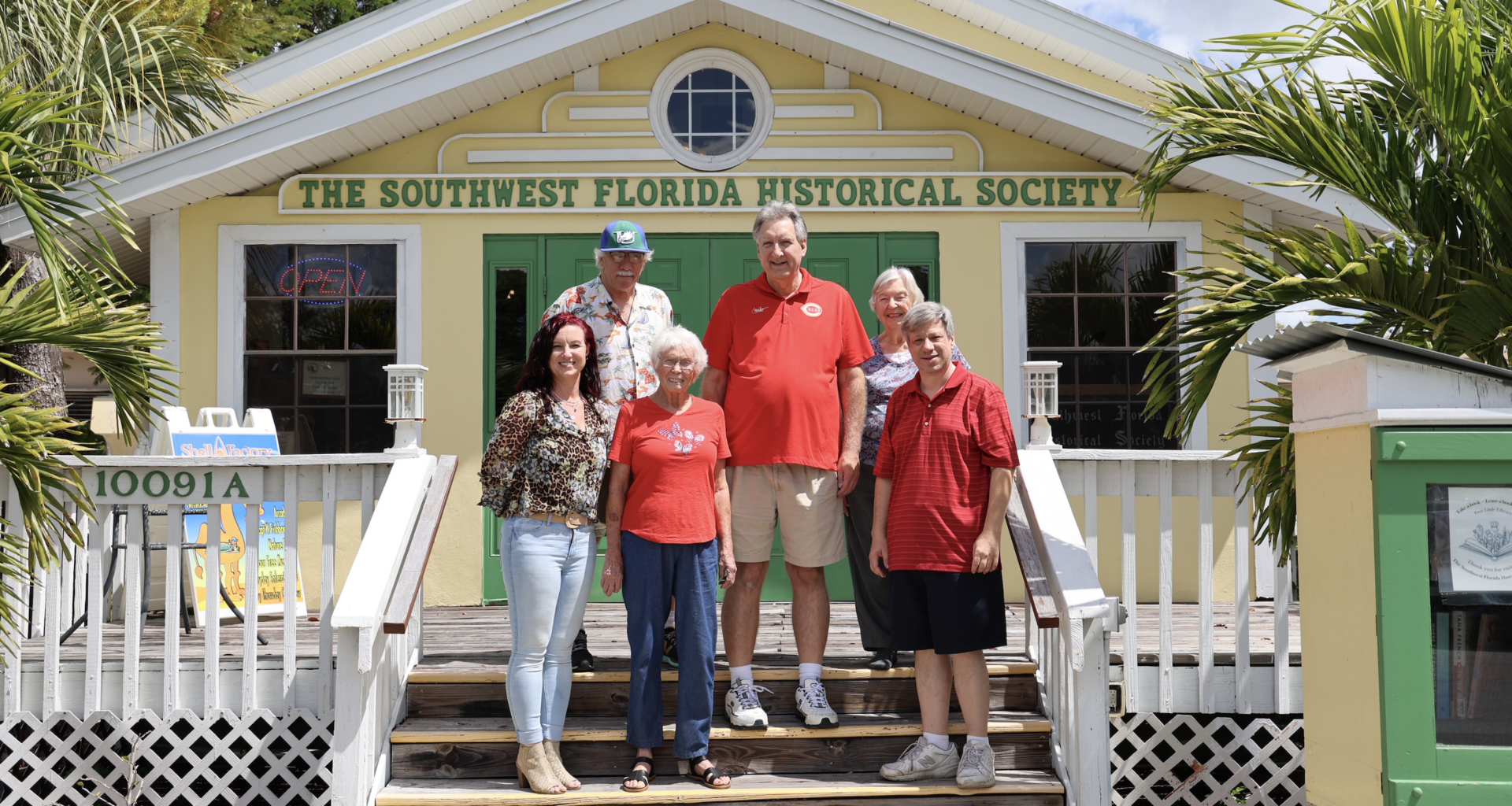

Front row- Jean Gray, Helen Farrell, Stephan Schonberg. Back row- Glenn Miller, Scott Fowler, Genevieve Bowen. Society members and volunteers stand in front of the Little Yellow House, home to the Southwest Florida Historical Society. -CRISTINA POPE / FLORIDA WEEKLY
On a quiet morning in Fort Myers, Helen Farrell walks through a cemetery with surprising familiarity.
She pauses at certain names, not simply to read them, but to photograph and post them for online records.
Years ago, a woman came to her with a question burdened by grief. She had heard that her baby brother’s grave had been washed away in a storm. Seeing Farrell’s pictures online, the woman hoped Farrell could help uncover the truth.
Farrell didn’t just search the records. She brought her to the tomb herself. There, at the Fort Myers Cemetery, they found the gravestone still standing.
“She broke into tears knowing it’s still there,” Farrell said.
At the Southwest Florida Historical Society, moments like that are a part of the work. The “Little Yellow House,” home to the society and located in Downtown Fort Myers, has a way of connecting the past with the present, sometimes in unexpected ways.
Deeply rooted volunteers
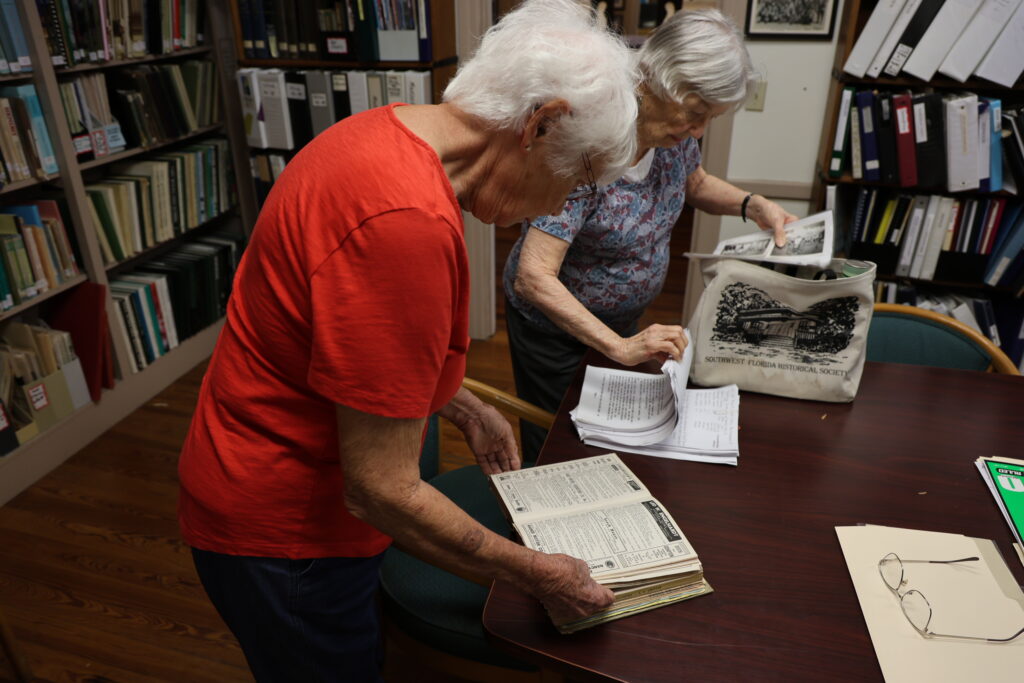
Society members Helen Farrell and Genevieve Bowen flip through old city directories and documents. -CRISTINA POPE / FLORIDA WEEKLY
Farrell has been a volunteer at the Little Yellow House since 1988, but her roots run even deeper. Her ancestors were one of the first settlers on Marco Island, in Naples and across what would become Collier County. Names like Collier and Weeks are part of her family tree. She is also a descendant of Camp Daniels, a Civil War-era site near Fort Myers.
“Home is important,” Farrell said. “You know more about yourself when you know about your history.”
That depth of knowledge has made her a trusted resource for visitors who come through the society’s doors looking for answers. Sometimes, they want to learn more about their genealogy. Other times, they’re searching for the history of a house, street name or a sports team. No matter the question, Farrell knows where to find the answer. Even her own family artifacts line the walls of the Little Yellow House.
“This morning I just brought in the military enlistment papers from my great uncle, Milton Taylor Mark,” she said.
For Mel Smith, another devoted member of the society, the Little Yellow House serves as both a window into her past and a tool in her present.
Curious about her family roots and the history behind the homes she lists as a realtor, Smith quickly became a regular.
“I started going every Wednesday and Saturday, really digging into family stuff but also real estate listings,” she said. “Once you start digging into that, the story of the house just comes unfolding.”
Her research progressed with the help of Joanne Miller, another society member and retired Lee County Clerk of Courts employee. The two of them were even able to correct the recorded history of one home Smith listed, tracing it back nearly three decades earlier than official records showed.
“The Lee County Property Appraiser said it was in 1954, and that didn’t tell me the story,” she said. “I was able to pull Joanne’s research from the Historical Society… and it was changed.”
Although Smith discovered countless rich stories behind the homes she sold, it was at the Little Yellow House that she found the most surprising of all: her own.
Sitting next to Farrell, Smith dug into genealogies and traced through her family tree. That’s when Farrell leaned over and noticed a name that looked familiar.
Douglas.
“Sitting next to Helen, she says, ‘Oh Douglas, I’m a Douglas, let me see,’” Smith said.
They started cross-checking their genealogies, following branches back through generations. That’s when they realized the records matched. They were part of the same family tree.
“It’s crazy how we had talked for so long and didn’t even know that we were in there,” she said with a laugh. “Now we have a cousin table.”
What’s inside
Inside the Southwest Florida Historical Society, no question is too small or too unusual.
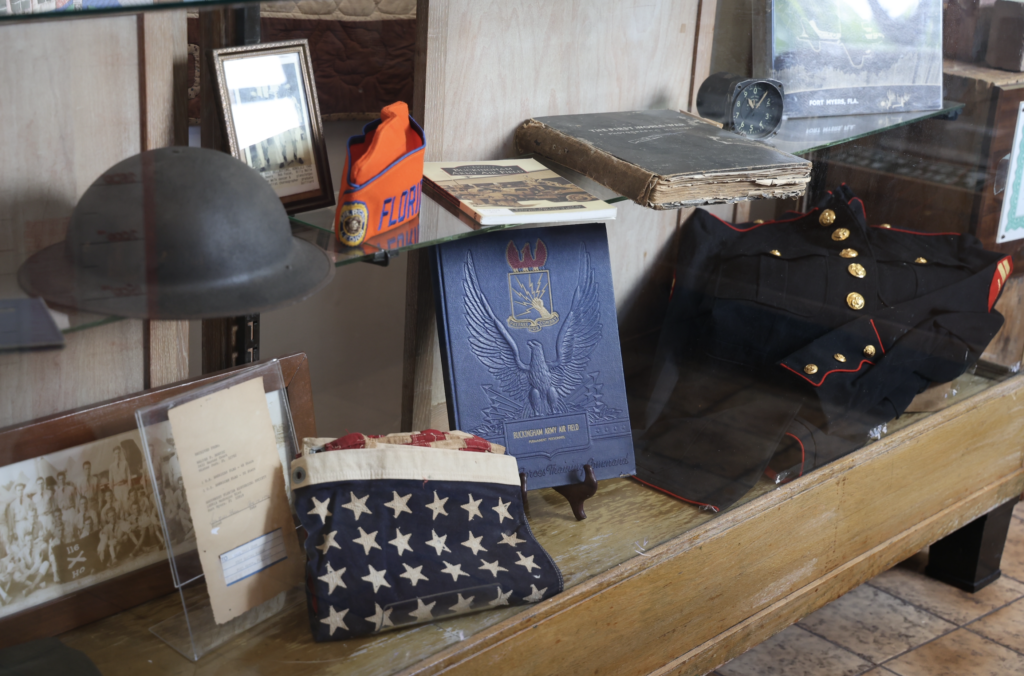
At the entrance of the Little Yellow House, a glass display showcases old military artifacts, including a vintage Buckingham Army Air Field book. During World War II, Lee County housed a U.S. Air Force school. -CRISTINA POPE / FLORIDA WEEKLY
“Somebody once wanted photographs of cisterns and another, of telegraph poles,” Farrell said with a laugh. “You just never know what somebody walking in the front door is interested in finding out.”
More often, visitors are searching for something closer to home. Some want to know who lived in their house before they did. Others want to trace genealogies, verify documents and piece together family stories.
The Little Yellow House, filled with old yearbooks, phone books, city directories, maps, and newspaper clippings, serves as a good starting point.
“If they did own property or were married here…you can also establish exactly where they lived with the city directories,” Joanne said.
Resources at the society can also verify information that might be harder to find. For example, if a family member never married or owned property, volunteers can help establish the general vicinity of where they lived through their collection of old petitions, some dating back to the 1800s.
Before social media or websites existed, petition papers were how the public voiced their concerns and opinions to their local government.
“Petitions have names of people who signed for a new road or for a new cattle inspector back in the day,” Joanne said. “It was very important because people had hundreds of cattle here.”
While Southwest Florida may not be as widely recognized as some of the nation’s most well-known historic regions, there’s a wealth of history to discover for those who take the time to look. Famous artists like Ernest Archer “Frog” Smith spent most of their lives right here in Southwest Florida, and many of their artworks center around the region. Two of Smith’s original paintings hang on the walls of the Little Yellow House. One depicts the First Lee County Courthouse. The other is an old “cracker house,” which was common in Southwest Florida from the mid-1800s to the early 1900s. The house is wood-framed with a metal roof and a large porch. This architecture was ideal for Florida’s hot, humid climate and was popular before the implementation of air conditioning.
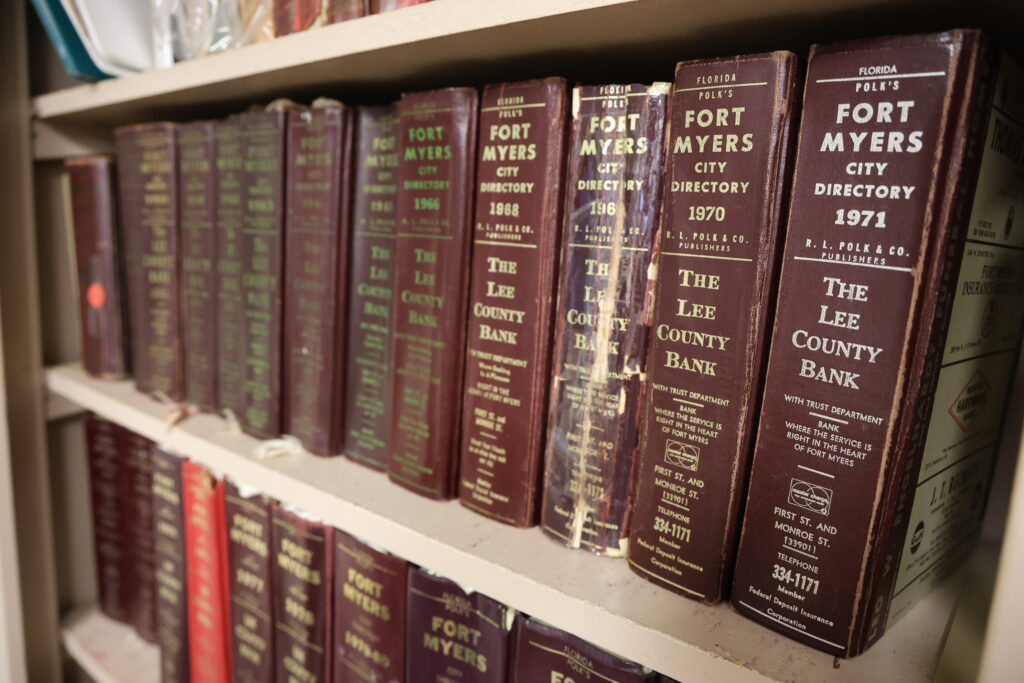
Old city directories sit archived at the Southwest Florida Historical Society. The directories document past residents, addresses and businesses in the area. -CRISTINA POPE / FLORIDA WEEKLY
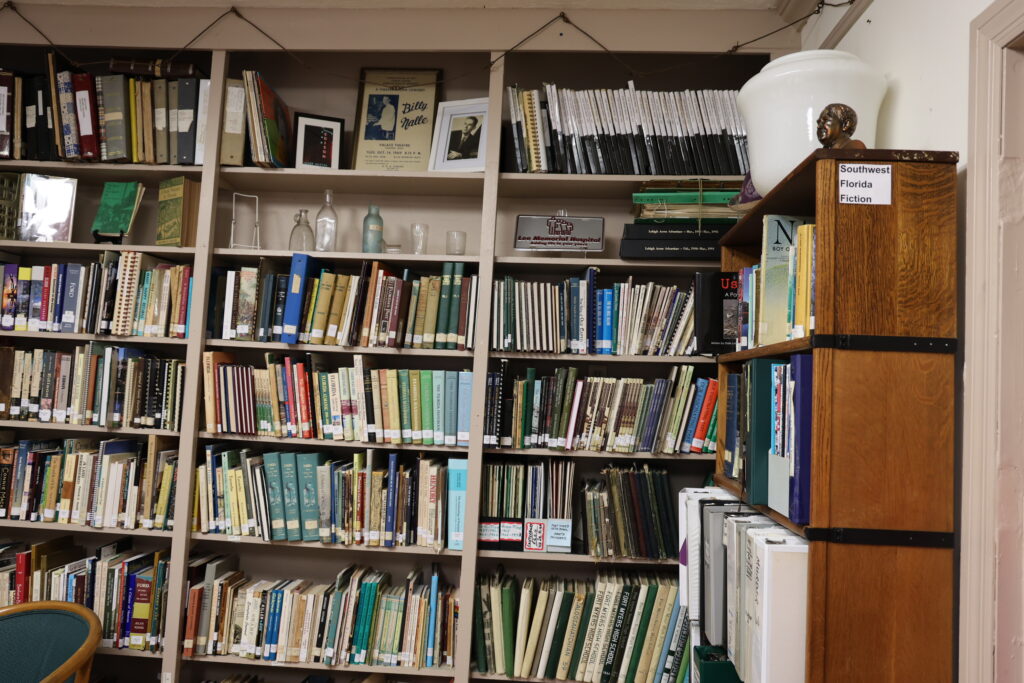
Old photographs, city directories, yearbooks, newspaper clippings and phone books line the shelves at the Little Yellow House. Two photos of William Temple “Billy” Nalle sit on the top center shelf. -CRISTINA POPE / FLORIDA WEEKLY
At the entrance of the Little Yellow house, a plethora of military artifacts ranging from generations of eyeglasses to original uniforms tell the story of how Southwest Florida started. Resting on a table near the front door is a beam of wood said to be from the original fort during the Civil War era. The fort bordered the area now known as Hough Street, Monroe Street and Second Street in Downtown Fort Myers, until it was torn down by Confederate soldiers after their defeat in the war. Soldiers repurposed that same wood for their homes and stores.
“F.A. Hendry built his house with that wood,” Joanne said. “So, when his house was torn down, I believe in the 1940s, someone must have saved that wood.”
Preserving Southwest Florida history
As time passes by and memories risk being lost, members of the historical society are dedicated to keeping Southwest Florida’s stories alive.
Society president, Stephan Schonberg, first walked into the Little Yellow House looking for research materials for a short film he was producing. What he found inside inspired him.
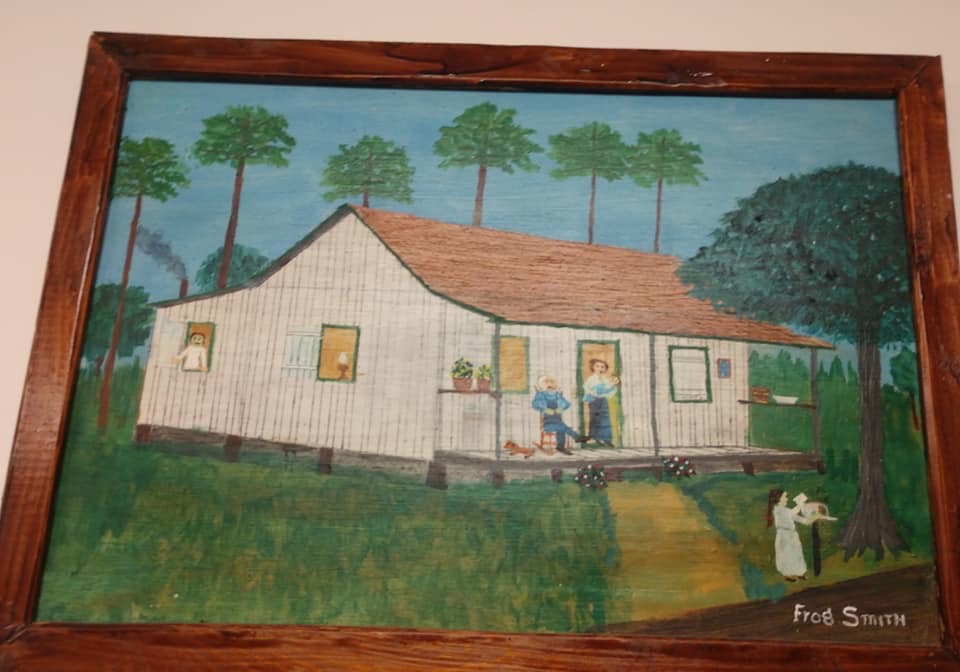
A painting by Ernest “Frog” Smith is displayed at the Southwest Florida Historical Society. The painting depicts a wood-framed “Cracker” house, designed for Florida’s hot and humid climate. -CRISTINA POPE / FLORIDA WEEKLY
“I started exploring the collection and realized what a true gem it is,” Schonberg said. “There’s just a fabulous number of things here.”
In roughly five years, Schonberg went from visitor to volunteer to president of the all-volunteer organization.
“Really, the mission of the society is both to preserve documents and also make them available and to really cultivate an interest in history locally,” Schonberg said.
That work is especially important in an area that has undergone dramatic change.
Farrell remembers when Fort Myers had fewer than 20,000 residents. She would take the bus down to Fort Myers Beach to visit her grandmother, who was a postmistress. There, they’d walk along the beach and pick up shells.
“There were shells everywhere,” she said. “Now there are so many people coming that it’s hard to find shells anymore as we used to.”
Schonberg says it’s all about carrying on what’s left.
“While there’s been a lot of change in the area, a lot of that history still remains,” he said. “It’s all about making sure that people know that.”
While the society is growing in visitors and artifacts, they run on a modest scale. The organization is entirely run by volunteers and operates on financial gifts from generous donors. Society members organize fundraising events throughout the year, but Schonberg says they can always use more help.
“We’re not paying salaries, so it’s really maintenance of this 100-year-old building,” he said.
Next projects for the Little Yellow House include ongoing efforts to organize the collection and to digitize old photographs so they can be more accessible to the public.
“I hope that visitors come in and learn a little bit more about the history of this area, and they realize just how fascinating it is,” he said.
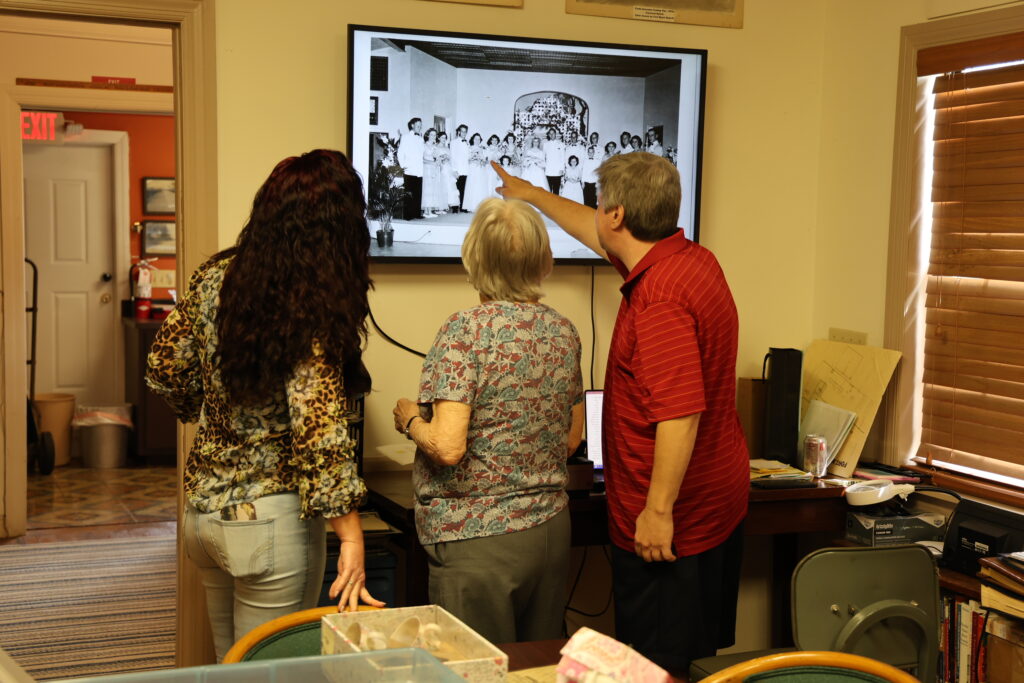
Society members Jean Gray and Genevieve Bowen and society president Stephan Schonberg identify past residents in an old photograph. -CRISTINA POPE / FLORIDA WEEKLY