
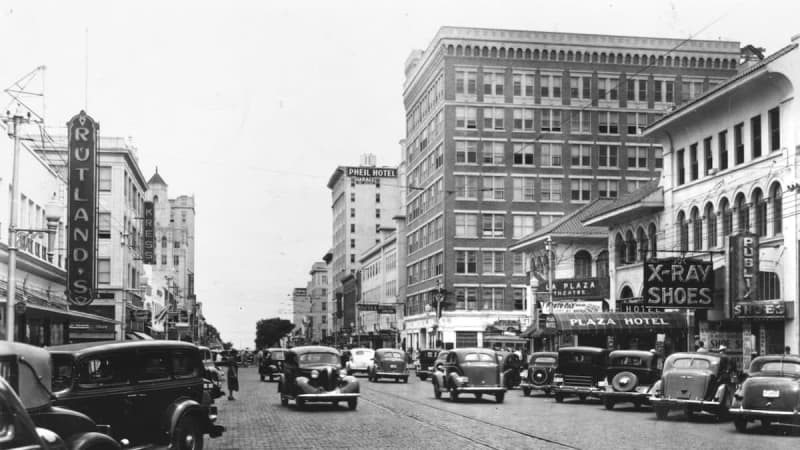
On New Year’s Day 1930, Floridians felt whiplashed from the brutal ending of the wildest decade in the state’s history. Like a titanic roller coaster, the 1920s had brought unimaginable prosperity — and loss — to the Sunshine State.
Looking back at what became known as the Roaring ‘20s, F. Scott Fitzgerald captured the decade’s essence: “America was going on the greatest, gaudiest spree in history.” And nowhere was that spree greater, gaudier — and greedier — than in Florida.
But by New Year’s Day 1930, the frenzied boom — and the fortunes of those who fed it and fell for it — had folded like a paper airplane.
St. Petersburg provides a dramatic example of the roller coaster ride. In 1925, bank deposits in the city rested at $46 million, along with $24 million in building permits. By 1932, St. Petersburg bank deposits plunged to $4.6 million, and the value of building permits fell to $278,000.
Jacksonville’s Welfare Federation reported in 1931 that 24,000 people in Duval County were “facing starvation.” Desperate families overwhelmed welfare institutions.
In the cities, steel skeletons, once a symbol of prosperity and pride, rusted. The skeletons stood for decades. The Great Depression and a failed marriage devastated circus king John Ringling’s health and fortune. George Merrick, the developer of Coral Gables, lost everything, accepting a job as a postmaster. Miami Beach mogul Carl Fisher boasted a portfolio estimated at $25 million in 1925 but was left penniless after the crash.
Examples of humanity and generosity occurred. Neighbors and churches did their best. In Tampa, the Spanish, Cuban and Italian voluntary associations maintained social clubs and hospitals. In Lakeland, the United Brotherhood of Carpenters erected a retirement home for its members.
TheNew York Sungauged the public mood of Florida in a remarkable 1930 article:
Absolutely unique among the 48 states.
Crowded with curious and fascinating things.
The only state in the Union favored by nature with inexhaustible and dependable steam-heating plant. Bigger than all of New England with Massachusetts left out… A million sunseekers pour in by railroad, steamship, motor car, airplane, and even bicycle…
A national winter playground
Florida was a vast state, yet in 1930 its population was small and scattered. The 1.47 million residents comprised less than 1% of the U.S. population.
Florida claimed the title of America’s South Star, luring nearly a half-million new residents during America’s darkest decade. Images of Floridians in the 1930s toasting the new year and dancing the jitterbug included many seniors. An affordable state of balmy winters and no income tax, Florida was fast becoming America’s Fountain of Youth.
Those seniors dancing on New Year’s Eve in 1940 became the first generation of Americans to receive a monthly Social Security check — an average of $22 a month in 1939. No city in America rivaled St. Petersburg’s relationship with seniors. In winter, the green benches of the “Sunshine City” served as a welcome mat for retirees from Keokuk, Kaskaskia, and Kokomo. By 1940, 1 in 5 city residents was 65 or older, an extraordinary demographic inflection point.
Urban life was not always urbane. American society in general, and Florida neighborhoods were divided along class, racial and ethnic lines. Every city had pockets of grinding poverty and wretched conditions, identified with nicknames such as “the Scrub,” “Lincolnville,” “Colored Town” and “Frenchtown.”
Many communities developed economic niches. Sanford and Sarasota claimed the title, “Celery Capital,” while Plant City and Starke vied for “Winter Strawberry Capital.” Citrus labels advertised Frostproof oranges, Dunedin grapefruit and Fort Myers lemons. Apalachicola oysters earned high marks, while Fernandina shrimp, Sanibel scallops, Okeechobee catfish, Mayport porgies and Barron River stone crabs boasted national reputations.
Most of all, Florida was a land of contrasts and contradictions. It alternated between an American Mediterranean, a rural backwater, a former paradise forfeited to avaricious phosphate and timber companies, and a tourist trap baited with honky-tonk jook joints, alligator farms and shady land salesmen.
Everywhere, one found extremes. In Palm Beach, some of the world’s wealthiest families lived in Old-World style mansions and shopped on Worth Avenue. Just miles away, Black and Caribbean farmworkers toiled under the blazing sun in Reconstruction-like conditions. Like the Peter Paul Rubens paintings hanging in the John and Mabel Ringling Museum in Sarasota, Florida was a place of brilliant sunshine and dark shadows.
No shadow was darker than the racism that prevailed throughout the state.
In 1930, Florida staged more lynchings than any other state. Even liberal politicians such as Claude Pepper, who joined the U.S. Senate in 1936, caved to public sentiment, voting against anti-lynching legislation.
The 1930s reinforced what everyone knew, but that every North Florida legislator wished to forget: The region was losing ground to Central and South Florida. By the eve of Pearl Harbor, Florida had become the South’s most urbanized state, as two of every three residents lived in a city.
African Americans were leaving Florida, part of the Great Migration. During the 1930s, 28 of the state’s 67 counties lost Black residents.
In 1940, when Florida legislators posed for a group portrait, it was a sea of masculine white faces. No Hispanic, Black, Republican or female lawmakers answered the roll call.
African Americans exercised little political power. The White Primary had been established in 1897 to bar from the Democratic Party anyone whose admission violated “the purity and integrity of the party.” Since the Democratic Party was effectively the only relevant party, this rule meant, as the Tampa Morning Tribuneboasted in 1905, Black people’s “right of suffrage is only a name.”
The White Primary survived the Great Depression, as did the Ku Klux Klan, which terrorized African Americans throughout the decade.
The United Daughters of the Confederacy maintained the drumbeat of the “Lost Cause,” erecting monuments, cultivating politicians and lobbying to ensure that sympathetic textbooks presented their view to schoolchildren.
An overview of Florida’s professional classes is revealing. Census takers surveying the entire state in 1940 enumerated 2,015 white engineers but no Black engineers, 365 white chemists but no Black ones, 2,652 white lawyers and nine Black attorneys. Black women faced even more daunting occupational prospects. The census discovered large numbers of Black female “domestics.” Huge numbers of Black men and women worked Florida’s agricultural fields.
Prejudice was not limited to race. Antisemitism was prevalent and unabashed. Posh hotels in Miami Beach posted signs reading, “Exclusive Gentile Clientele,” and signs on apartments warning, “GENTILES ONLY.”
Peter Finley Dunne’s cartoon character, Mr. Dooley, complained that historians were only interested in what ancient Greece and Rome died of. He insisted, “I want to know what they lived of.” Times may have been hard, but there was a feeling of shared community and purpose.
In 1979, I interviewed Angelina Comescone. She remembered, “If someone was sick, all the neighbors came with different remedies. … In the evenings, our parents would take us walking. We all loved one another. We sang as loud as we could, Italian, Spanish and American songs. Other children would sing back at us while doing their housework. It was beautiful then.” She added wistfully, “Nobody walks anymore. Nobody sings anymore.”
Although money was scarce, simple pleasures were cheap. America’s most popular soft drink, a 6-ounce bottle of Coca-Cola, cost only 5 cents. Pat Munroe, a banker in Quincy, appreciated the soft drink so much that he encouraged his customers to purchase the company’s stock. By 1940, so many had done so that the town of 3,888 residents was the richest per capita in the United States.
Few things offered tourists and residents more pleasure than cheering Babe Ruth and Lou Gehrig of the New York Yankees at Crescent Lake Park in St. Petersburg.
The introduction of “talkies” ushered in a golden age of American cinema, and Floridians flocked to movie theaters to enjoy an escape from reality. From Orlando’s Art Deco Roxy to Jacksonville’s neo-Georgian Imperial, to the Tampa Theatre, many of the theaters were architectural gems. The Florida Theatre in St. Petersburg exemplified Mediterranean Revival architecture with its mosaics and marble floors, along with a towering ceiling and stage.
The 1930s ushered in an alternative film experience — the drive-in theatre. Florida’s first, Miami’s Loew Drive-In, opened in 1938. Baptist preachers railed against this newfound “passion pit.”
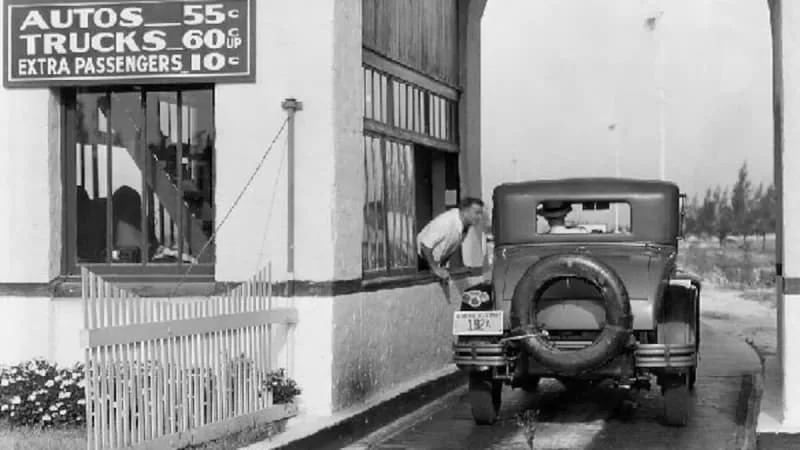
The Ford Model T and Chevy roadster changed the face of Florida tourism. “Tin-Can tourists headed to places such as Sebring and Bradenton, where new municipal trailer parks welcomed visitors and their dollars. Fueled by New Deal investment, Florida enjoyed a flurry of road building, connecting previously isolated towns.
By the late 1930s, Florida was emerging from the Depression. In 1933, the Depression’s leanest year, Floridians earned a total of $423 million. In 1941, their incomes soared to $1.05 billion. “The people of Florida are now eating high on the hog,” boasted former Gov. Fred “Old Suwanee” Cone.
Sports, especially baseball, offered Floridians and tourists escape and excitement. Major League Baseball devoted several months annually to spring training in the Sunshine State. During the 1930s, when the St. Louis Browns were “first in shoes, first in booze, and last in the American League,” the Browns and the vaunted New York Yankees called St. Petersburg home during spring training. Soon, spring training would be held in places such as Cairo, Illinois,
World War II thrust America into a new age.
Gary R. Mormino is professor emeritus at the University of South Florida and an expert on the history of Tampa and the state of Florida.
This column is condensed from an essay that appeared in FORUM Magazine and is republished with permission. Become a Florida Humanities member to have the award-winning FORUM Magazine delivered to your door three times a year. Visit Floridahumanities.org/membership.