
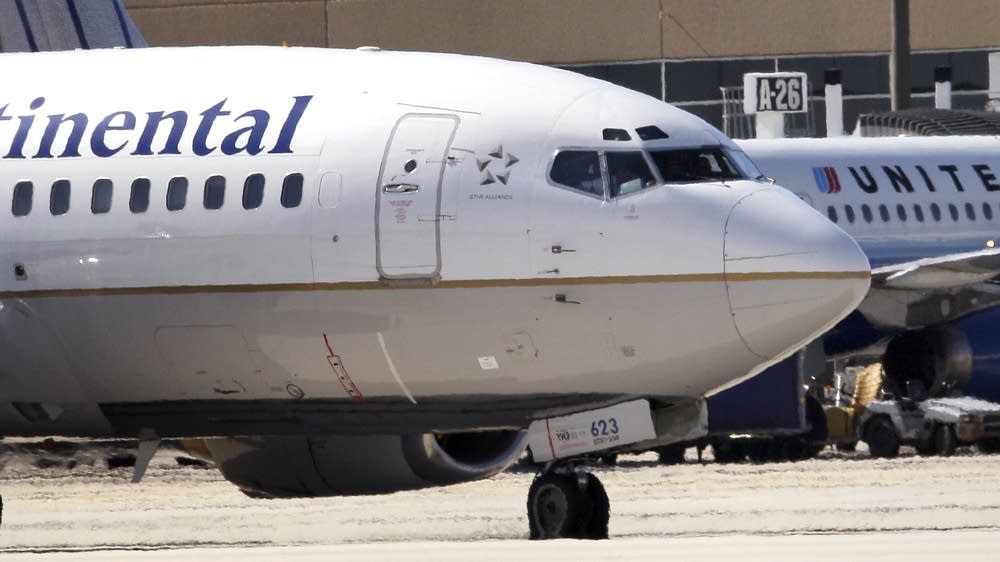
Michael Goldberg remembers life back when Cleveland was a hub for Continental Airlines.
“It feels like you’re kind of on the map as a significant metro area, when you have sports teams and when you’re an airline hub,” said Goldberg, a professor in the School of Management at Case Western Reserve University.
But then, in 2010, after the Cleveland Browns placed last in their division again, Continental merged with United Airlines. That meant United now had hubs in D.C., Chicago, Newark and Cleveland. It didn’t really need all of those. So, four years later, Cleveland got axed.
“The number of direct flights into our airport started decreasing, and that led to a whole bunch of challenges,” Goldberg said.
The airport lost dozens of nonstop destinations. It shut down its fourth — and newest —concourse, which still sits empty 12 years later. Today, Clevelanders still talk about how air travel was better back before United bailed.
“There’s a certain ding to your civic pride that I think carries with us,” Goldberg said.
The Fort Lauderdale-Hollywood area could be facing a similar fate. Until this month, it served as the main hub for Spirit Airlines. The demise of Spirit Airlines is a blow to the region around its main hub, Fort Lauderdale-Hollywood airport.
“I’m very concerned. Any time we lose a homegrown company, and they go under, and they’re the size of Spirit, it’ll take the wind out of your sails,” said Dan Lindblade, CEO of the Greater Fort Lauderdale Chamber of Commerce.
The airline employed 4,000 people in the area, Lindblade said. It’s too early to say what’ll happen to the number of flights or direct connections long-term. But short-term, Lindblade said other airlines are picking up the flights that Spirit dropped.
A similar thing happened to Cleveland, which led to one shiny silver lining.
“Fares went down considerably. The market became much more competitive to serve because more airlines were serving it, and the average fares went down dramatically because of the competition,” said Baiju Shah, who leads the regional chamber of commerce called the Greater Cleveland Partnership.
In the end, Cleveland’s airport is serving more passengers now than it did before the merger, even though it has fewer nonstops. Frontier recently added flights, and United is still one of the airport’s top airlines.
But Cleveland’s story and Fort Lauderdale’s aren’t apples-to-apples.
”United was the high-cost carrier, not the low-cost carrier. And so when they liberated gates, fares went down. Fares could go up in Fort Lauderdale,” Shah said.
Fort Lauderdale-Hollywood airport also has competition, because the much larger Miami International is just 30 miles away. Cleveland doesn’t have that kind of competition.
But South Florida definitely beats Cleveland as a spring break or beach vacation destination.
“Passenger volume is significant. It’s a business and a leisure destination,” Shah said. “I think they’re going to be fine.”
Related Topics