
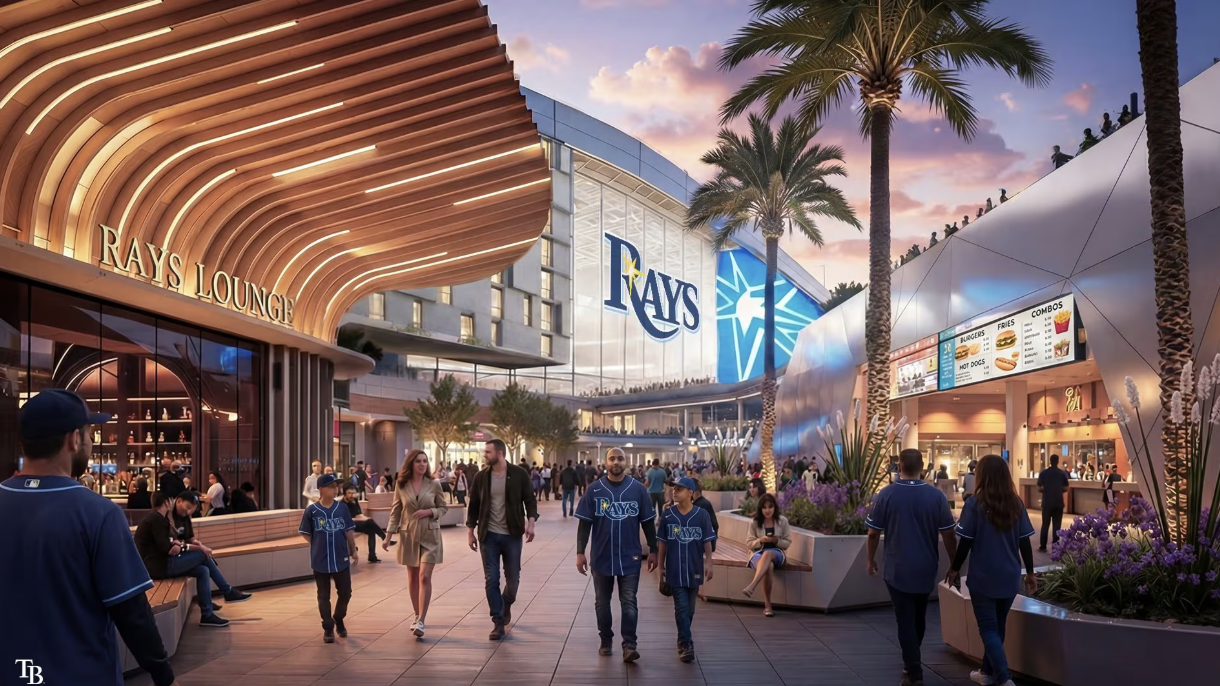
The Hillsborough County commission and Tampa city council look set to vote tomorrow and Thursday, respectively, on a nonbinding MOU for a Tampa Bay Rays stadium project requiring about $976 million in city and county tax dollars plus $839 million in property tax breaks and at least $250 million in free land for the stadium site, coming to just over $2 billion in subsidies for a stadium that will cost $2.3 billion. Let’s hear what some of the main players have to say for themselves:
Tampa council chair Alan Clendenin wrote an op-ed in the Tampa Bay Times declaring that this one will be different, because unlike when Tampa gave money to the Buccaneers owners for an NFL stadium and the New York Yankees owners for a spring training facility and the Lightning owners for an NHL arena, this is “an expansion of that successful public-private model to an entirely new level” and “a city building deal” that will “create tens of thousands of jobs and generate new tax revenues that can help improve parks, roads, infrastructure and future transit opportunities” [citation extremely needed].
Rays CEO Ken Babby got a column worth of softball questions from Florida Politics (with “assistance from AI,” okay then), which he used to assert that the stadium district will generate “$55.5 billion in economic impact” (as reported previously, this is a largely meaningless number based entirely on assuming the team’s projections are correct), that “there will be no new taxes to fund this project” (only true if Tampa and Hillsborough County don’t have to raise taxes to fill in the resulting budget holes, which LOL) and that it would be “the largest private investment by a sports team in Florida history” (also the largely public investment in a privately controlled sports stadium in Florida history, but who’s counting?). Babby also got his own TB Times op-ed space, alongside Hillsborough College president Ken Atwater, to assert: “This is not merely a ballpark project. This is the definition of transformation” (but in which sense of the noun?).
County commissioner Joshua Wostal, also speaking to Florida Politics, said of the new MOU, “if anything, it may have gotten worse,” and that the increase in county Community Investment Tax spending from $272 million to $360 million would eat up more than half of the tax’s revenue between 2027 and 2030, with the result that “we’re going to have to delay a significant amount of projects.”
Tampa council member Charlie Miranda told Florida Politics that the new MOU is “all about pie in the sky and that everything is going to work out. Well, that’s not the way I do business.”
Tampa Mayor Jane Castor assured residents in her weekly newsletter that the nonbinding MOU is “less like a contract and more like a handshake with a witness,” so all good to agree to it and then figure out what it actually means later.
UPDATE: Late addition to the TB Times op-ed section this morning: Five former local elected officials say current elected officials should “just say no”: “The owners of the Rays need to be in the Tampa Bay market much more than we need them to stay. So, elected officials, call their bluff.”
It seems likely — though by no means certain — that the county and city will okay the nonbinding MOU this week. After that, it’ll be up to the state legislature to decide if that’s enough local skin in the game for Florida to hand over state land and funds, or if it will wait until there’s a binding MOU. And after that, it’ll be up to the city and county to turn that handshake into a contract — something that could go more smoothly once the project gets state approval and seems like a fait accompli, or could run into even more opposition if, I dunno, Tampa Bay gets hit by another hurricane, say. But don’t worry, that probably won’t happen unless … oh. Oh. Maybe don’t place your prediction market bets on a new Rays stadium just yet, at least until you see the fall water temperatures in the Gulf of Mexico.