
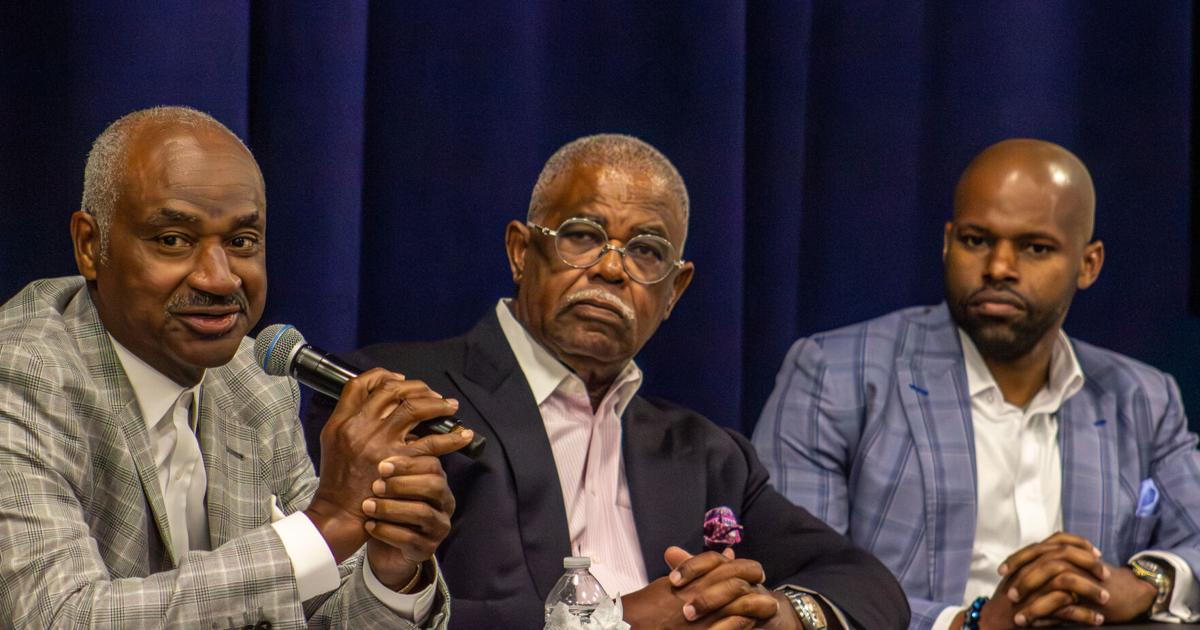
On Thursday, May 14, Black stakeholders across South Florida convened at the Marshall L. Davis African Heritage Cultural Arts Center for an annual community meeting known as The State of Black Miami 2026, held by the Miami-Dade County Black Affairs Advisory Board (BAAB).
According to Retha Boone-Fye, BAAB program director, six advisory boards in the Office of Community Advocacy will soon be rolled back as a result of SB 1134, a new law banning local DEI funding beginning Jan. 1, 2027. Black Affairs is one of those six, making this meeting the last of its kind.
The event presented five distinct panels that addressed some of the most pressing issues in Black Miami today. On each panel, experts from the community spoke to the advancement of the African diaspora in South Florida.

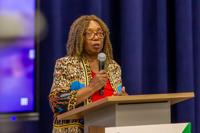
Retha Boone-Fye welcomes the audience to The State of Black Miami 2026.
(Elisabeth Campbell for The Miami Times)
“We may not have all the answers,” said Pierre Rutledge, chair of the BAAB, at the beginning of the event. “We may not solve even one problem, but this dialogue helps us. This is the only board that is the official voice of the African American community. I’d like to think that everyone leaves here having learned something.”
It was clear from the start, however, that some attendees desired more than just dialogue. Several audience members posed questions about how to implement change in more tangible ways.
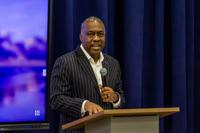
Pierre E. Rutledge introduces the first panel of speakers at The State of Black Miami 2026.
(Elisabeth Campbell for The Miami Times)
One concern involved the voting process. A panel entitled Criminal and Social Justice Outcomes, moderated by Dr. Jonathan Spikes, focused on the importance of enfranchisement in the Black community. When Spikes spoke to the power of voting in shaping policy, an audience member responded by asking how going to the polls will help in the context of a partisan government that has “betrayed” Black voters.
Last month, the Florida Legislature approved a new congressional map that significantly reshapes the state’s voting boundaries, altering districts with sizable Black populations to favor Republicans.
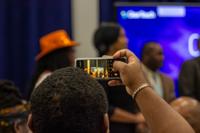
The audience of The State of Black Miami 2026 was made up of diverse attendees from across South Florida.
(Elisabeth Campbell for The Miami Times)
“We’ve got to show up in greater numbers,” replied panelist and former state Sen. Dwight M. Bullard. “Florida is the state with the third largest number of Black people in the country; some argue it’s the second. But the question is, what are we willing to do with it?”
Other panels addressed Youth and Education, Housing Affordability, Health Equity, and Economic Development and Mobility.
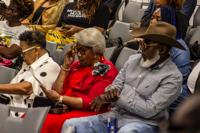
An attendee at The State of Black Miami 2026 reviews the program.
(Elisabeth Campbell for The Miami Times)
Gale Nelson, president and CEO of Big Brothers, Big Sisters of Miami, spoke to the importance of representation.
“They say if you don’t have a seat at the table, you’re most likely on the menu,” said Nelson. “Now is not the time for us to say what others have taken from us, but to reinforce who we are.”
Other panelists argued that the current state of the Black community owes itself to a lack of vision. To move forward, Black residents must honestly assess where their communities are.
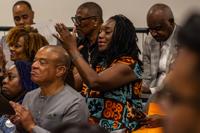
The audience of The State of Black Miami 2026 applauds the panelists after their presentation.
(Elisabeth Campbell for The Miami Times)
The Rev. Charles Dinkins founded the Hosanna Community Foundation, a nonprofit outreach organization that provides comprehensive prevention and intervention plans to high-risk neighborhoods in Miami’s Black communities.
“I’m old enough to realize that when the world was most anti-Black, we were the most prosperous and the most productive,” said Dinkins. “We’ve been talking about this stuff forever, but we have yet to implement a plan.”
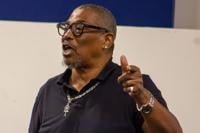
An audience member voices his concerns at The State of Black Miami 2026.
(Elisabeth Campbell for The Miami Times)
One recurring talking point was the change in the nation after President Donald Trump’s inauguration. Some claimed that the current administration has less regard for vulnerable populations than past administrations, leading to regression in the Black community.
According to The Grio, the Black unemployment rate reached 8.3%, its highest level since the COVID-19 pandemic, under President Trump’s second-term economic and domestic policies. As a result, millions of Black Americans are left jobless and unable to maintain themselves and their families during the U.S. affordability crisis. This, coupled with the anti-DEI agenda, puts hard-won progress in racial equality across the nation under threat, including within the medical field.
“The mistrust of the medical system in general has been amplified post-COVID,” said Dr. Armen Henderson, executive director of the Dade County Street Response Team. “Overall, people’s health and their access to health have gotten worse due to rollbacks. Whole families have been decimated. I believe that we are worse off than we were before.”
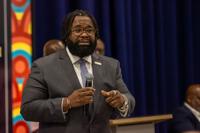
Ryan Hawkins gives a brief presentation about health equity at The State of Black Miami 2026.
(Elisabeth Campbell for The Miami Times)
Whether or not Black stakeholders are at the table became less of a concern when a panelist suggested that they’re not even in the room. Others argued that in order to advance within the current economic climate, Black communities must circulate the Black dollar in their own neighborhoods, fighting for opportunities now more than ever.
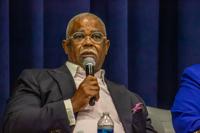
Bill Diggs discusses housing equality in Miami during The State of Black Miami 2026.
(Elisabeth Campbell for The Miami Times)
William “Bill” Diggs, executive director of the Miami Dade Economic Advocacy Trust (MDEAT), emphasized the importance of doing business within the community or, as he put it, “doing business with people who do business with us.”
“We are going to be the only generation where our children have done worse than we have,” said Diggs. “It’s not their fault, it’s ours. We need to pick whatever fight we want to pick and fight it. No one will fight it for us.”
Metris Batts, executive director of the Overtown Business Association, spoke to the importance of small businesses in creating job opportunities, noting that companies don’t support themselves. She advocated for involvement from Black churches and Black nonprofits to uplift Black businesses.
“We are the most unforgiving group of people when it comes to loving on us,” said Batts. “We have to tell our story to be part of the history of America.”
Each panelist argued that in their own sectors, change comes from the ground level, working within homes, schools, community organizations, businesses and medical facilities to create opportunities not only for this generation but for the next. There was a call for unity within the Black community to advance beyond survival to create generational wealth, better health outcomes and greater representation across the board.
“For some people, they play by different rules,” said Diggs. “We need to learn how to play by our own.”