
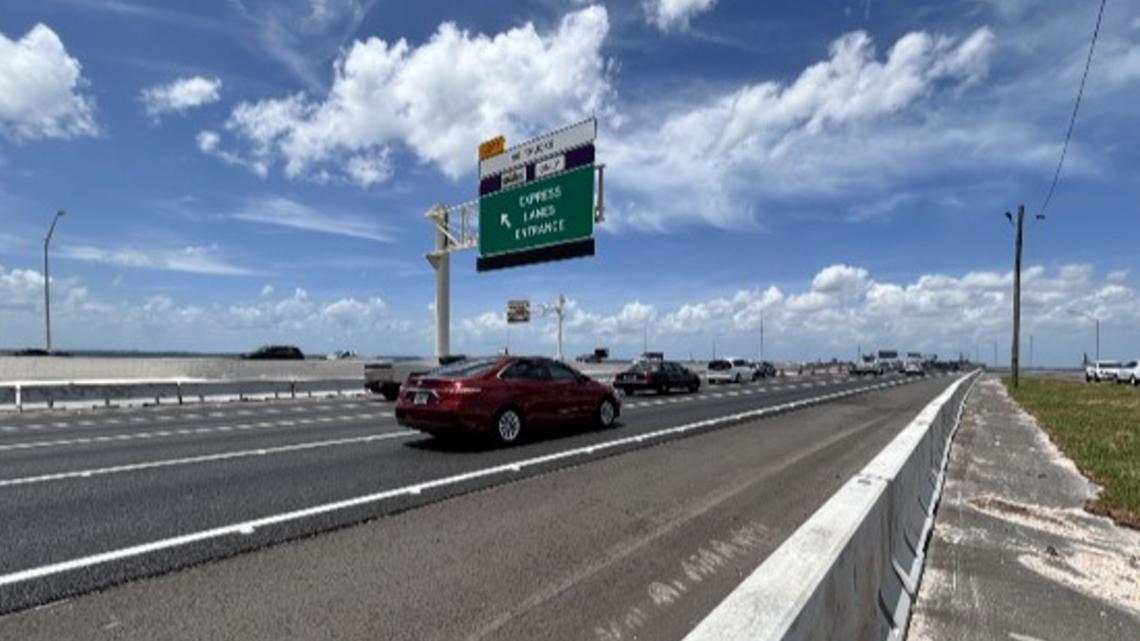
Transportation leaders say the lanes are designed to improve traffic flow and reduce commute times across the bay.
TAMPA, Fla. — Drivers crossing Tampa Bay could soon see relief on one of the region’s busiest bottlenecks.
The Florida Department of Transportation (FDOT) says the new express lanes on the Howard Frankland Bridge could open as early as this week, weather permitting, marking the final major phase of the massive $973.4 million bridge project connecting Tampa and St. Petersburg.
During a media preview Tuesday, FDOT officials offered reporters a behind-the-scenes look at the nearly completed toll-based express lanes, which transportation leaders say are designed to improve traffic flow and reduce commute times across the bay.
“As far as capacity goes, yes, this is the final full capacity of the bridge at its current configuration,” FDOT engineer Austin Petersen said.
The project adds four express lanes — two in each direction — alongside four general-use lanes on the new southbound span of Interstate 275. FDOT says the expanded bridge configuration could significantly improve traffic throughput.
“And that will obviously be adding a great amount of capacity that we can push through the bridge,” Petersen said.
The express lanes are not reversible, but Petersen said the added lanes will still improve evacuation capabilities during hurricanes and major emergencies.
“With the express lane opening, we will have an improvement in the throughput of the capacity of the bridge,” Petersen said. “We’re getting a wider bridge that will give increased capacity.”
The lanes are also expected to eventually connect with additional express lane systems on both sides of the bay.
“You get from end to end in an express lane,” Petersen said. “We do have plans in the future for connectivity on the east end of the bridge to additional express lanes.”
FDOT says the Tampa Bay region’s rapid growth has made expanding bridge capacity increasingly important.
“People are moving here every day. They’re here on vacation,” Petersen said. “So, yes, it’s a challenge that we have to try to meet to keep up with the demand.”
The project also includes a new 12-foot-wide pedestrian and bicycle trail linking Hillsborough and Pinellas counties.
Before the lanes can officially open, crews still must complete final striping work separating the express lanes from general traffic.
“Those are heavily weather dependent,” Petersen explained. “We can’t put down paint, we can’t put down the adhesive if we get weather.”
Drivers will need a SunPass or compatible transponder to use the express lanes. FDOT says the lanes will initially be toll-free, with tolls eventually expected to start around 50 cents per trip.
Some commuters told 10 Tampa Bay News they would consider paying the toll — depending on traffic conditions and how badly they need to get somewhere.
“If I have to be somewhere important, like work or anything, you know, I would just pay the toll,” commuter Uniqueika Walker said.
Others expressed concerns about the added cost.
“It just really depends upon how much traffic there’s going to be on the bridge,” commuter Ashley Sanchez said. “I mean, stuff is really expensive here right now, so I don’t think that people will be necessarily happy to pay more for it.”
Even after the express lanes open, drivers will still see ongoing lighter construction activity around the bridge through the remainder of the year as crews complete additional concrete work, roadway elements and testing of transportation systems, according to FDOT.