
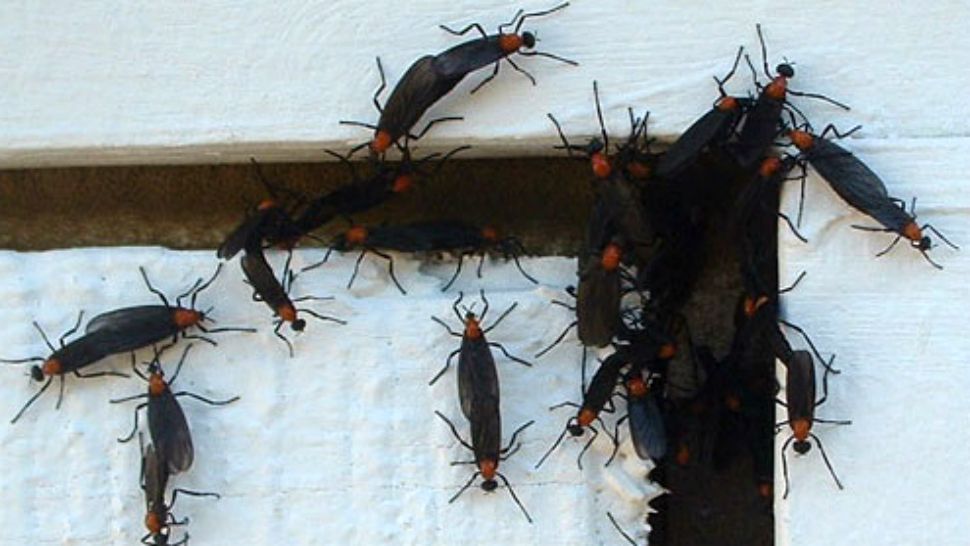
ST. PETERSBURG, Fla. — If you’ve stepped outside lately, chances are you’ve noticed swarms of lovebugs filling the air across the Tampa Bay region.
While this season’s invasion is winding down, these insects can still leave their mark.
On Wednesday morning, SDS Auto Detailing owner Noah Self scrubbed residue off a boat.
“Lovebug season is coming to an end, thank God,” said Self. “This year… it’s probably been the worst so far that I’ve seen. Being in the detailing industry, (we) kind of see them all over the place now. So man, they are a pain in the butt. I’ll tell you that much.”
He knows the impact these flying pairs can have.
“Florida and lovebugs together with your car? It’s not good, not a good combination,” added Self.
Self said if you drive on the highway, your car can get hit with these lovebugs.
That’s why it’s important to act quickly, as its dead body can get stuck on the car with the sun’s help.
He recommended reaching out within 24 hours for a detail. Self noted the longer you wait, the worse it will get.
“Because if not, it’ll sit on that paint, it’ll etch into your clear coat, and then you’ve got permanent damage that needs to be sanded out or polished out then it becomes a big deal if you don’t deal with it right away,” Self said.
Drivers can be preventative with a film, but if the damage is done, sanding can be an effective route to get rid of them.
“Sometimes you may be able to even polish the vehicle and that may get rid of them with a good compound and polish maybe a two-step polish and then afterwards you do the ceramic coating on that and that way you don’t got to worry about them again,” Self added.
University of Florida professor Dr. Norman Leppla, who specializes in integrated pest management and biological control, echoed the importance of removing lovebugs quickly.
“They aren’t harmful and they can be avoided (by) driving at night. They don’t fly at night. They aren’t active early in the morning or late in the evening, not in great numbers. So middle of the day is time to avoid them,” Leppla recommended. “Don’t plan on painting your home a light color in lovebug season. They come to the paint, they come to the car exhaust and heat, you’ll attract them.”
Leppla has noticed a decline in lovebugs in the last three to four years, but not this year.
Leppla called them unpredictable.
“Apparently it’s been moist enough for them this year,” Leppla shared.
At USF St. Petersburg, Dr. Deby Cassill is intrigued by these creatures.
The associate professor of biology exclaimed, “Every year the lovebugs come out and I adore them!”
She likes lovebugs because they don’t sting or bite.
“I find them kind of adorable,” Cassill smiled.
Cassill explained why she’s fascinated by them. The female lovebugs are in charge.
“Now it’s to the advantage of the female to mate with maybe several males, just to get diversity among her offspring. So the male has developed these gigantic claspers with teeth to hang on to her,” she said.
This prevents the female lovebug from mating with another.
From there, the pair takes flight, as the female drags the male.
“They fly in this way because it takes time for the male to move his sperm into the female’s body and it can take sometimes two to three days to make that transition from his body,” she said.
The reason the two continue flying? The duo has to eat.
“She flies around, finds nectar, and he has a drink. She has a drink. They pollinate the plants,” explained Cassill.
She said weather patterns may explain why some areas are seeing larger swarms than others.
“They’re going to come out based on local temperature and water conditions. So it’s less predictive because our weather is less predictive than it has been,” Cassill shared.
She explained that the recent drought played a role.
“It’s drying out the larval phase and it can kill all of a plot of land that isn’t being watered. They all die, so we’re seeing this kind of spotty populations of larvae because of the drought,” she added.
For Cassill, she loves these creatures for several reasons, including their role as pollinators and their ability to be good fertilizers.
“I see the lovebugs as a benefit to keep a lawn healthy,” said Cassill. “My attitude is that they’re a signal that it’s springtime and love is in the air for so many animals, mammals, reptiles and all insects. So it’s a time to be grateful because we’re growing crops, we will harvest them in the fall and these are cool little orange and black bodied insects, (they) are a sign of good weather coming.”
While they’re a nuisance for some, Dr. Cassill sees it as love in the air.
The next round will be back in August and September and these swarms can last about four weeks at a time.