
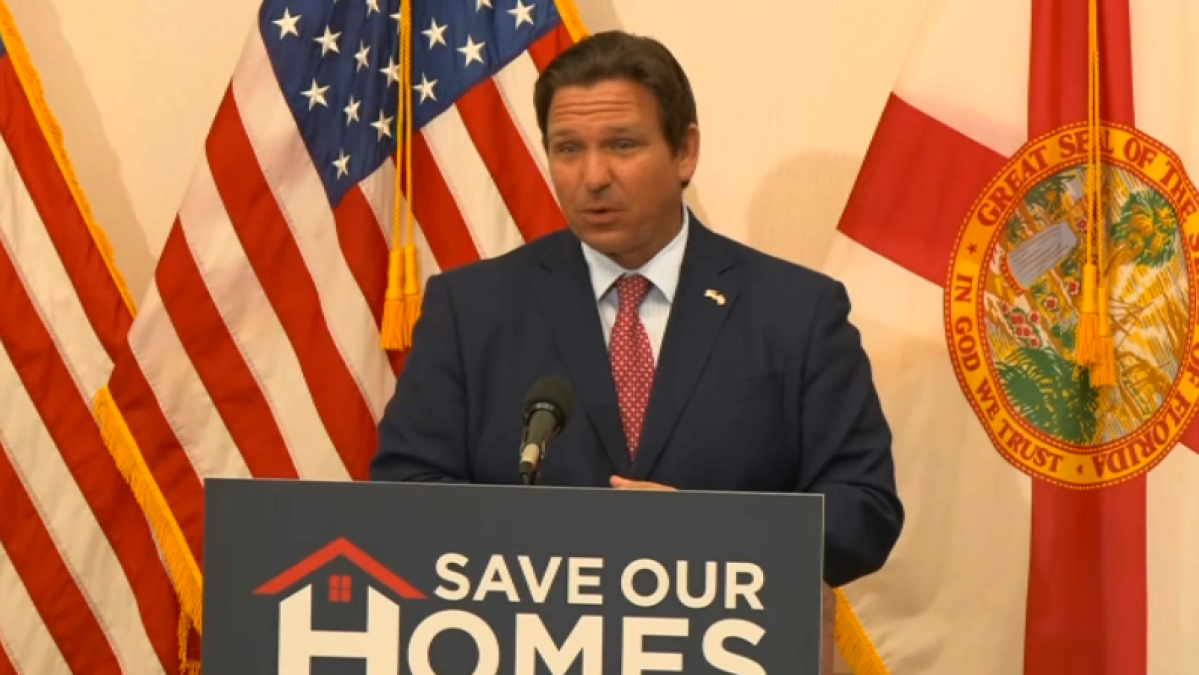
Florida Gov. Ron DeSantis said he would call a special legislative session for Monday to get an initiative on the November ballot to eliminate homestead property taxes.
“And that will be historic,” he said at a news conference in Tampa on Wednesday.
But, the governor said, the proposal will have to be “phased in” to ensure support from the Legislature and voters.
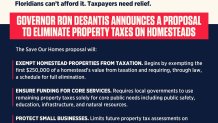
“And so the proposal… will begin with an initial raising of the homestead limit to $250,000 for all Florida homeowners, with then the Legislature commanded to enact a schedule that will lead to a full elimination of the homestead limit,” he said.
Under current law, homeowners can qualify for homestead exemptions from the first $25,000 of assessed value, and from the $50,000 to $75,000 portion of their assessed value for non-school taxes.
The state also offers “Save Our Homes,” for homeowners, which places a 3 percent cap on annual increases in taxable values of homestead property.
GOV. RON DESANTISGOV. RON DESANTIS
Gov. Ron DeSantis’ shared his plan to eliminate homestead property taxes in a news conference on May 27, 2026. He shared this graphic on his Facebook page.
The increase to $250,000 “would eliminate property tax for 60 percent of Florida homeowners,” the governor said.
The amendment would require 60 percent of both the Florida House
of Representatives and the Senate to make it to the ballot. From there, it would require the approval of 60 percent of voters to pass.
Lawmakers have already completed one special session this year to pass new congressional districts, and are in the middle of another to complete the budget they failed to finish during the regular session.
“Focusing on Homestead I think is a way to show, look, we think that there’s too much money going from taxpayers to these local governments,” DeSantis said. “Obviously you’ve got to run services, but all the time the tax payers is having to pay more and more for basically the same level of services they would’ve gotten 10 years ago when their property tax bill was a lot less.”
The formal proclamation for the special session and the details of his legislation were not immediately posted.
At a news conference Wednesday, Gov. DeSantis called for a special legislative session for his property tax plan.
The potential impact on local budgets
In February, NBC6 Responds examined how the measure could impact homeowners if it passes.
An analysis from the Broward County Property Appraiser estimates that property owners would save an average of about $1,800 per year. Our analysis of data from the Miami-Dade County Property Appraiser shows that homeowners in Miami-Dade could see average savings of around $1,500 annually.
However, the measure would significantly affect local county and city budgets.
In Miami-Dade, our analysis of property tax data indicates the county could lose approximately $500 million in revenue. In Broward County, officials estimate a budget reduction of about $329 million.
At the city level, some smaller municipalities could be hit even harder because a larger portion of their budgets comes directly from homestead property taxes. Our analysis found that Cooper City could see a 35% decrease in its budget, Tamarac could face a 33% reduction, and Plantation could experience a 23% decrease.
Lawmakers respond
House Speaker Daniel Perez, R-Miami, issued a succinct statement that implied the governor’s proposal was not presented to legislative leaders before Wednesday’s announcement.
“The Florida House has already passed a proposed constitutional amendment to eliminate homestead property taxes,” Perez said in the statement. “We are pleased the Governor has finally gotten around to share an actual proposal. We look forward to reviewing it once we have received the language.”
The issue of tax cuts has been one of several divides between Perez and DeSantis for over a year.
Perez initially sought a reduction in the state’s sales tax rate. But as DeSantis increased his calls for lawmakers to enact a property tax proposal, the House introduced a series of property tax proposals in October.
One House proposal would have phased out the non-school homestead tax by increasing the exemption by $100,000 a year. The state Revenue Estimating Conference projected the impact to local governments at $4.4 billion the first year enacted, growing to $13.3 billion a year.
The House approved a proposal in February to eliminate most non-school homestead property taxes, but it failed to gain Senate support due to the effect on small counties expected to lose their tax base.
Florida Association of Counties deputy executive director Cragin Mosteller said the counties are up for the pending special session conversation, but it needs to be “grounded in real budget math and the long-term needs of Florida’s communities.
“Floridians want affordability, but eliminating property taxes does not eliminate the cost of infrastructure, emergency response, and other essential local services,” Mosteller replied in an email. “Those costs do not disappear — they shift somewhere else, often onto businesses, renters, and working families.”
Under DeSantis’ proposal, the property tax revenue that remains would only be able to pay for schools, law enforcement, fire and other core services. Also, it would set up a trust fund to help mostly rural counties without a large tax base, which has been a concern of Senate leadership.
DeSantis and Chief Financial Officer Blaise Ingoglia have traveled the state the past year criticizing local government spending, noting it has nearly doubled the past seven years.
On Tuesday, House Minority Leader Fentrice Driskell, D-Tampa, characterized the move to limit homesteaded property tax as “a boneheaded move.”
“Any cut, even though it might seem small in the grand scheme of things, could be devastating. There is no plan to make our local governments whole on the back end,” Driskell told reporters in a conference call. “Property taxes cover the costs of law enforcement and first responders. They make sure that you can visit the library without having to pay a fee. Once you start explaining these things, you start to understand that property taxes are not the real enemy here.”
This is a developing story. Refresh for updates.