

The latest pitch for property tax cuts from Gov. Ron DeSantis has both homeowners and cities around the state crunching numbers.
Homeowners want to know how much money they would save. And cities and counties want to know how much they would lose.
The governor called a three-day special session of the Legislature that starts on Monday to consider a proposed property tax amendment that would be placed on the November ballot.
The latest proposal would let voters decide whether to raise the state’s homestead exemption from $50,000 to $150,000 starting in 2027. The exemption would increase to $250,000 in 2028.
After that, the Legislature would establish a schedule to eliminate property taxes entirely for owner-occupied residential properties with homestead exemptions.
Property Appraiser Marty Kiar has crunched the latest numbers for Broward County, offering a detailed look at the impact in the first year and beyond for both homeowners and local governments.
His projections were calculated based on the 2025 tax year.
In Broward County, the average savings for a homesteaded property owner would come to $2,146 in the first year, according to Kiar’s analysis. The savings would jump to $4,129 in the second year.
And if property taxes were eventually eliminated altogether? The average savings would come to $5,278.
Property taxes for county services make up about 25% of a homeowner’s overall tax bill, with the remainder divided among cities, school districts and special taxing districts.
Broward County, home to 424,899 homesteaded properties, collected more than $1.8 billion in property taxes in 2025.
In the first year of tax cuts, 98,742 homesteaded properties in Broward would become fully exempt from property taxes because their assessed value is below $150,000.
In the second year, 189,000 homesteaded properties would become fully exempt from property taxes because their assessed value is below $250,000.
Should the property tax cuts go through, all cities would lose money. But those with a higher percentage of residential properties compared to commercial stand to lose more, Kiar told the South Florida Sun Sentinel.
He pointed to Pembroke Park.
Even if property taxes on all homesteaded properties were eliminated, Pembroke Park would lose less than $143,000, a mere 1.3% of the town’s property tax revenues.
But an overwhelmingly residential town like Cooper City would lose more than $17 million, close to 62% of its property tax revenue.
Parkland would be even worse off, losing more than $28 million, a staggering 75% of its property tax revenue.
Fort Lauderdale, with its heavy mix of commercial properties, would stand to lose close to $80 million, or 29% of its property tax revenues.
For Pembroke Pines, a town with more than 41,000 homesteaded properties, the loss would hit $53 million, or 44.6%.
Hollywood, where more than 31,000 properties are homesteaded, would lose $58 million, or 26.6% of its property tax revenues.
Broward County would lose $624.8 million, or 34.6% of what it receives in property taxes.
The Broward County School District would lose 35.7%, or $803.6 million.
The prospect of losing millions in revenue has sent shock waves through cities and counties statewide.
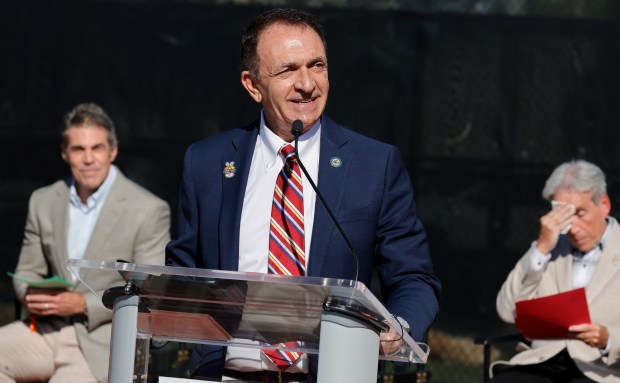 Fort Lauderdale Mayor Dean Trantalis, shown on Dec. 8, says he hopes voters understand what’s at stake if property tax cuts go through. (Carline Jean/South Florida Sun Sentinel)
“It’s voodoo economics 2.0,” Fort Lauderdale Mayor Dean Trantalis said. “If we lose income, we have to cut services. We may have to shut down our parks division. There will be no future raises for police and fire. I just think it’s a very short-sighted political tactic.”
Trantalis says he hopes voters understand what’s at stake.
“It’s going to cause a recession the likes of which Florida has not seen in decades,” Trantalis said. “It could push rents up. And people are going to be pushed out of their homes because we might have to raise taxes on their properties. The impact is going to reverberate in a way that’s going to be catastrophic.”
Kiar, a former state representative who also served on the County Commission, said he is not taking an official position on property tax cuts.
His analysis is meant for informational purposes only, he says.
“I believe that anything that’s placed on the ballot will be the most important vote that any person in Florida is going to make,” Kiar said. “Because it will essentially change the way things are. When you amend the constitution, it’s there forever. My goal is to provide all the information to the public so they can make the best, most informed vote possible.”
The governor needs approval from at least 60% of the Legislature for the proposal to make it onto the ballot for the Nov. 3 election. Passage requires approval from at least 60% of voters.
If the measure does make it on the ballot, most people are going to vote for it, predicts Kitty McGowan, president of Fort Lauderdale’s Edgewood Civic Association.
“There’s been so much talk of doom and gloom by the cities,” she said. “They’ve gotten fat and happy expecting all this revenue. I’m ecstatic. But most people think it’s not going to happen. And they’re not going to get their hopes up. It’s like, ‘I’ll stand by and see.’”
Homeowners are thrilled about the prospect of a tax break, said Chris Williams, president of Fort Lauderdale’s Coral Ridge Association.
“They’re saying, ‘Oh my God, this is going to be great,” he said. “People are going to vote for it. It’s not as catastrophic as when they were talking about eliminating property taxes for everyone. This is much more palatable.”
The impact on local government would be markedly less drastic in the first year and get more intense in the second year, Kiar’s analysis shows.
The county stands to lose $195 million in the first year, or 10.8% of its property revenues. In the second year, the losses would increase to $333.8 million, or 18.5%
The School District would lose $294 million in the first year, or 13.1%. In the second year, the losses would increase to $455 million, or 20.2%.
Fort Lauderdale, the county’s most populous city, would lose $14.5 million in the first year, or 5.3% of its property tax revenues. In the second year, the impact would increase to $26 million, or 9.4%.
Pembroke Pines, Broward’s second most populous city, would lose $20.7 million in the first year, or 17.5% of its property tax revenues. In the second year, the loss would increase to $36 million, or 30.3%.
Hollywood, Broward’s third most populous city, would lose $20.3 million in the first year, of 9.3% of its property tax revenues. The loss would jump to $33.9 million in the second year, or 15.6%.
Here are more details from Kiar’s analysis of the impact on Broward County:
$150,000 Homestead Exemption to be applied in Year 1
Number of Homesteaded Properties: 424,899
Average Savings for Property Owner: $2,146
Properties that would become fully exempt from property taxes: 98,742
Total Taxes Levied: $1,804,017,327
Total Taxes Levied if cuts in effect for 2025: $1,609,159,102
Total Tax Dollar Impact: $194,858,225 (10.8% decrease)
$250,000 Homestead Exemption to be applied in Year 2
Number of Homesteaded Properties: 424,899
Average Savings for Property Owner: $4,129
Properties that would become fully exempt from property taxes: 189,000
Total Taxes Levied: $1,804,017,327
Total Taxes Levied if in effect for 2025: $1,470,227,093
Total Tax Dollar Impact: $333,790,234 (18.5% decrease)
Full Elimination of Ad Valorem Taxes for Homesteaded Properties
Number of Homesteaded Properties: 424,899
Average Savings for Property Owner: $5,278
Properties fully exempt from property taxes: 424,899
Total Taxes Levied: $1,804,017,327
Total Taxes Levied if in effect for 2025: $1,179,209,687
Total Tax Dollar Impact: $624,807,640 (34.6% decrease)
Susannah Bryan can be reached at sbryan@sunsentinel.com. Follow me on X @Susannah_Bryan