
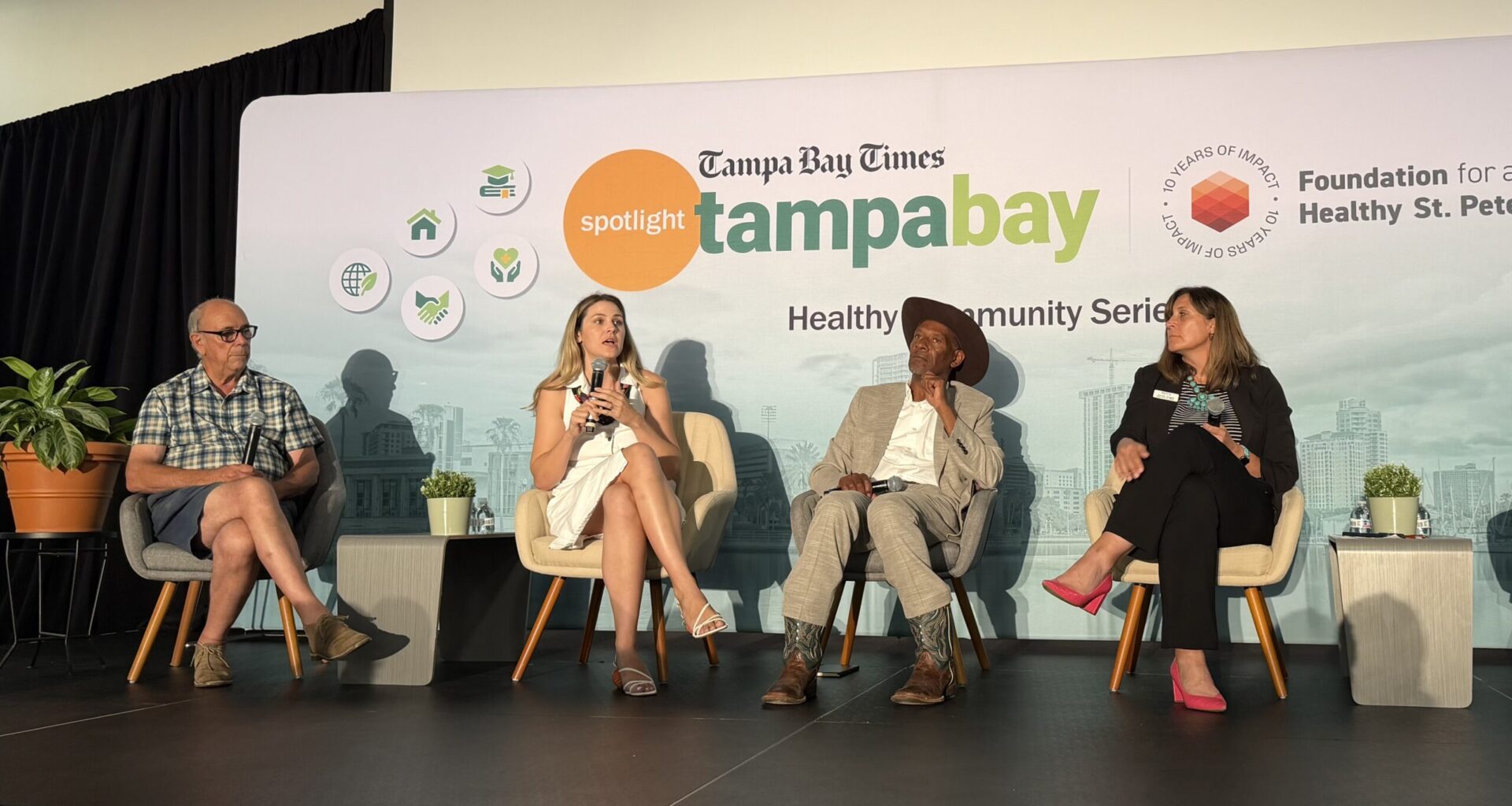
A group of panelists discussed the impact of food on the local community Thursday evening in St. Petersburg. Key themes included health, education and access challenges.
The panelists were 15th Street Farm founder Emmanuel Roux, Homegrown Hillsborough food system program coordinator Monica Petrella, Florida Black Farmers and Agriculturalists Association co-founder Howard Gunn Jr. and St. Petersburg Free Clinic CEO Jennifer Yeagley.
Gunn emphasized that it’s important to know “how the food gets to the table”; it’s critical to understand “exactly where the food is coming from.” He explained that farmers sometimes have a difficult time “trying to convince the public” that “health is your wealth.”
Education is key, Gunn added. People should learn about farming systems. Some growers may use fertilizers or chemicals to aid in the process, which can be ultimately harmful to eat. “Know your farmer,” he said.
Gunn cautioned the audience about purchasing processed food. Diet can lead to “preventable” health problems such as heart attacks, cardiovascular disease and diabetes. “We don’t live to eat,” he explained. “We eat to live.”
Roux agreed.
“It’s very simple,” he argued. “You are what you eat.”
A local food system is key. Supporting regional farms can not only have a major economic impact, but can help make nutritious food more accessible. “We have tremendous potential to expand,” Roux said.
He recommended exploring underutilized land to encourage more farming in the bay region. Community members could make an inventory of available real estate.
“I can assure you that the farmer in Central Valley, California who grows 150 acres of broccoli doesn’t give a hoot about the health, educational and social impact of his broccolis,” Roux added. “Because he cannot. On the other hand, the farmers who are in the community are entrapped with the consumers.”
The 15th Street Farm, a St. Petersburg-based nonprofit, has helped create more than 15 school gardens.
“We live in a society where we are disconnected from nature,” Roux said. “Food magically appears in the supermarket and magically disappears when you flush.”
He argued that every school should have a garden to help educate students about farming. This would allow them to experience it firsthand.
While eating healthy is critical, access is a problem that many members of the Tampa Bay community face. Yeagley offered a unique perspective. The St. Petersburg Free Clinic provides food and health services to thousands of people every month.
Food insecurity is prominent in the area, she said, due to a variety of economic factors. These include increased housing costs, utility costs and high grocery prices.
“The role that we play is to fill that gap for now,” Yeagley explained, “while all of these systems are catching up and while the economy hopefully is shifting.”
Individuals may not have the time to learn about healthy food, she added. They often do not have the ability to think about where their meals are “coming from.”
Yeagley invited the audience to “challenge” their “assumptions about food insecurity.” While there is a stigma, “we all need help sometimes.” She said that “neighbors helping neighbors is the fabric of community.”
Petrella emphasized the importance of taking action. People can start or join a nonprofit to help address food security.
“It can’t be an individual effort,” she said. “It can’t even be an individual institution, even if it’s the best funded organization in the world with a staff of 300.”
When community leaders “come together and bond around a common idea,” this can have a larger reach.
The event was sponsored by the Foundation for a Healthy St. Petersburg.