
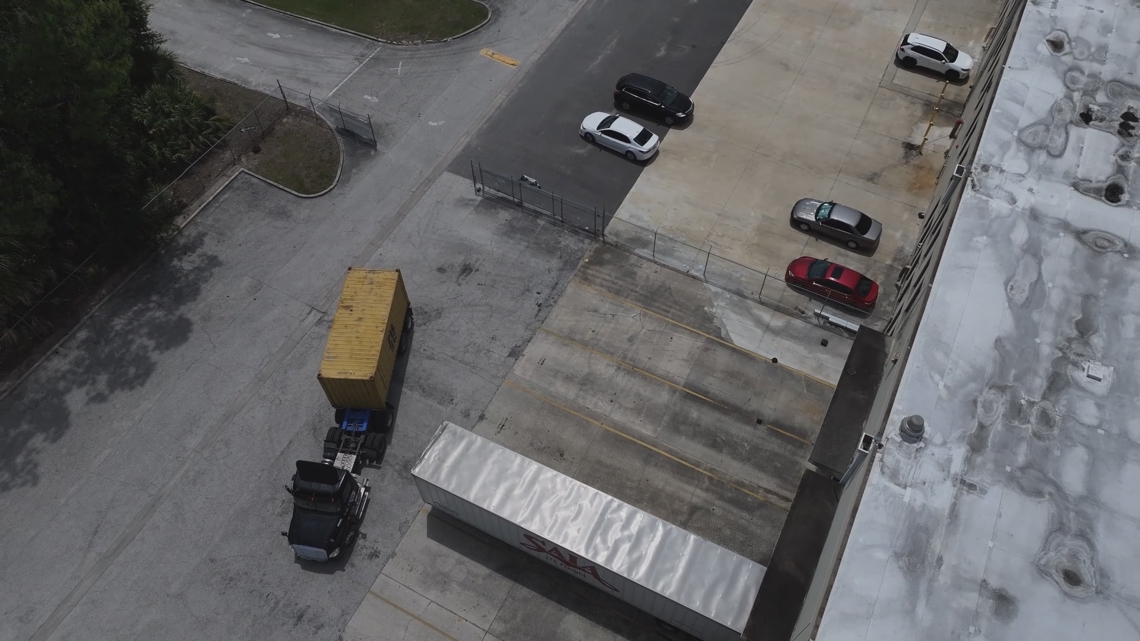
Jacksonville trucking companies are feeling the impact of a nationwide crisis.
JACKSONVILLE, Fla. — Hundreds of millions of dollars worth of goods ranging from food and toiletries to electronics are stolen every year as cargo thefts continue to rise across the trucking and transportation industry. Companies in Florida and Georgia are among those being impacted, with industry leaders warning that theft operations are becoming more sophisticated and more reliant on fraud and cybercrime.

This story continues below.
More in Investigations
Florida ranks among top states for cargo theft activity
Thomas Piatak is the head of risk management for Magellan Transport Logistics in Jacksonville. The company has grown into a one-stop-shop for transportation and logistics.
“Say you have a load going from Miami to Pittsburgh. If we have a carrier who’s down in the Miami area that’s looking to get up there, we can connect the two together and we’ll move that load for the customer,” Piatak explained.
Like many trucking companies around the country, Piatak said Magellan has been hit by cargo theft.
“It’s definitely something over the past two years that has been an issue…we were affected early on in the wave that’s come across,” Piatak said.
Piatak told First Coast News they have dealt with cases of identity fraud where someone stole a carrier’s information and posed as that company.
“They’ll pick up the load, they’ll hire another carrier who’s completely unwitting to this information, and they will pick up the load from Point A and instead of taking it to where we think they’re taking it, they’ll take it to another warehouse where it’ll be unloaded. They think they’ve done their job fine, and we don’t find out until two days later when it misses the other delivery. At that point it’s been offloaded at that warehouse, most likely put onto another truck, moved out from there, and all trace of it is gone,” Piatak said.
Cargo theft on the rise
It is problem that has grown over the last five years. Keith Lewis is the Vice President of Operations at Verisk CargoNet, a company that tracks cargo theft data. He said this trend got worse around the COVID-19 pandemic.
“From 2020 to 2024, we saw almost a 100% increase in overall in supply chain theft,” Lewis said.
According to data collected by Verisk CargotNet, there were 3,594 cargo thefts reported across the U.S. and Canada in 2025. The state of Florida, which ranked seventh in the U.S. for the most cargo theft activity, saw 124 thefts. Georgia ranked fifth in the U.S. for the most cargo theft activity and saw 132 cargo thefts.
Organized theft groups evolving
Industry leaders say the way cargo is being stolen has evolved and has become more sophisticated.
First Coast News spoke with a state trooper in the Florida Highway Patrol who investigates cargo theft crimes. He is not being named because of the nature of his work.
The trooper said cargo can be stolen in different ways, but it usually involves a major theft organization. Sometimes these MTOs commit what is called a straight cargo theft when a driver stops the truck to rest.
“These MTOs will take advantage of that and they will burglarize these semi trailers as they’re sitting to see what the freight is inside and see if it’s something that they’re going to steal,” the trooper said.
They are also using fraud to steal shipments. MTOs will hack a company’s online system to change names, manipulate email addresses, and even change trucking routes.
“A lot of these shipments and brokers for the transportation industry of moving cargo are utilizing online platforms to post these shipments to say, hey, we need this shipment to move from this location to this next location, and these major theft organizations are committing fraud to target these shipments online,” the trooper said.
Food and beverages are some of the top items targeted, making up 34% of the thefts in the state of Florida last year, along with vehicles and electronics. The trooper told First Coast News most of the stolen goods are taken to South Florida where they are sold.
“They’ve already coordinated with a fence of where his is going to, and it’s already sold by the time it’s even reported to law enforcement,” the trooper said.
Lewis said only about 10% of cargo thefts are reported to CargoNet.
“There’s no mandatory reporting. So let’s just take a small company that delivers a load and three or four boxes are missing. Well, the driver, got outcounted. The driver didn’t catch it at the truck stop when somebody took a few off. It’s not worth our time to report it to law enforcement,” Lewis explained.
Companies losing millions of dollars from theft
Once a company realizes their cargo has been stolen, then comes the process of reporting the theft and filing an insurance claim.
“You have to go through a stringent process with insurance, with law enforcement, reviewing everything we did on that shipment and with that carrier to understand where the gap did happen. So it takes a lot of time, a lot of resources from ourselves,” Piatak explained.
Verisk CargoNet estimates companies lost nearly $725 million worth of goods in 2025, a 60% jump from 2024. Lewis said those losses are felt by the consumers.
“It’s almost like this has become an accepted practice now. It’s just the cost of doing business and is, as we say, this is the new norm, so we bake this cost back into the price of goods,” Lewis explained.
Federal government taking notice
Industry leaders are now working on ways to curb cargo theft.
Joe Ohr, the Chief Operating Officer for the National Motor Freight Traffic Association, said they are focusing on cyber security and helping trucking companies get ahead of fraud.
“A lot of this starts with someone clicking on an email, someone getting access into the system. Some of it is real basic like use multi-factor authentication, before if you get a reroute, make sure you know who that reroute is coming from, make sure you have technology in your trailer,” Ohr said.
A spokesperson for the U.S. Department of Transportation told First Coast News the agency has collected feedback from the trucking industry and is currently putting together a full report that is due to Congress later this year. The U.S. House of Representatives also recently passed the Combating Organized Retail Crime Act to help tackle this growing crisis. It is currently being discussed in the U.S. Senate.
Piatak said Magellan has already adapted and changed the way they vet carriers and identify drivers. He now hopes more help is on the way to protect companies.
“Maybe a central point of command that can work with multiple different jurisdictions and different agencies and come back to them as the center point. That would be great for us,” Piatak said.