
Inside the voting booth on election day, a first-time voter studies the ballot, making their decisions carefully, as a simple checkmark carries more weight than any test or assignment ever before.
Floridians rush to the polls on Nov. 3 to vote in the midterm election. The election will decide Florida’s next governor, the U.S. Senate and House Representatives, local school boards and more.
Compared to presidential elections, midterm elections tend to draw less attention, especially from voters ages 18 to 25.
“Politics start affecting your life now more than before. You’re going to start paying taxes. You’re going to start worrying about the minimum wage in the state. You’re going to start to get worried about interest rates,” said Juan Diez, Community Services Education Director at Lee County Elections Office. “Most of those decisions are made by elected officials here at the local level, at the state level and at the federal level. All of these people that make those decisions are on the ballot.”
Story continues below advertisement
In the 2018 midterm election, Lee County had a total of 13,471 votes from voters ages 18 to 25. This decreased in 2022 to 8,371 voters in that age group. As of April, Collier County currently has a total of 21,272 registered 18-25 year old voters.
Collier County Supervisor of Elections and Lee County Elections Office are both making connections with colleges, like FGCU and Florida SouthWestern State College (FSW), as well as high schools all around their district, to continue to increase young voter registration and engagement for the November election.
“That’s what our office does,” said Alex Argueta, Outreach Coordinator at Collier County Supervisor of Elections. “We try to get ahead of that and warn [young voters]. We always try to beat them to the punch, so they’re not surprised when they get to the polls.”
How they are getting involved
Both election offices have a High School Voter Registration Challenge. The challenge allows the election office to attend high schools and put on a presentation to inform students about voting rights and requirements, how to register to vote, the three ways to vote, election dates, voting deadline and what will be on the ballot.
“I feel that this year, young voters are definitely more engaged than compared to previous midterm elections,” said Diez. “I have been working here [Lee County Elections Office] for nine years, but this year, I’m getting a lot of calls from colleges to have our office help them with voter registration.”
The Lee County Elections Office assisted FSW with its recent student government election through creating a mock election for students to vote for their student government. The elections office provides the ballots, voting booths, machines and “I voted” stickers.
Mock trials are also performed during high school student government elections in both Collier County and Lee County Schools.
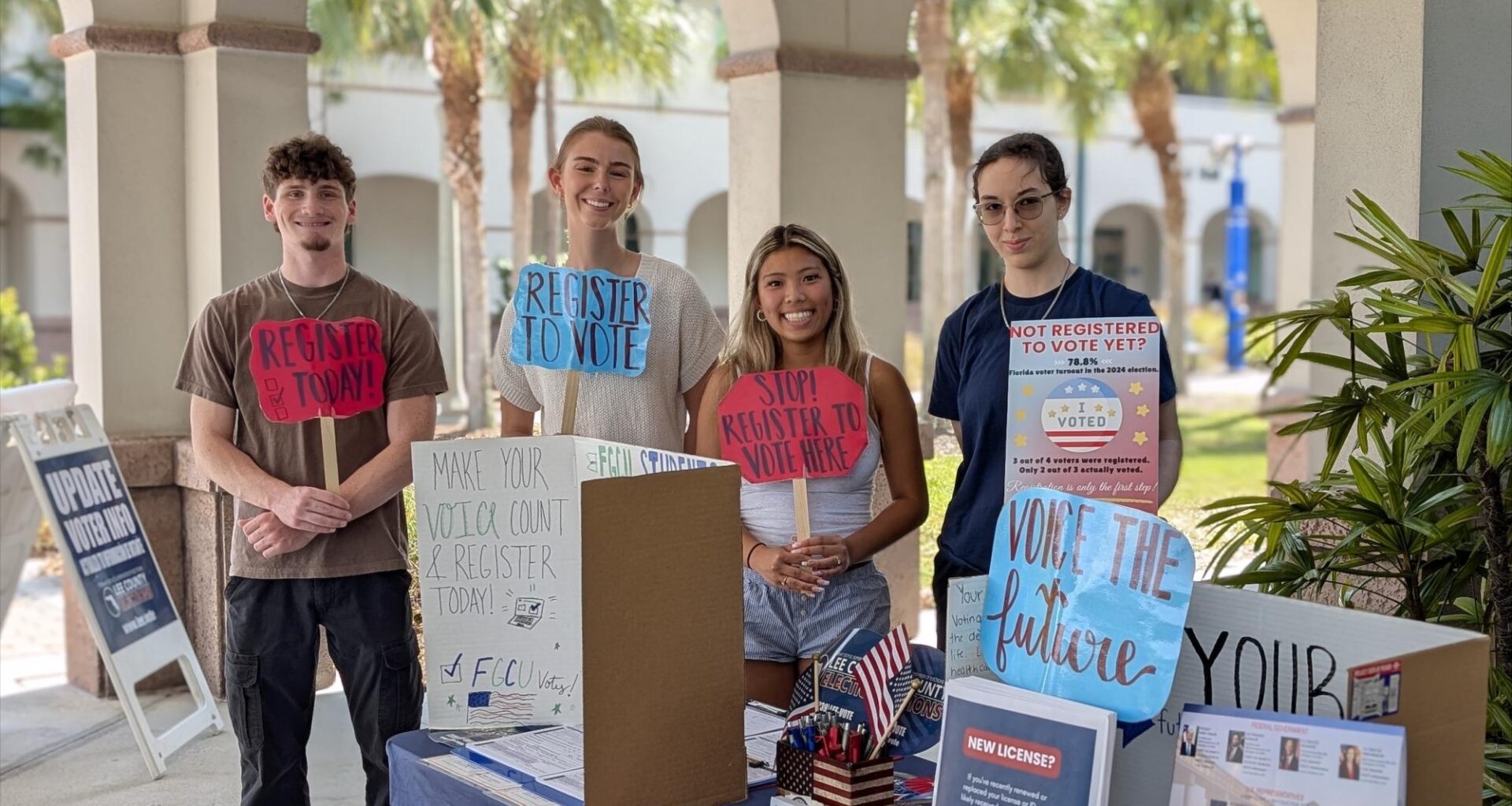
The Lee County Elections Office has also partnered with a political science professor at FGCU on a project that gets students more involved with voting.
This project divides the political science class into three groups. The first group research how elections work. The second group create media and posters from the research obtained by the first group. The final group sets up tables around FGCU’s campus to hold voter registration drives.
The goal is for all three groups to work together to help their peers register to vote by tabling.
“Talking to [students] and bringing the conversation to them has been very helpful in getting them engaged,” said Argueta. “We’ve seen some students who just want nothing to do with elections. They are not interested, or they don’t even want to register.”
Debunking common misconceptions
There are many misconceptions people have when it comes to voting. Registering to vote does not make one obligated to vote in every election. Registering allows one to vote only if they decide to.
All voters must be registered before Oct. 5, to vote in the midterm election in November. Those who have not registered before that date cannot participate in the election.
There are misconceptions about going to vote. Many people do not vote because they believe they can only vote on Election Day, but there are three ways to vote. A voter can vote by mail, during early voting at their designated polling place or vote on Election Day.
“We work hard to provide young people a path not only to vote but to become active in the process of elections and the civic duty of a United States citizen,” said Gage Griffin, vice president of College Democrats at FGCU. “Any change begins at the voting booth.”
Many young voters also face misconceptions about party affiliation when registering. Some believe they have to make the decision to be a Democrat or a Republican, but a voter can register to be whatever political party they desire. There is a No Party Affiliation option for those who do not want to be assigned to any political party.
Someone who is registered with a political party does not have to vote only for candidates in that political party and the beliefs that align with the political party. That is the foundation of the freedom to vote.
Those registered with a political party are able to vote in primary elections. The primary election decides the candidates that will be on the ballot in November. The primary for the Midterm election in Florida is taking place in August.
“We are the future, and we look around at our leaders, and they don’t look like us. They don’t talk to us. They don’t pray like us. They don’t believe in us,” Griffin said. “In the words of Nike, ‘Just Do It.’ Who you vote for matters. Not voting is forfeiting one of your fundamental rights as a citizen of the United States.”