
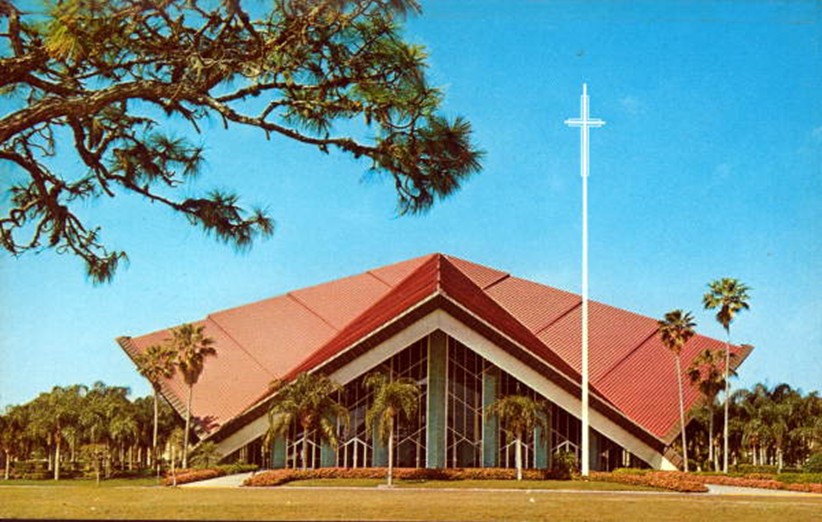
A prominent St. Petersburg landmark has landed on Florida’s annual list of endangered historic places.
The Florida Trust for Historic Preservation has named Pasadena Community Church to its 2026 “11 to Save” list, citing concerns over the future of the church’s iconic sanctuary following damage from Hurricane Milton.
The designation places the St. Petersburg church alongside 10 other threatened historic sites across the state. Another Tampa Bay-area location, Egmont Key State Park, was also selected because of ongoing threats from coastal erosion, hurricanes and deterioration of historic resources.
For local preservationists, Pasadena Community Church represents one of the most significant preservation questions currently facing St. Petersburg.
Completed in 1961, the sanctuary is widely regarded as one of the city’s most distinctive examples of mid-century modern religious architecture. Designed by architect Bertwin A. Moore, the building features a dramatic folded-plate roof and expansive glass walls that helped distinguish it from traditional church designs of the era.
The structure has served as a visual landmark along Pasadena Avenue for more than six decades. According to information released by the Florida Trust, the sanctuary reflects both the architectural experimentation of the postwar period and the growth of west St. Petersburg during the mid-20th century.
Its future became uncertain after Hurricane Milton struck the Tampa Bay region in October 2024. The building has remained closed since the storm. Earlier this year, church members approved a resolution to replace the sanctuary and adjacent Hamilton Building with a new worship center rather than pursue restoration.
Church leaders have said the decision followed months of study into repair options, engineering assessments and projected costs. Preservation advocates, meanwhile, argue that the sanctuary represents an important chapter in St. Petersburg’s architectural history and deserves additional consideration before demolition moves forward.
The debate reflects a challenge increasingly playing out across Florida. Buildings from the 1950s and 1960s are reaching an age where they qualify as historic resources, yet many lack formal protections and often require expensive repairs after decades of exposure to storms, humidity and coastal conditions.
Unlike older Victorian homes or early 20th-century commercial buildings, mid-century modern structures have only recently begun receiving broader preservation attention. As a result, many remain vulnerable when redevelopment opportunities emerge or major repair costs arise.
The Florida Trust’s annual “11 to Save” program is designed to draw attention to sites facing those types of threats. While the designation does not provide legal protection, it often helps generate community discussion, fundraising efforts and preservation planning.
Pasadena Community Church is the only St. Petersburg site included on this year’s list.
The second Tampa Bay-area selection, Egmont Key, highlights a very different preservation challenge. Located in Hillsborough County at the mouth of Tampa Bay, the island contains the historic Egmont Key Lighthouse, remnants of Fort Dade and archaeological resources dating back centuries.
The island’s historic assets are increasingly threatened by shoreline erosion and storm activity. Organizations including the Egmont Key Alliance have worked with state and federal partners to preserve both the island’s historic resources and sensitive natural habitats.
Together, the two selections illustrate how preservation threats can take very different forms. At Pasadena Community Church, the debate centers on whether a damaged but architecturally significant building should be restored or replaced. At Egmont Key, the concern is whether historic resources can withstand the environmental forces reshaping Florida’s coastline.
For St. Petersburg, the listing places renewed attention on a sanctuary that has been part of the city’s skyline since the early 1960s. The decision facing the congregation is ultimately local, but the inclusion on the state’s preservation watch list ensures it will now be watched well beyond the city limits.