
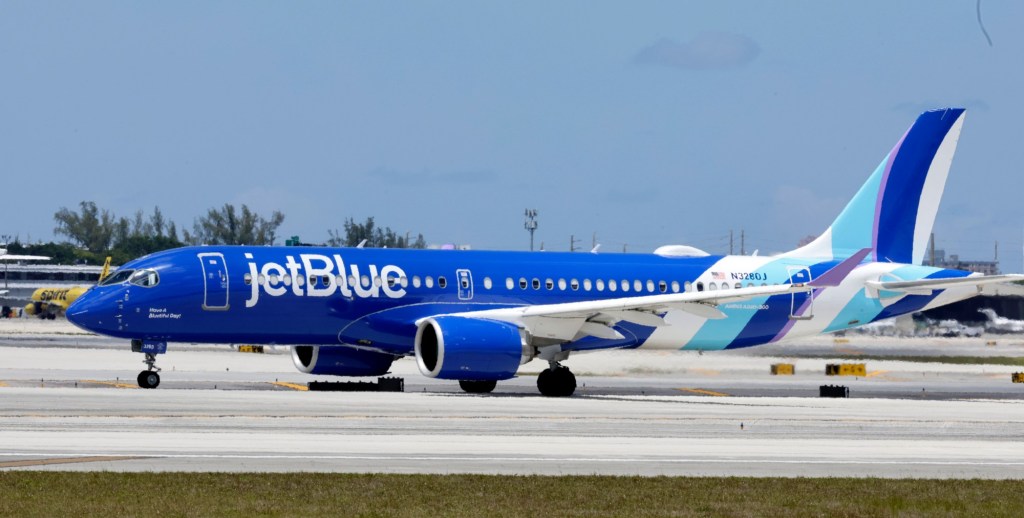
The Federal Aviation Administration is investigating a close call between a JetBlue flight heading toward the Fort Lauderdale airport and another plane, officials confirmed Tuesday.
Just after 6 p.m. Monday, JetBlue Flight 1256 was approaching Fort Lauderdale-Hollywood International Airport after taking off from Guayaquil, Ecuador, earlier that day, according to FlightAware. But the passenger plane had to divert its path to avoid a potential collision with another aircraft, according to archived radio transmissions.
The air traffic controller first warned the pilot about “VFR traffic” 6 nautical miles away, according to the archived radio. VFR traffic refers to planes that are navigating by Visual Flight Rules, or by sight, rather than using instruments.
Less than two minutes later, the JetBlue pilot can be heard telling the air traffic controller, “they’re turning toward us,” according to the radio, while the air traffic controller reported that the plane was 1 nautical mile away.
“We have a TCAS alert, we’re moving,” the pilot said. A TCAS alert, referring to the plane’s Traffic Alert and Collision Avoidance System, is a cockpit alert designed to avoid mid-air collisions by monitoring the space around an aircraft.
“That guy’s insane,” the air traffic controller said after the pilot had successfully navigated away to avoid a potential collision, referring to the pilot of the VFR aircraft as “Mad Max.” He later warned another pilot that “there’s a VFR out there that’s been trying to climb at aircraft.”
Despite the close call, the “required separation was maintained” between the two aircraft, a spokesperson for the FAA said in an email, referring to the minimum distance legally allowed between two aircraft. The agency said it is investigating the event but did not respond to questions about the identity of the second aircraft.
The incident comes amid heightened concerns over aviation safety in the wake of the mid-air collision that killed 67 people in Washington, D.C., in January 2025. Close calls involving commercial aircraft occur more often than people realize, averaging multiple times a week in 2023, the New York Times reported. A shortage of air traffic controllers has exacerbated the problem.
Kristy Kiernan, associate director of Embry-Riddle’s Boeing Center for Aviation and Aerospace Safety, told the Sun Sentinel that TCAS alerts are not unusual, especially in a congested airspace like South Florida. Areas that have more traffic will see more alerts, she said, especially during certain times of year.
“It’s not like it happens every day,” she said, but “it is the system functioning as it’s supposed to in order to protect airplanes from a conflict.”
Over time, information about aviation—including near-misses—has become more accessible to the public. That greater awareness can lead to more alarm, Kiernan said.
“A lot of times I think what’s misinterpreted is the normal system functioning that catches risk and mitigates it,” she said. “That’s a good thing. When people see and hear those things, their first thought should be how successfully this mitigated a threat.”
Commercial aviation is still considered highly safe, despite public concern. A report released last month at Embry-Riddle comparing the dangers of commercial flying to those of other modes of transport and activities found that airline travel “consistently emerges as the safest mode of transportation.”
Spokespeople for JetBlue and the Fort Lauderdale airport did not respond to requests for comment Tuesday.