
LARGO, Fla. — The Pinellas County Sheriff’s Office is using new technology to strengthen communication with the community.
For the past five years, the agency has utilized body-worn cameras for transparency.
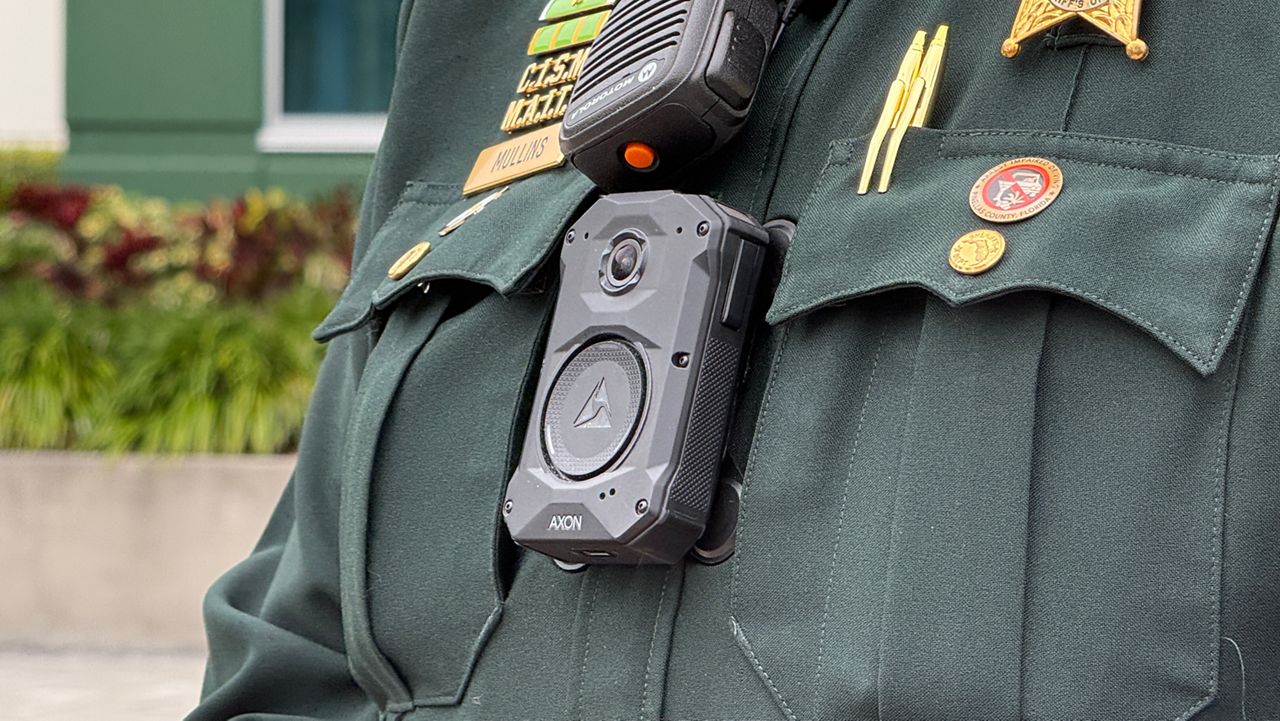
Now, those devices have real-time translation capabilities. This gives deputies dozens of languages at their fingertips.
“There’s currently 57 languages that the cameras are capable of translating,” Sgt. John Mullins said. “(Before) we would use the language line or any other services, Google Translate things like that with deputies on the road. Sometimes that leads to some frustration between having to type the questions and answers back in and wait for the response there.”
Agency-wide, more than 800 deputies can break down language barriers with the push of a button. Bailiffs at the Pinellas County Jail have access to this, too.
The Pinellas County Sheriff’s Office acquired this new tool by adding an additional fee to its pre-existing contract with the company Axon.
Here are the languages offered:
Afrikaans, Arabic, Armenian, Azerbaijani, Belarusian, Bosnian, Bulgarian, Catalan, Chinese (Mandarin), Croatian, Czech, Danish, Dutch, English, Estonian, Finnish, French, Galician, German, Greek, Hebrew, Hindi, Hungarian, Icelandic, Indonesian, Italian, Japanese, Kannada, Kazakh, Korean, Latvian, Lithuanian, Macedonian, Malay, Marathi, Maori, Nepali, Norwegian, Persian, Polish, Portuguese, Romanian, Russian, Serbian, Slovak, Slovenian, Spanish, Swahili, Swedish, Tagalog, Tamil, Thai, Turkish, Ukrainian, Urdu, Vietnamese, Welsh
This new feature launched Nov. 15, kicking off a 90-day trial.
Since launching, this is what the department learned:
Seventeen languages have already been used, including Greek, Hebrew, Arabic, Spanish, French, Russian, Ukrainian and Polish.
Spanish has accounted for 95% of those translations.
Since it’s still AI-generated, translations are about 90-95% accurate.
It is less accurate with hybrid or mixed languages such as Spanglish, but partial translation can still be helpful.
There are a couple of languages in the translation tool that aren’t represented, such as Creole and Albanian. This has been reported so it can be included in future upgrades.
“This gets used on everything from routine day-to-day traffic stops all the way up to physical domestics, any sort of in-progress calls. We’ve used it on virtually everything we’ve responded to at this point,” said Mullins.
Mullins explained how it works.
“When we first activate the function, we’ll push a button on the side of the body camera. As we hold the button, it will listen to whatever language is being spoken in. The AI software will determine what language it is and then provide the response back to us,” he said.
From there, a conversation begins.
Mullins noted, “The shorter phrases back and forth is the most effective.”
Mullins has already used it at a traffic stop with an Arabic-speaking driver.
“So normally we’d have to go back to the car, reach out to the dispatch center or communications and say, ‘Hey, do we have anybody that speaks this language?’ They have to then go through and search with us, and they’ll pull the surrounding agencies,” Mullins said. “If they don’t, we call the language line. (We) have to walk back up, do everything on the cell phone with speakerphone to try and communicate with the person.”
Mullins said in the past, deputies would wait for another deputy who spoke the language. By doing so, this could pull that deputy away from assignment and delay communication for an hour.
He explained, it’s more than time. The translation tool is meant to curb confusion and improve interactions.
“That removes the inhumaneness of using a cell phone to be typing to talk to somebody, instead of being able to have that natural, free-flowing conversation,” he added.
Mullins is proud that their century-old agency continues to evolve.