
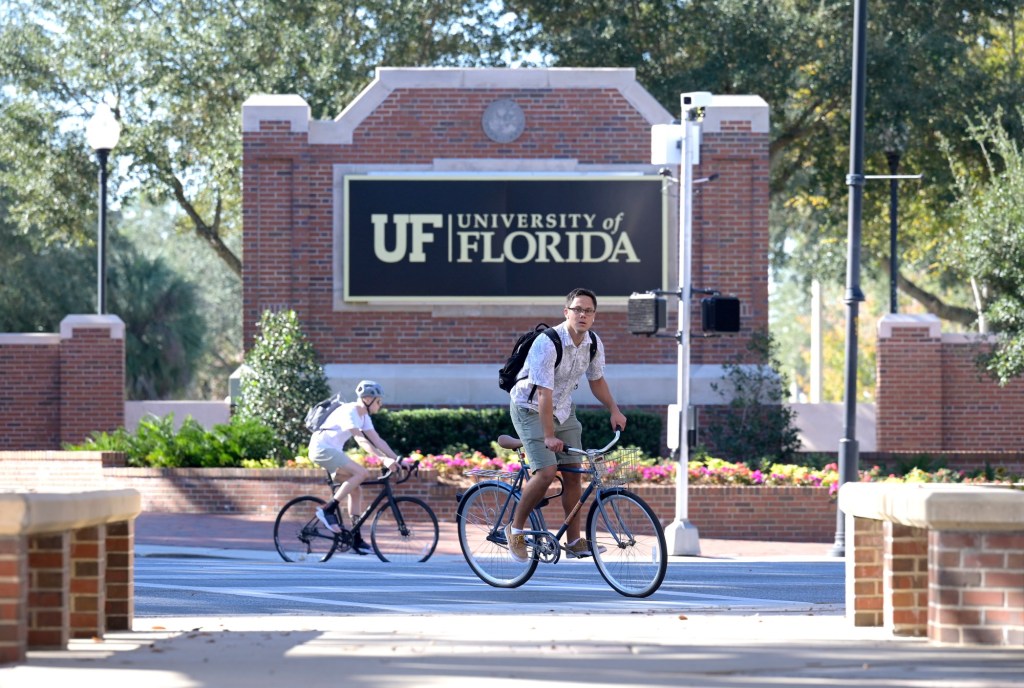
In 2022, the University of Florida had every reason to believe it was entering a golden age. U.S. News & World Report ranked the university fifth among public universities. I was an undergraduate student then. The campus was electrified. There was a sense that UF could become a truly great institution.
Since then, those entrusted with that inheritance have thrown it away as they audition for approval from online culture war commissars.
 Charles Horowitz is a University of Florida alumnus who graduated in 2024. (courtesy, Charles Horowitz)
The presidential search process says a lot. After then-president Kent Fuchs stepped down, former U.S. Sen. Ben Sasse, R-Neb., became president. He was the sole finalist in a search process made opaque by a law signed by Gov. Ron DeSantis in 2022. Sasse’s tenure ended abruptly, followed by reporting that university money had gone to contracts and high-paying positions for former political staffers and allies.
To replace him, Santa Ono, then the University of Michigan’s president, became UF’s next sole finalist. But the State University System Board of Governors rejected him after conservative activists and Republican politicians attacked him over DEI programs he actually shuttered.
Now UF has moved to Stuart Bell, former University of Alabama president, yet another sole finalist. The university claimed he helped elevate Alabama’s national standing. Yet Alabama’s latest U.S. News ranking places it at 169th among national universities. When he started, it was 88th. UF now has a problem with the truth.
This also means interim president Donald Landry will get a $2 million payout for not getting the full-time gig. In response, U.S. Sen. Rick Scott raised concerns. As a Democrat, it’s mind-boggling that I’m now agreeing with Scott!
UF’s response worsened matters. Its official X account declared DEI “discriminatory by design,” and “incompatible with the pursuit of truth.” This appears to have violated its own institutional neutrality policy and chilled campus free speech, violating the First Amendment.
Republicans claim to defend intellectual freedom. Yet when UF’s official machinery adopts their preferred slogans, no one says a peep. Apparently, a university can only become “political” when it says something Republicans dislike.
This pattern appears at UF Law. Florida Attorney General James Uthmeier received a $100,000 adjunct appointment to teach at the law school, more than 16 times what adjunct professors typically earn. Reporting found internal backlash over the appointment and questions about procedure, pay and political favoritism.
Even more troubling: Uthmeier is a deeply partisan figure accused of ignoring state law and helping divert $10 million in Medicaid funds to fund political ads.
Nor is Uthmeier the only example of the university’s strange new patronage economy. Surgeon General Joseph Ladapo has held a lucrative UF role while becoming nationally known for ideological combat. At UF, he has apparently done little other than write his memoirs and compare vaccines to slavery.
Then there is the law school’s white-supremacy scandal. UF Law student Preston Damsky promoted white supremacist and antisemitic views and wrote academic work advancing a white-supremacist constitutional theory. That won an award. A serious university can defend constitutional rights without elevating racist argumentation.
The new Hamilton School for Classical and Civic Education raises similar concerns. There is nothing wrong with studying Western civilization or great philosophers. But UF’s newest school was created to foster an imbalanced, preferred viewpoint. Its incoming director is former Florida Supreme Court Justice Charles Canady, a hyperpartisan former Republican congressman and Clinton impeachment manager.
UF increasingly treats one ideological project as worthy of investment while other forms of inquiry are treated as suspect, wasteful or subversive.
A great public university does not become great by narrowing itself. It becomes great by letting students encounter the world as it is: complicated, plural, contested and larger than the politics of any governor, board, donor class or presidential administration.
This matters to me personally. As a Gator, I want UF to succeed. I want it to be more rigorous and respected. I want everyone, conservative and liberal, to feel welcome. But public doesn’t mean politically captured.
The danger is that UF slowly becomes less attractive to serious scholars, ambitious students, competitive researchers and alumni who believed the university was better than this.
Change needs to be forced. Alumni should stop writing checks. Students should demand transparency. Athletes should stay away (not that the football team can get worse).
The University of Florida is self-destructing because too many people in power have forgotten what a university is for. The Gator Nation should remind them.
Charles Horowitz, of Weston, is a University of Florida alumnus who graduated in 2024.