
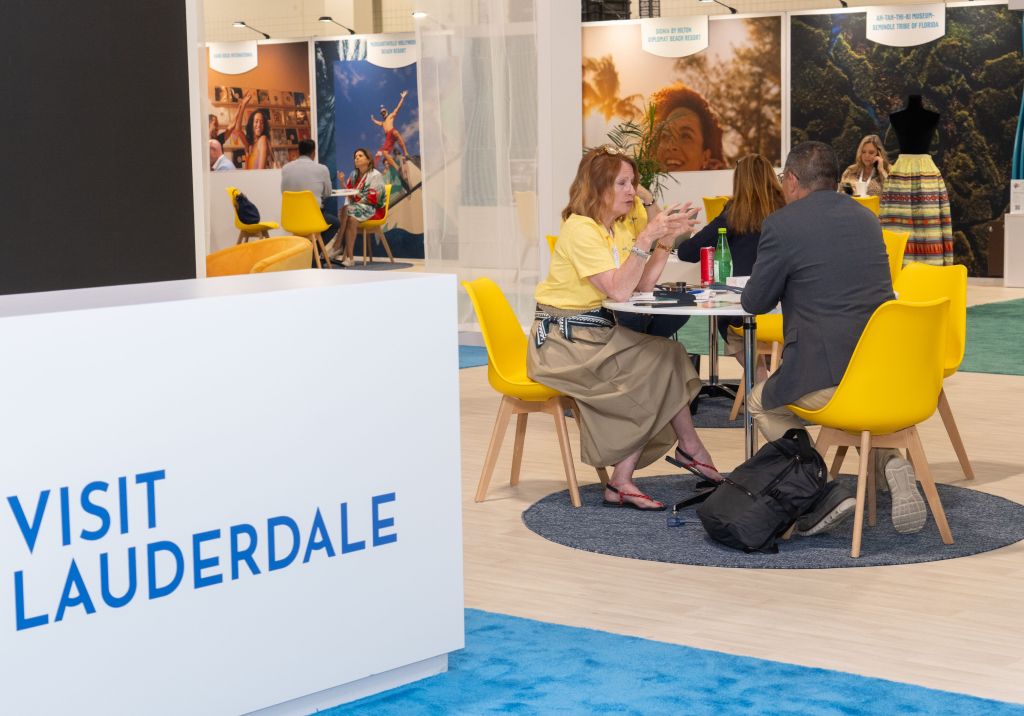
For the South Florida region’s lodging industry, 2026 is likely to go down as a banner year for international visitors after World Cup soccer takes center stage in June and July at the Hard Rock Stadium, not long after Formula I racing drew thousands of upscale travelers to the venue and after an international travel conference drew a crowd the size of small city at the Broward County Convention Center in Fort Lauderdale.
The IPW international travel conference last month drew an estimated 5,000 people from more than 50 nations. The visitors included more than 1,500 international and domestic buyers and media professionals. The result: $26.1 billion in projected future travel business to the United States over the next three years.
The seven World Cup soccer tournament games scheduled for Hard Rock Stadium this month and next will generate between $150 million and $175 million in economic impact for Greater Fort Lauderdale, according to the Downtown Development Authority, with roughly 30% of an expected 700,000 plus visitors staying in Broward County.
Average daily hotel room rates typically range between $145 and $155 during June and July and are projected to double that figure during the World Cup matches, according to the DDA, citing figures supplied by the Visit Lauderdale tourism marketing agency.
But travel industry advocates led by the U.S. Travel Association are expressing considerable unease about the federal government’s decision to increase visa fees for international travelers and add hoops to the visa application process. The visa proposal is another negative, they assert, to an international travel environment already facing a strong dollar, war-driven hikes in fuel prices and inflation in general.
A new “visa integrity fee” of $250 has been in the wings for months for non-immigrant visa applications. It was to be imposed last Oct. 1 for nationals from Brazil, China and Mexico among others. Visitors would get a refund if they leave the U.S. within five days of their visa’s expiration.
‘Tone deaf’
“Things like that are absolutely tone deaf in the environment we are in today,” USTA CEO Geoffrey Freeman told the South Florida Sun Sentinel.
The fee would lift the up-front cost of a U.S. tourist visa to $435. Despite its passage by Congress, the Department of Homeland Security has yet to impose the fee and the association is lobbying lawmakers and enforcement agencies to drop the idea.
The U.S. is also seeking to expand digital and social-media screening for foreign travelers and visa applicants applying for Electronic System for Travel Authorization. The proposal from U.S. Customs and Border Protection calls for travelers from visa-waiver program nations, including Great Britain, France, Germany and South Korea, to disclose five years of social media history as part of their travel-authorization applications.
The travel association is a national, nonprofit organization that advocates for policies to increase travel to and within the United States. Its annual IPW international trade show took place at the Broward County Convention Center last month. Visit Lauderdale, the county’s tourism marketing agency, served as host, lining up everything from local hotels and transportation for visitors to events and promotions.
The idea was to connect global buyers and media with thousands of American suppliers such as hotels, resorts, state and county tourism agencies, entertainment venues, airlines and rail lines. But the conference was smaller than previous events in other cities, Freeman said.
“We had a very good IPW,” he said. “Our numbers were consistent with the trends, and the trends are a slight downtown in travel to the United States, and we felt that during IPW.”
“That’s why we’re focused so diligently on addressing the downturn on inbound travel,” he added. “It’s one of the things that makes this $250 visa fee so off-putting. The United States is already an expensive market.”
Neither the fee nor the additional social media vetting has been implemented, according to Freeman, primarily because of the lobbying against them.
“The fee could have been implemented in October of last year,” Freeman said. “We have been successful to date, and we continue to work every day to stop it.”
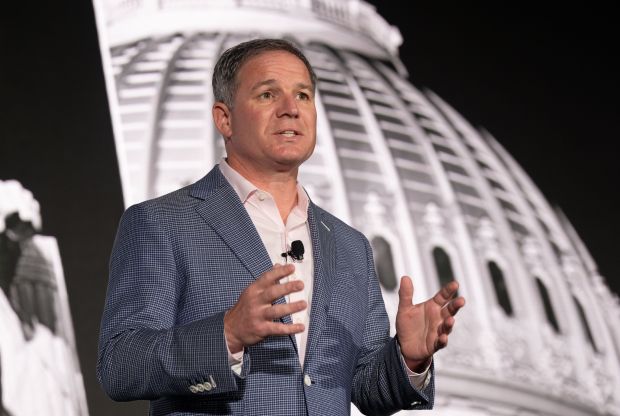 Geoffrey Freeman, president and CEO of the U.S. Travel Association, speaks at the group’s IPW conference in Fort Lauderdale. in May He warns that a $250 fee for international tourists along with increased government vetting of visitors could erode visitor traffic nationally. (U.S. Travel Association/Courtesy)
Lift for Lauderdale
For Visit Lauderdale and Broward County, the conference represented an enormous advantage in the perennial battles against other destinations for international vacationers and their dollars.
“Most of these attendees had never been here,” said Stacy Ritter, Visit Lauderdale’s president and CEO. “We had an opportunity to show off this place.”
Visit Lauderdale ended up with requests for proposals to host conferences “we never would have been in running for,” she added.
There were 2.29 million international travelers to Florida in the first quarter of this year, up 8.5% from the same period of 2025, according to figures recently released by Visit Florida.
“The international tourist represents the ‘Montage or Lamborghini’ type of traveler … they spend more, stay longer, and, in general, visit the U.S. to do more things,” said Peter Ricci, director of the hospitality, tourism and management program at Florida Atlantic University’s College of Business.
“The media stories are equally impressive,” Ricci said in an email. “In a time where visitation to Florida fell in the first quarter of 2026, we need more positive stories being told about the beauty of Greater Fort Lauderdale, and South Florida in general. Our welcoming of Formula 1, World Cup events, and IPW all converge on showcasing the great destination collectively known as ‘South Florida.’”
Among those businesses looking to make new connections: Brightline, the higher-speed rail line serving travelers between Miami and Orlando.
“The U.S. Travel Association’s IPW Conference in Greater Fort Lauderdale delivered a strong boost for ridership during the event and, more importantly, created meaningful momentum for future bookings,” Brightline Holdings CEO Nicolas Petrovic said. “It presented us the opportunity for international travel advisers and buyers to experience the product firsthand. Being able to look, feel, and touch gave them an authentic sense of the Brightline guest journey and how we connect their clients between Central and South Florida.”
Canada is a continuing concern
“I think the industry’s hope was that as we got into the winter months of ’25 and 2026 that we would see Canadians return,” Freeman said. “While it varied across the country, some places may have seen some success — the fact is the Canadians didn’t return. We were down 22% in 2025. Even as we got into 2026, we’re lapping bad numbers. We had bad numbers in February, March and April. And we are still off of those numbers here in 2026. I think the Canadians are staying resolute.”
For the state, Visit Florida reported a rebound in visitors last year from the downturn caused by political and economic friction between the U.S. and Canadian governments.
“We’re grateful for the 16 million Canadians that came last year. But there were still 4 million Canadians missing,” Freeman said of the national picture in 2025. “That is the concern. It does need to be addressed. This is still our most important travel market both in terms of the volume of travelers and the money they spend. It is harming the industry significantly.”
Latin market strength
Freeman said the one market he can point to that has shown strength in the U.S. is Latin America. But again, the proposed visa fee is inviting trouble, he asserted.
“Here we have the one market — Latin America — that has been doing well, and we’re going to throw a fee on top of that,” he said. “It’s just bad business.”
“For a family of four from Brazil, this is $1,000 that they would have spent with U.S. businesses, but instead they are giving it to the U.S. Government. It seems foolhardy,” he said.
Ritter said proposed government fees and requirements aimed at international travelers “is going to make it worse” when it comes to the task of attracting them to visit here.
But she was cheered by the presence of visitors at the IPW conference from Asia — another declining source of international travelers. A group of 65 representatives from the People’s Republic China hopped buses for a little shopping tour — at the Sawgrass Mills outlet mall in Sunrise.