
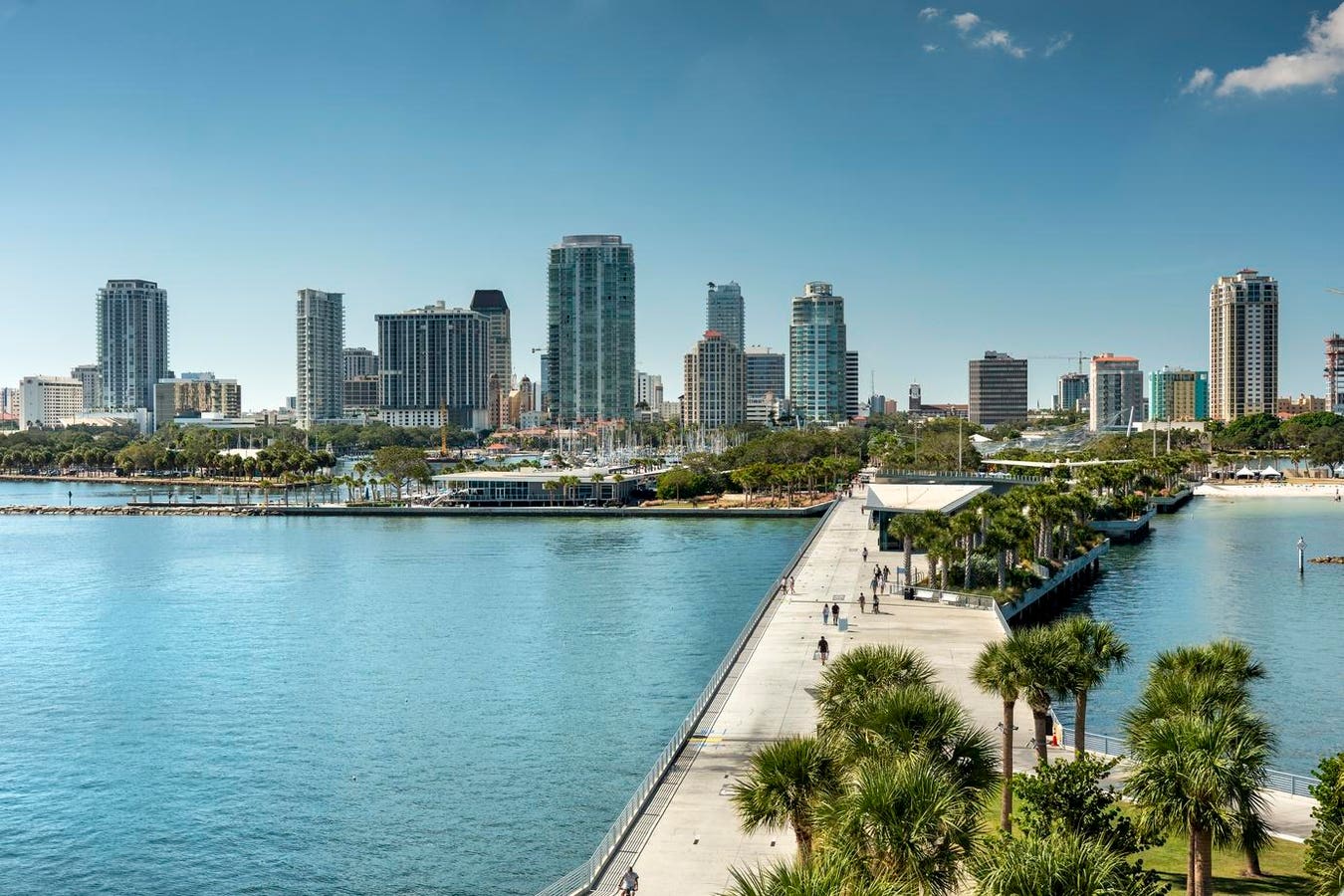
Spring training baseball games used to be held in downtown St. Pete, Florida.
getty
St. Petersburg, Florida, hardly ever comes up in conversations about America’s great baseball cities, but it probably should. Long before it became a Gulf Coast destination known as the “Sunshine City,” it quietly helped invent one of the sport’s defining traditions: spring training as we know it today.
For more than a century, professional baseball teams have come to St. Pete to escape northern winters and warm up for the regular season. In the process, the city became a kind of winter getaway for the sport itself—hosting star players, shaping fan culture, and building its own legends.
Many people already come to the St. Pete region in March for spring training, but there’s more baseball lore to discover. Today, you can retrace some of that history as a traveler and enjoy some of the modern fruits that have grown from it.
First Pitch: Crescent Lake and the Public Park Era
Before teams practiced at an official ballpark in St. Pete, they literally played ball in a park; that is, before the city had purpose-built spring training facilities, baseball lived in its public spaces.
In the early 20th century—particularly the 1910s and 1920s—major league teams and semi-pro clubs would train and scrimmage on open fields, using Florida’s winter climate as a competitive advantage long before “spring training” became a formalized industry. These weren’t ticketed stadium experiences; rather, they were public fields with grass worn down by repetition, temporary stands, and teams practicing in full view of everyday life.
In St. Pete, there were many improvised diamonds scattered across the city’s growing neighborhoods, but one of the earliest and most important of these was Huggins-Stengel Field at Crescent Lake Park. It is still a popular public park today.
In his book, 100 Years of Baseball on St. Petersburg’s Waterfront: How the Game Helped Shape a City, baseball historian Rick Vaughn recalls stories from these early days, revealing some of the challenges and charms of the era. For example, certain players were hesitant to go too deep into the outfield at Huggins-Stengel for fear that an alligator would come out of the lake.
The St Louis Cardinals play the Houston Astros in a spring game at Al Lang Stadium in St Petersburg, Florida, circa 1968. Today, the stadium has been repurposed into a professional soccer stadium, home of the Tampa Bay Rowdies.
Getty ImagesThe Golden Era of Spring Training
Today, Al Lang Stadium is the home of the Tampa Bay Rowdies, a professional soccer team, in downtown St. Pete. Just steps from the waterfront, it offers a beautiful view from its stands of a quiet harbor—a view that competes with the game itself.
Flash back in time, and instead of watching soccer, you’d be watching a spring training game featuring the New York Yankees, St. Louis Cardinals, New York Mets, Baltimore Orioles, New York Giants, or the Tampa Bay Devil Rays.
From 1922 through 2008, spring training games were played across four fields in St. Pete. First, it was Waterfront Park hosting games from 1922 to 1946. Then it was replaced by Al Lang Field (1947-1975), which later became the Al Lang Stadium we know today (1977-2008). In 1976, games were played at Campbell Park while Al Lang Stadium was replacing Al Lang Field.
These parks were home to some of baseball’s most iconic franchises. The Yankees—stocked with names like Babe Ruth, Lou Gehrig, and Joe DiMaggio—were Al Lang Field’s inaugural MLB tenant when it opened in 1947, playing spring-training games there until 1961. During that time, they shared Al Lang with several other clubs, and its use continued well into the modern era. The Cardinals, for example, trained in St Pete from 1938 to 1997, playing at all four fields. The Devil Rays were the last team to call Al Lang home, playing there from 1998 to 2008.
By the mid-20th century, spring training had turned St. Pete into a known baseball hub. Clubhouse staff, scouts, sportswriters, and traveling fans returned year after year, filling the same hotels, bars, and waterfront streets. Major League Umpire Richie Garcia once recalled that a night game in St. Petersburg could feel surprisingly close to Yankee Stadium—not because of its scale or intensity, but because it was filled with baseball people.
Looking back, this era established the template for what we see today in the region’s spring training scene. Within roughly an hour’s drive, visitors can reach Grapefruit League parks for the Yankees, Phillies, Blue Jays, Rays, Orioles, Braves, Tigers, and Pirates, and it is as much of a tourism draw as ever, bringing fans and personnel to the area late-February through March.
The Tampa Bay Rays have been the city’s MLB team since 1998, playing at Tropicana Field, or as it is locally called, “The Trop,” in downtown St. Pete.
Tropicana Field is one of the best stadiums for away fans to visit due to the controlled climate, affordable tickets, and friendly home fans.
Getty ImagesModern Day: A Visiting Fan’s Paradise
St. Pete is a paradise for visiting baseball fans every spring because of its proximity to so many teams and their respective stadiums. But St. Pete also thrives during the regular season. The “Trop” is often treated poorly in stadium rankings due to its lack of history and flashy features. But, in my view, it’s one of the most underrated parks to visit as an opposing fan.
Tropicana Field is the league’s only fixed-dome stadium, which means guaranteed climate control during the hot summer months and complete protection from rain, sun, and humidity. It’s a guarantee that the game won’t be delayed or postponed—which is not something to overlook when you’re shelling out cash on flights and hotels—and that you won’t bake in the sun.
While the Trop may not win any architectural awards, the stadium design does have its perks. It has the smallest seating capacity in Major League Baseball, meaning bad seats are hard to find, and despite having lesser seats, tickets are often available and comparatively affordable.
What’s better: Rays fans are as chill as they come, with transplants and snowbirds sometimes rooting for both teams. The legendary local sport’s bar next door, known as Ferg’s, often hosts parties for visiting club fans. It’s a stadium where you won’t feel out of place or be heckled for wearing the opposing jersey.
The Trop also benefits from its surrounding area. It sits just a block from Central Avenue, the city’s main drag for nightlife. Within a short walk, you’ll find breweries, restaurants, and bars that turn a night game into a full evening out. Visitors staying downtown can walk to the Trop from Central Ave hotels or stay along the nearby waterfront for a broader St. Pete experience. The St. Pete Pier, the Salvador Dali Museum, and the city’s waterfront parks are all worth exploring, as are the St. Pete beaches and Fort De Soto Park.
Schrader’s Little Cooperstown in the St. Pete Museum of History has a large collection of signed balls as well as spring training history.
Wake and Wander MediaA Baseball City Hiding in Plain Sight
When walking along Central Avenue in the blocks surrounding the Trop, look down. There are historical markers in the shape of home plates on the sidewalks. Each commemorates a different moment in St. Pete baseball history.
Down by the main pier is the St. Petersburg Museum of History, and out front sits a statue of Babe Ruth. Inside, you’ll find one of the largest collections of signed baseballs anywhere on the planet as part of Schrader’s Little Cooperstown.
Some people think the ghost of Babe Ruth still makes an appearance in the places he frequented, and there are several that are still standing: The Vinoy, the Don Cesar, and the Jungle Country Club, among others. You can visit the University of Tampa’s Plant Field to see the plaque for the 587-foot homer Ruth hit there, considered to be one of the longest ever.
There’s an even larger legend in St. Pete, where Ruth apparently hit another long homer in 1934 at Waterfront Park (near today’s Al Lang Stadium) that broke the window of the old West Coast Inn (now the St. Pete Hilton). Rui Farias, Executive Director of the St. Pete Museum of History, says the distance from home plate was more than 600 feet.
There are plans to put a historical marker at the site sometime this summer to honor the feat as well as the Babe’s legacy in St. Pete—which was, according to Farias, much larger than life.
“When the Yankees arrived for Spring Training in 1925 and Babe Ruth [got] off the train, it was like The Beatles arriving at JFK airport in 1964,” Farias told Fox13 Tampa.
Nearly a century later, crowds still gather every spring for meet-and-greets with MLB’s biggest stars, and baseball remains woven into the fabric of St. Pete, scattered across parks, sidewalks, hotels, and waterfront streets—hiding in plain sight for anyone willing to look.