
St. Petersburg is, for all its sunshine and geography-is-destiny optimism, a city of discontent. That’s not the worst civic setting to have — South Florida has its corruption, Jacksonville and Orlando are soulless, Tampa is forever unfulfilled — but discontent is the ‘burg’s resting state.
It’s a place stitched from dozens of well-defined neighborhoods that, come election season, get pitted against one another like the Greek and Italian city-states I’ve been reading about from this side of the Mediterranean.
Modern St. Pete is a wonderful place to live and work. It has also been marred by race riots and failure factories, and it has minted its share of demagogues — Bill Klein, Curt Curtsinger, and Kathleen Ford among them.
The city succeeds in spite of its elected officials, not because of them. Rick Baker and Rick Kriseman each had genuinely good stretches across their two terms, but St. Pete mostly lurches forward on a bipolar mix of Sunshine City optimism and the nagging suspicion that we could be doing better.
Which is exactly where Ken Welch finds himself, seeking a second term in front of an electorate that likes its city a good deal more than it likes its Mayor.

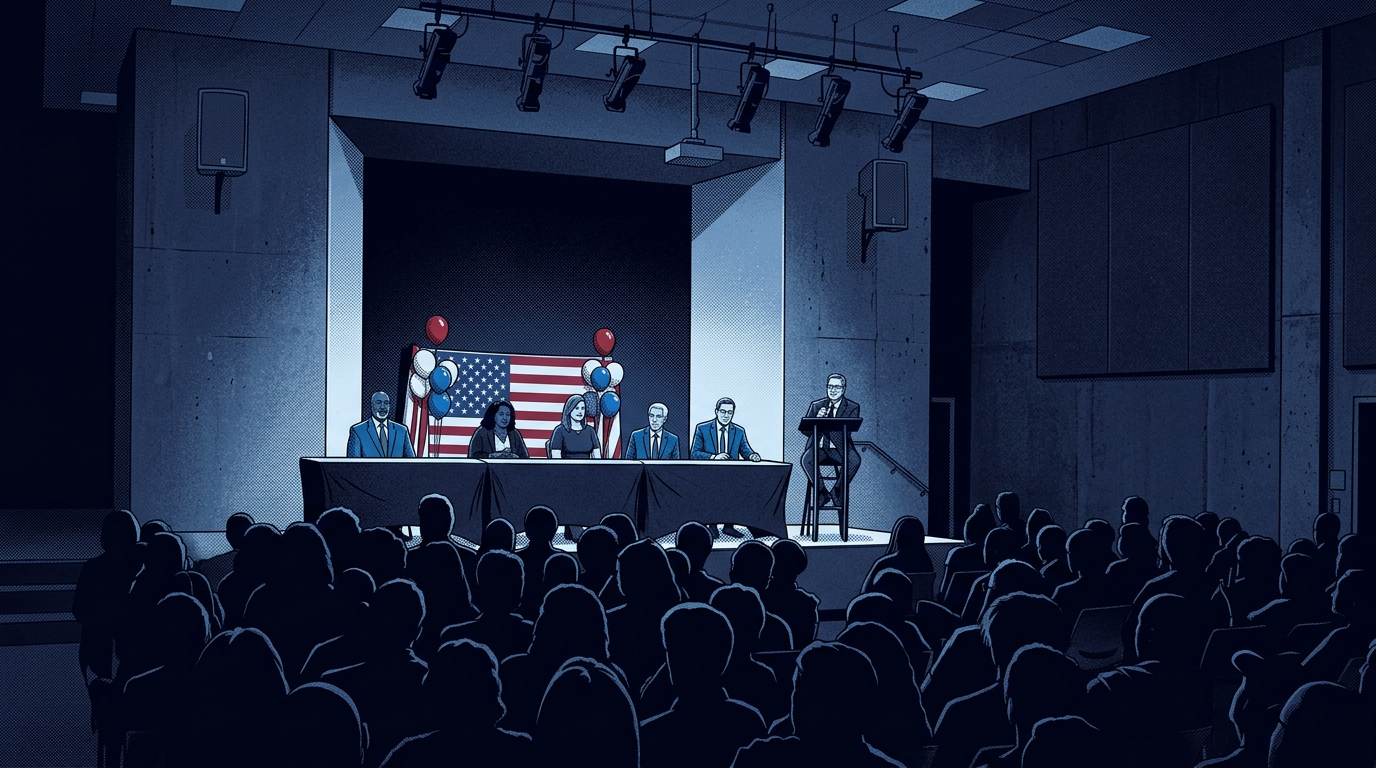
Going into the first mayoral debate, which I watched at 1 a.m. from Rome, this was always going to break one of two ways. Welch could make himself first among equals — concede that the last two years have been brutal, decline to take the blame for the weather, tick off what he’s done, and humbly ask for the chance to right the ship. Lock down his base and quietly dare White Democrats to unseat the city’s first Black Mayor. Or he could fail to find that pivot and become the target of everyone else on the stage.
The second thing is what happened.
Charlie Crist went straight at the storm response and the empty chair at the emergency operations center.
“It looks like we were not prepared for a few of these hurricanes recently, and that’s a problem,” Crist said, before, later in the debate, landing the line that doubled as the night’s thesis: that he was disappointed in the mayor and the city needs a change — and so, he noted, does everyone else at the table, or they wouldn’t be running. When Crist turned and told Welch he was disappointed in him, it landed like an entire city clearing its throat.
Maria Scruggs came out swinging on transparency, handing the administration a failing grade on procurement: “If I were to grade the City of St. Pete in the areas of transparency and when it comes to procurement, I would give them an F.”

Kevin Batdorf, the former Shore Acres neighborhood association president, doesn’t really sound like a man running for Mayor so much as one carrying the fury of a flooded neighborhood in his fist — his whole campaign is the claim that Shore Acres was punished for his criticism. “Shore Acres suffered because I was very critical of the process,” he said. That’s the kind of oppo-file material political consultants dream of — it’ll be on at least two mailers to every voter in the city’s largest neighborhood before this is through, whatever the merits.
And Brandi Gabbard, who spent the last several years mostly voting in lockstep with Welch, told the room the 2024 storms changed her mind and that the City needs to “get back on track” — even as she swatted away a Batdorf jab over a “secret” post-storm meeting in her district.
Welch’s answer to all of it was that everyone was talking the city down. “I’m really going to push back on folks talking our City down,” he said. “Our city is doing well two years after the most devastating storms that we have ever faced.” On the recovery itself, the pitch was patience: “Just be patient. We will get it all done in 90 days. More debris than we’ve ever moved.” It’s not a bad argument. It’s also only half-right — and “be patient, look how much debris” is exactly the note that lands badly in a neighborhood still drying out.
Welch suggested that, but for the Rays deal collapsing, he wouldn’t be facing this much company on a debate stage, which is how you know how badly he’s misread his own predicament. The Rays deal didn’t sink him. His preparation and response to the hurricanes did; the stadium fell apart in the rubble that followed.
To his credit, Welch gave the only honest answer when candidates were asked to name a mistake: the $250,000 in bonuses he handed 17 top officials for the Rays deal, money later ruled illegal and clawed back. “I should have waited until that was executed and the dirt was turned,” he said. “I didn’t do that.” Everyone else dodged.
A few other things I think I think about Tuesday’s debate:
—Scruggs is almost certainly not winning a citywide race, but she was the most compelling presence in the room — you never knew what was coming next, whether an old grievance with Welch over term limits or a genuinely felt lament about the neglected neighborhoods of south St. Pete. She also complicates life for Welch in a specific way: a former NAACP branch president running against him guts the ugly surrogate argument, pushed by JC Pritchett, that Crist is out to erase Black representation at City Hall. (I’ll have more to say about Pritchett another day.)
As an aside about what a disappointment Tuesday’s event was: for an NAACP-hosted debate, the room skewed strikingly White, and it took more than an hour before anyone said the word “Midtown.”
—Batdorf was a wonderful neighborhood association president and is plainly not ready, right now, to run the state’s fifth-largest city; his answers to anything not named “the storm” showed it. Gabbard, the self-styled “Dump Duke” candidate, demonstrated why in almost any other cycle she’d make a run-off — and why, boxed in politically, nights like this will be her high-water mark.
—The real winner didn’t show. Jim Large, the embattled former Fire Chief — accused in 2023 of racist, sexist, and homophobic remarks, then reinstated after a review — skipped the debate and presumably got a good night’s sleep. He says he’ll turn up at later forums, the next being the June 18 League of Women Voters debate at St. Petersburg College, and when he does, he’ll be aiming a fire hose of criticism at his old boss.
Mostly, though, nothing changed on the stage — and the night’s most consequential news broke off it. Welch’s base was supposed to fill that auditorium; instead his chief surrogates, Rene Flowers and Terri Lipsey Scott, stood up front at the open like maître d’s.
The real development came the same day, away from the library: Crist reported a $1.6 million haul — more than $330,000 of it raised across April and May — and rolled out a six-figure vote-by-mail push to rebuild the mail-ballot requests that collapsed after a 2021 law required voters to renew them every cycle. In a Pinellas electorate that votes by mail more than any in the state, that’s close to the whole ballgame. Crist closed the last period with $1.1 million on hand; Welch had less than $193,000, and his campaign has been fending off questions about money since his kickoff. About 125 people sat in the Obama Main Library on debate night. Crist can talk to the entire city by mail, again and again — and Welch, without the cash to change the narrative, can mostly sit back and take it.
For an incumbent, “nothing changed” is the diagnosis, not the reprieve. Three-quarters of this city isn’t sold on a second Welch term, and the calendar to the Aug. 18 Primary is long.
It’s going to be a long summer for KT.
—
Ed. Note: Michelle Todd Schorsch is the Chair of St. Pete Shines, a political committee backing Crist for St. Petersburg Mayor. Todd Schorsch is married to Peter Schorsch, the publisher of Florida Politics.