
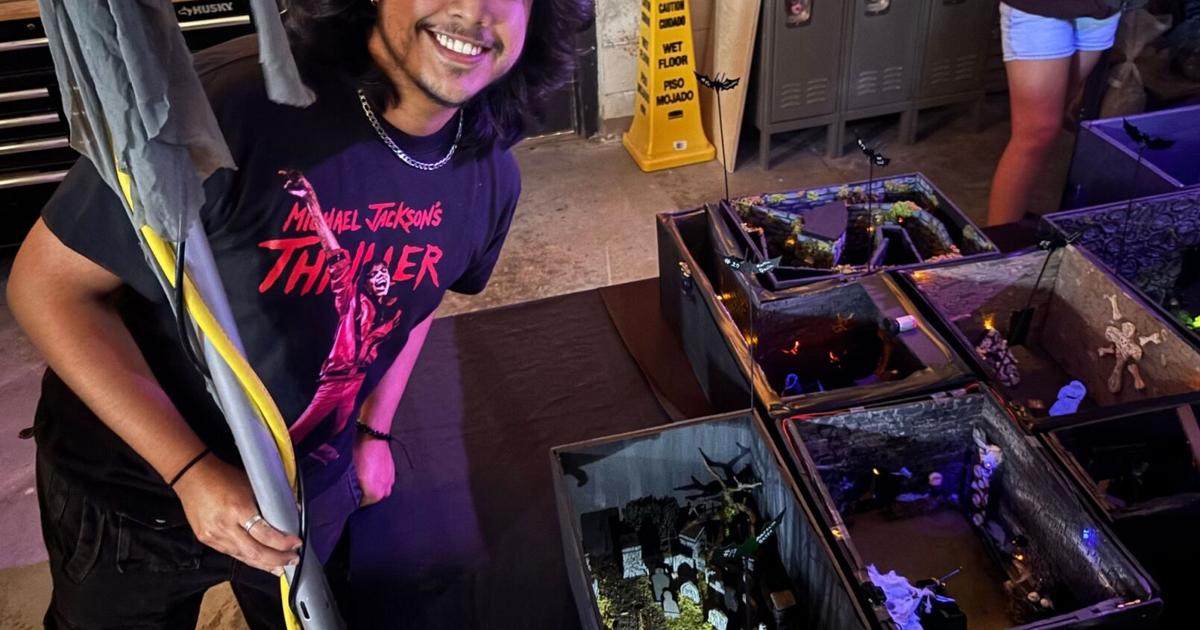
Inside Room 165-B of the Visual Arts Building, Halloween music filled the lab as blacklights illuminated a table of handcrafted haunted models on Wednesday afternoon.
Students from the Immersive Experience Design program spent their semester building miniature attractions that blend the thrill of the spooky season with design and storytelling.
The “Advanced Art Lab Haunted Attraction Showcase” is the first of its kind for the School of Visual Arts and Design, highlighting the precision and imagination behind themed entertainment elements. Each student created a small-scale scene based on their own haunted concept, combining artistic creativity with real-world design techniques.
Amy Avalos, professor of immersive experience design, said her passion and love for Halloween inspired the project. She wanted students to embrace the spooky season while learning the fundamentals of industry-level, theme-based design.
“Well, in themed design, everything is artistic — from the props you make to the show set design, the wall textures and the flooring, everything goes into those spaces,” Avalos said. “So this is all like real-world application processes that we would do in a normal themed-experience profession.”
This project gives students a hands-on opportunity to apply their own artistry to professional design practices, bridging creativity with practicality.
At the start of the semester, Avalos gave each student a scene tied to a larger narrative of a haunted attraction. Over several weeks, they developed sketches, built scale models, experimented with different materials and lighting to tell a story.
Caraline Neil, junior studio art major in themed entertainment design, said that the process began when she drew “plague doctors and a chamber” from a hat. The assignment quickly grew into a dark, intricate space filled with texture and small surprises hidden in every corner.
“I started with researching what actually happened during the bubonic plague and stuff,” Neil said. “We went first to textures, we focused a lot on that, built our walls and then we moved on to props, then scarecrows and everything. So we kind of really built it up over time.”
Martin Davile, sophomore immersive experience design major, created the model’s finale: a graveyard inspired by Michael Jackson’s “Thriller.”
“My concept process was, since you exit from a catacomb-like area to out in the open, for the exit to be straight out of a random hedge,” Davila said. “Then from there, I just have a strobe light from this mausoleum that disorients the ‘people’ out there. You won’t have time to react because you have someone coming at you from the right, from the left, from behind you.”
Both students mentioned they had never built models like this before and learned through trial and error. From wiring tiny lights to molding foam, the process required patience, collaboration and improvisation. They learned how to test and adapt different designs and gained confidence in problem-solving skills that Avalos taught as essential to the themed entertainment field.
“Some things are a struggle, but you overcome it and you work through it,” Avalos said. “And, you know, they gain that experience of how things might have to change and you can redo it — it’s not like the end of the world if you have to start over on something.”
Mastering scale was another major challenge, Avalos said. Each model was built at a half-inch scale, so even the most minor details had to be carefully measured and given close attention.
“A lot of them haven’t done anything in scale,” Avalos said. “So, you know, cutting foam core, and kind of getting used to the idea of having to think about everything in scale and have to work through that process and understand how scale works in a real-world environment.”
To Avalos, the showcase represents a step forward for UCF’s Immersive Experience Design program, showing how students can turn classroom concepts into art and professional-quality designs.
“Doing this kind of showcase stuff kind of gives a little bit more exposure and lets people know that we’re here,” Avalos said, “And if people are interested, come sign up and make a haunted house.”