
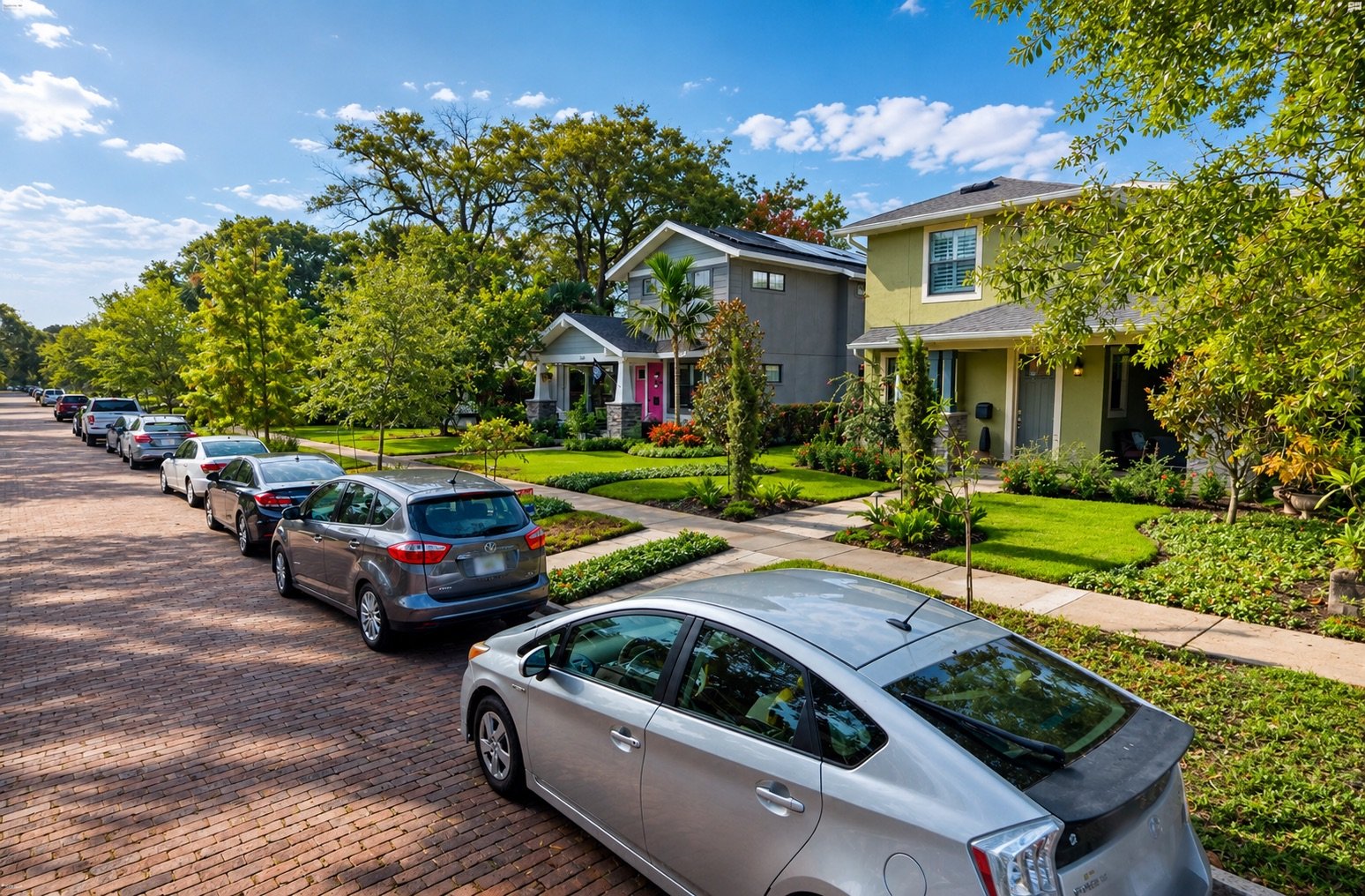
More recently, city staff said similar parking pressures have emerged in neighborhoods throughout the city as St. Petersburg has grown beyond downtown.
“Businesses continue to open and expand along various commercial corridors, major roadways, and in pockets along lower-volume roadways in the City, while neighborhoods continue to experience challenges with overflow customer and employee parking,” Mory wrote in a memo to the city’s Public Services and Infrastructure (PSI) Committee ahead of an April meeting.
The ordinance would have created a framework for Neighborhood Resident Only Parking Areas, giving residents in certain neighborhoods a path to petition for permit-only parking restrictions on residential streets.
Rather than automatically creating new parking zones, the proposal established a process for evaluating future requests.
Under the proposed program, neighborhoods would have needed support from at least two-thirds of households before the city would conduct a parking study.
To qualify, an area would also have needed to demonstrate that parking occupancy exceeded 75% and that at least 25% of parked vehicles belonged to people who did not live nearby.
If a neighborhood qualified, the decision to implement a Neighborhood Resident Only Parking Area would go before City Council approval for approval.
Throughout the discussion, one question remained at the center of the debate: if residents receive greater access to neighborhood parking, where do employees and customers of nearby businesses park?
In his memo, Mory acknowledged the challenge directly.
“Unfortunately, to make parking abutting residential property more available to residents, employee overflow parking into neighborhoods may need to be reduced and is a tradeoff for consideration,” he wrote.
During Thursday’s public hearing, business owners argued that tradeoff could have significant negative consequences.
“I think over the last two years we’ve all seen dozens of small businesses close,” said Steve McGarry, owner Wildflower Ice Cream on Dr. Martin Luther King Jr. Street North. “It’s just a bad time basically for a lot of businesses with rising rents, insurance, health care, all that good stuff.”
McGarry urged city leaders to consider conducting an economic impact study before pursuing similar restrictions in the future, noting that many businesses, employees, and customers depend on nearby residential streets for parking.
Representatives of the business community also praised city staff for working to address concerns raised after the ordinance’s first reading.