
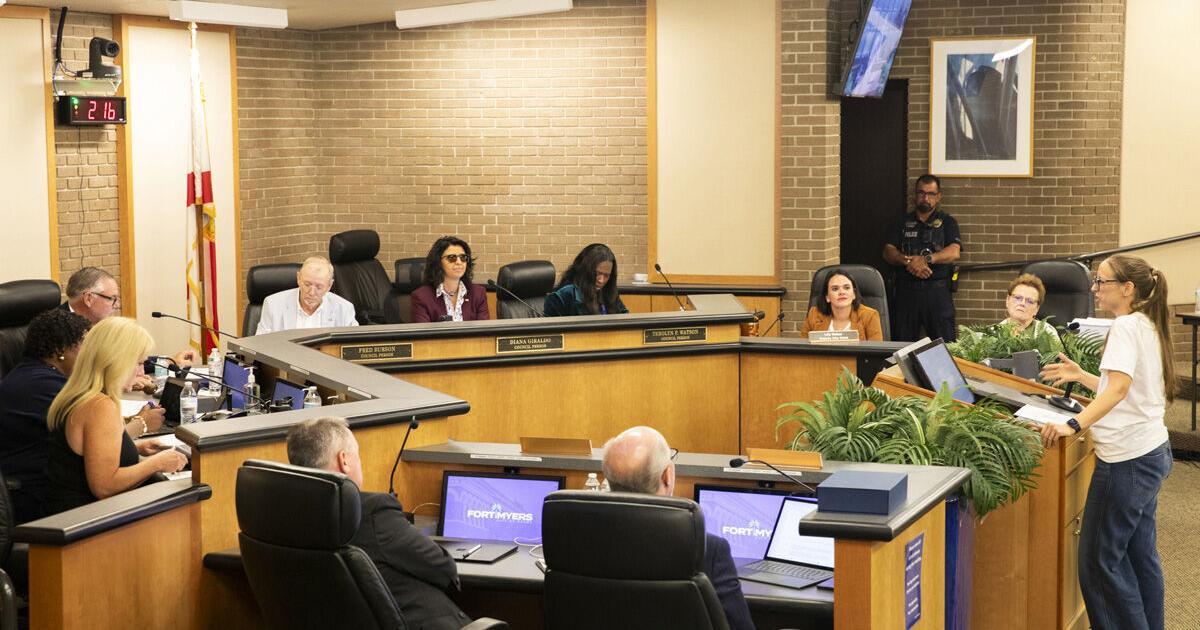


A resident speaks during a June 15 public hearing before the Fort Myers City Council regarding the future of the city’s minority-owned and local vendor preference programs. Multiple speakers urged officials to consider replacement programs before ending the existing policies.
Evan Williams
Fort Myers officials may overhaul programs that support minority-owned and local businesses, replacing them with initiatives that would comply with new state rules banning Diversity, Equity and Inclusion programs.
What those replacements might look like remains unclear, but public speakers gave officials plenty to consider during a June 15 public hearing.
Council members were set to vote on ending the city’s Minority Business Enterprise and Local Vendor Preference programs. Instead, they tabled the hearing after Mayor Kevin Anderson suggested waiting until councilors could review and potentially vote on replacement programs before the new state law takes effect Jan. 1, 2027.
Currently, when the city seeks contractors for goods and services, part of the selection criteria includes their status as, or use of, minority-owned or local businesses and subcontractors.
“Is there something we can look into that will continue to be inclusive with supporting contractors that want to do business with the city?” Council member Teresa Watkins Brown asked.
“There are probably other programs out there that would not violate the state’s directive,” Fort Myers City Manager Marty Lawing responded. “I can’t tell you exactly what that would look like, but we can do some research on something.”
The new state law, Senate Bill 1134, prohibits local governments from participating in DEI programs and requires city and county governments to certify they will not use public funds for programs the law defines as discriminatory.
Federal executive orders also direct federal agencies to end what they describe as “illegal DEI” mandates and revoke affirmative action policies related to federal contractors.
City staff said ending the MBE and Local Vendor Preference programs would keep Fort Myers in compliance with federal and state grant requirements.
At the June 15 hearing, members of the public said ending the programs without replacements could harm businesses.
They argued the DEI ban represents an overreach into local matters in a state that grants broad home-rule authority to local governments.
The discussion also revived broader questions about the effectiveness of affirmative action and related programs designed to address historic inequities.
“I want to remind each and every one of you that I’m a product of affirmative action or DEI or whatever you want to call it, and I don’t think any one of you can say that I disappointed you,” former Council member Johnny Streets said.

A speaker addresses the Fort Myers City Council during a June 15 public hearing on proposed changes to minority-owned and local vendor preference programs. Officials delayed action while researching possible replacement initiatives
Evan Williams
“We’re entering into something because the federal government and the state of Florida [are] usurping your home rule. Nobody knows any better what to do with people who are in their own towns than you do.”
Fort Myers resident Jacquelyn McMiller suggested replacing the minority-owned and local vendor programs with initiatives that “achieve the same goals while ensuring that the program remains inclusive, sustainable and legally dependable.”
“There is an opportunity to modernize this particular approach by focusing on the challenges that many small businesses face, regardless of race, ethnicity, gender, veteran status or disability,” Miller said.
“Rather than categorizing businesses by personal characteristics, the city should establish a program based on objective criteria, such as business size, annual revenue, years in operation, access to capital and bonding capacity.”
Fort Myers resident Amber Ware suggested a similar approach.
“I agree that the city should go to a race-neutral small business enterprise program that prioritizes businesses located within the city limits,” she said. “Most importantly, any decision of this magnitude should be supported by data.”
Fort Myers established its MBE program in 2019, defining an MBE as a business that is more than 50% minority-owned and managed. MBEs were previously certified by the Florida Office of Supplier Diversity, which later became the Office of Supplier Development.
City documents state that the MBE program is intended to increase opportunities for minority-owned businesses by promoting open competition and helping business owners compete independently in the local marketplace.
The program set a goal of directing 15% of spending on goods and services to minority-owned businesses. When selecting a contractor, the city generally chooses the lowest qualified bidder unless an MBE proposal is within 6% of bids for services exceeding $25,000 and within 7% of bids between $3,000 and $25,000.
Fort Myers has nine active contracts that include MBEs and received 46 responses to solicitations involving MBE participation during the past 12 months.
During the same period, 15 contractors received benefits through the city’s local vendor program.