
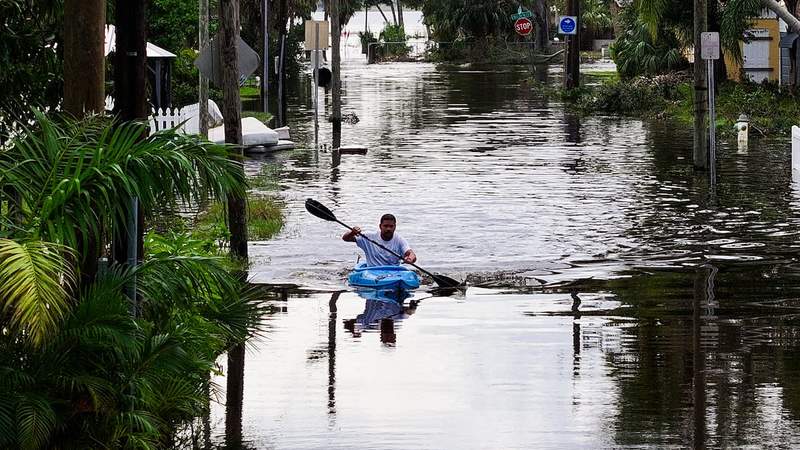
Three community groups are working through concerns with St. Petersburg over a referendum that, if approved by voters, would create a new property tax to finance faster upgrades to water and stormwater systems in the face of intensifying storms.
Representatives from the Suncoast Sierra Club, the Council of Neighborhood Associations and the St. Petersburg Area Chamber of Commerce have been meeting with city officials to go over sticking points in the city’s plans. They range from funding injection wells and addressing storm surge to having a clear road map for how the $600 million raised will be spent and publicly tracked.
“There are substantive issues here that we do need clarity on,” said James Scott, executive committee chairperson of theSuncoast Sierra Club. “We would like to get to yes. And we’re working toward that and the administration has made it very clear they would work to the best of their ability to help us get there.”
The City Council is expected to vote late July on the language that would be placed on the November general election ballot. If the language isgreenlit by the council, state law prohibits city officials from spending public dollars to promote the referendum. They would rely on those local groups to convince residents to vote yes.
That support is crucial, especially in a year where voters may face seemingly diametric referendums. St. Petersburg seeks a new property tax while a statewide ballot question supported by Gov. Ron DeSantis would cut property taxes for primary residences.
If St. Petersburg voters approve the local referendum, property owners would pay $96 for every $100,000 of taxable property value. That money would be used to make payments on bonds issued to do 24 years’ worth of projects in 19 years.
“We’ve got to improve this infrastructure. It’s not built for Helene- and Milton-type storms,” Mayor Ken Welch said. It’s “a community-specific response to a community problem that we’ve talked about that we’re vetting.”
Groups seek nature-based solutions
Chief among the groups’ concerns is a lack of detail in the city’s proposal.
Scott with the Suncoast Sierra Club said St. Petersburg has failed to create a resilience master plan like those adopted by other cities on the front lines of climate change. As a result, he said, it’s unclear how much of this money could go toward nature-based solutions such as tree canopies, rain gardens and living shorelines.
“Investing in infrastructure has to go alongside smarter land use and zoning decisions,” he said.
The Sierra Club has asked the city to earmark at least 15% of the stormwater allocation, about $37 million, to nature-based resilience and green infrastructure, according to its letter to St. Petersburg.
In a response to the groups Friday afternoon, Public Works Administrator Claude Tankersley said the city “can’t promise to spend a set amount on just one type of infrastructure” using the bond funds, but agreed to continue exploring those kinds of stormwater options.
Tara Lynn Hubbard, chairperson of the chamber’s Sustainability and Resilience Committee, said city staff and leaders haven’t been receptive to baking green solutions into the plan.
Hubbard suggested rain gardens planted in low spots in the landscape where water tends to pool and bioswales, culverts that include vegetation to catch runoff. These natural solutionsabsorb rainwater and could divert tens of millions of gallons of rainwater that stress the city’s outdated pipes, she said.
“We’re about to spend millions of dollars on these pipes and pumps, and we’re not even considering upstream solutions, which would actually prolong the life of these pipes and pumps,” Hubbard said. “The current administration and employees are only seeing this from the old school engineering.”
City officials also said Friday that more than half of the $600 million in bond money will be used to harden utility infrastructure against storm surge.
Will Michaels, chairperson of the Flood Control Planning and Resiliency Committee under the neighborhood association umbrella group, said he supports the ballot language but would like to see the city prioritize coastal resiliency projects for neighborhoods and homes.
“Personally, I’m a yes on it, with the expectation that storm surge as it affects neighborhoods directly, in terms of in-house flooding or in-business flooding, that is going to be addressed,” he said.
Voicing concern with deep injection wastewater wells
One example presented by staff last month suggested a deep injection well at Emerald Lake in North Kenwood could reduce flood risk for more than 160 homes and buildings.
In 2024, Hurricane Milton’s rains flooded residents living on the 28th Street North block between 13th and 16th avenues, rising around 3 feet at its highest point, and ruining property.
Most deep wells in the country are found in Florida, where cities and private companies bury their waste more than a mile underground.
This method of waste disposal is controversial, and St. Petersburg has a fraught history with it. The city currently operates 15 wells, some of which date to the late 1970s and ’80s, according to a state database.
The city discharged 220 million gallons of undertreated wastewater in 2016, spurring an investigation by state environmental officials. Three years later, St. Petersburg officials again broke state law by pumping 21 million more gallons of wastewater into its deep wells over more than a year.
“Why do the same thing that has been poisoning our aquifer for decades? Why not try something different?” Hubbard said.
St. Petersburg produces 11 billion gallons of treated wastewater each year and sends half that much into its existing deep injection wells, Tankersley said. That much waste would be enough to fill 44 Tropicana Fields. St. Pete’s wells are dug 1,000 feet underground into a confined layer of saltwater aquifer.
The bond issue could include $30 million toward an additional six injection wells across three low-lying areas, according to Scott with the Sierra Club.
In a statement to the city, the Suncoast Sierra Club said the group prefers deep wells to surface discharge, but noted that “deep injection still carries environmental, monitoring, migration and public-trust concerns.”
The nonprofit asked the city to monitor its wells, look into alternatives and provide information on any past upward migration of waste into the aquifer.
Who endorses the referendum?
The groups hope to sign a unified letter in support of the referendum. The city is working on setting up clear guides, dashboards and yearly public meetings so residents can stay up to date on timelines and costs.
“It just feels like we could’ve used more time,” said Franklin Alves, president of the Council of Neighborhood Associations. “I can only hope that everybody feels good about where this is at, the state of our city, the nature of the project, because we’re getting close to the end of where we can change it.”
The chamber’s president and CEO, Chris Steinocher, is personally in favor of the city’s referendum. He said the chamber’s membership will meet at the end of the month to vote on whether it endorses the city’s plans.
“We need to get this done so toilets flush and water is fresh when storms come through,” Steinocher said. “I think they’ve done a great job and have a great plan.”
Welch said the city’s plan is a targeted approach and not intended to support all of the city’s resiliency efforts. He said St. Petersburg can incorporate green solutions through its sustainability programs.
“This is about fixing our plants, our pipes and neighborhood programs to get the water out of the streets and to keep our wastewater system hardened to the degree it needs to be,” he said.