
Editors note: The meeting took place on Tuesday, June 16 2026. This story has been edited for accuracy.
The Florida Atlantic University Board of Trustees approved a series of major initiatives on Tuesday, including the largest operating budget in university history, a new doctoral degree program, and a five-year strategic plan designed to elevate the university’s national standing and research footprint.
The actions occurred during the board’s June meeting, where trustees also advanced legislative funding requests, approved campus development plans, and received updates on admissions growth.
Budget approval
Trustees approved FAU’s proposed $1 billion operating budget for fiscal year 2026-27, marking the largest budget in university history.
The budget includes $458.8 million for Education and General operations, $255 million for student financial aid, $181.2 million for auxiliary enterprises, and $123.5 million in contracts and grants. Additional funding includes $43.7 million for athletics and $13.6 million for student government.
Vice President of Financial Affairs, Jayson Iroff, highlighted consistent enrollment growth as a key factor behind the budget increase. Looking at fiscal year 2020-2021 to fiscal year 2024- 2025, FAU’s full-time equivalent enrollment grew from 24,999 students to 26,310 students, representing a 5.2% increase. In comparison, the State University System as a whole grew by just 0.9%, placing FAU fifth among Florida’s 12 public universities in enrollment growth.
The budget must still receive final approval from the Florida Board of Governors before taking effect.
2026-2031 Strategic plan
In a unanimous vote, trustees approved Florida Atlantic’s 2026-2031 Strategic Plan, a roadmap that will guide the university’s priorities over the next five years.
The plan’s goals are maintaining FAU’s R1 designation, establishing two new research centers, and continuing efforts to improve the university’s national rankings. Trustees also discussed expanding graduate education opportunities as part of the institution’s long-term growth strategy.
University President Adam Hasner pointed to the strategic plan as one of the primary objectives he set upon taking office.
“When I was first hired as president, I told you that my top three priorities in my first year were to hire a new provost, hire a new vice president of institutional advancement, and create a strategic plan for the future of the university,” Hasner said during the meeting. “With your support today and the Board of Governors’ support next week, I can be able to say that not only have we accomplished it, but in terms of the first two, certainly successfully.”
Determination of Florida residency status
The Trustees approved a new university regulation governing the determination of Florida residency for tuition purposes, bringing the university into compliance with requirements established by the Florida BOG.
The regulation requires admitted students seeking in-state tuition rates to submit a residency declaration alongside supporting documentation demonstrating their eligibility. Students, or their parents or legal guardians if they are dependents, must show they have maintained Florida residence for at least 12 consecutive months before enrollment and that their primary purpose for residing in the state is not solely to pursue an education. The policy also allows the university to request additional documentation when necessary and requires students to be informed of penalties for intentionally misrepresenting their residency status.
The regulation will take effect immediately after its approval by the Trustees during Tuesday’s meeting.
New doctoral program
The board approved the creation of a new Ph.D. in Health Sciences Innovation and Technology within the Charles E. Schmidt College of Medicine, effective in the fall 2026 semester.
The interdisciplinary program will offer advanced coursework and research opportunities in NIH-funded laboratories, with a focus on genomics, precision medicine, and emerging health technologies. The approval request form states the program will help expand advanced STEM and health-related degree offerings while preparing students for careers in health science research and innovation.
Legislative budget request: “Opportunity Engine: Recruit, Retain, Rise”
Trustees approved a legislative budget request seeking $51.3 million in new state funding to support what university officials are calling the “Opportunity Engine: Recruit, Retain, Rise” initiative.
The proposal focuses on three primary areas: recruiting nationally competitive faculty to support enrollment growth, providing more funding for faculty and staff salaries to help retention, and investing in quantum infrastructure and advanced technology research.
Trustees also approved a separate legislative funding request for the Center for Education Strategy and Innovation at FAU Lab Schools.
Admissions update
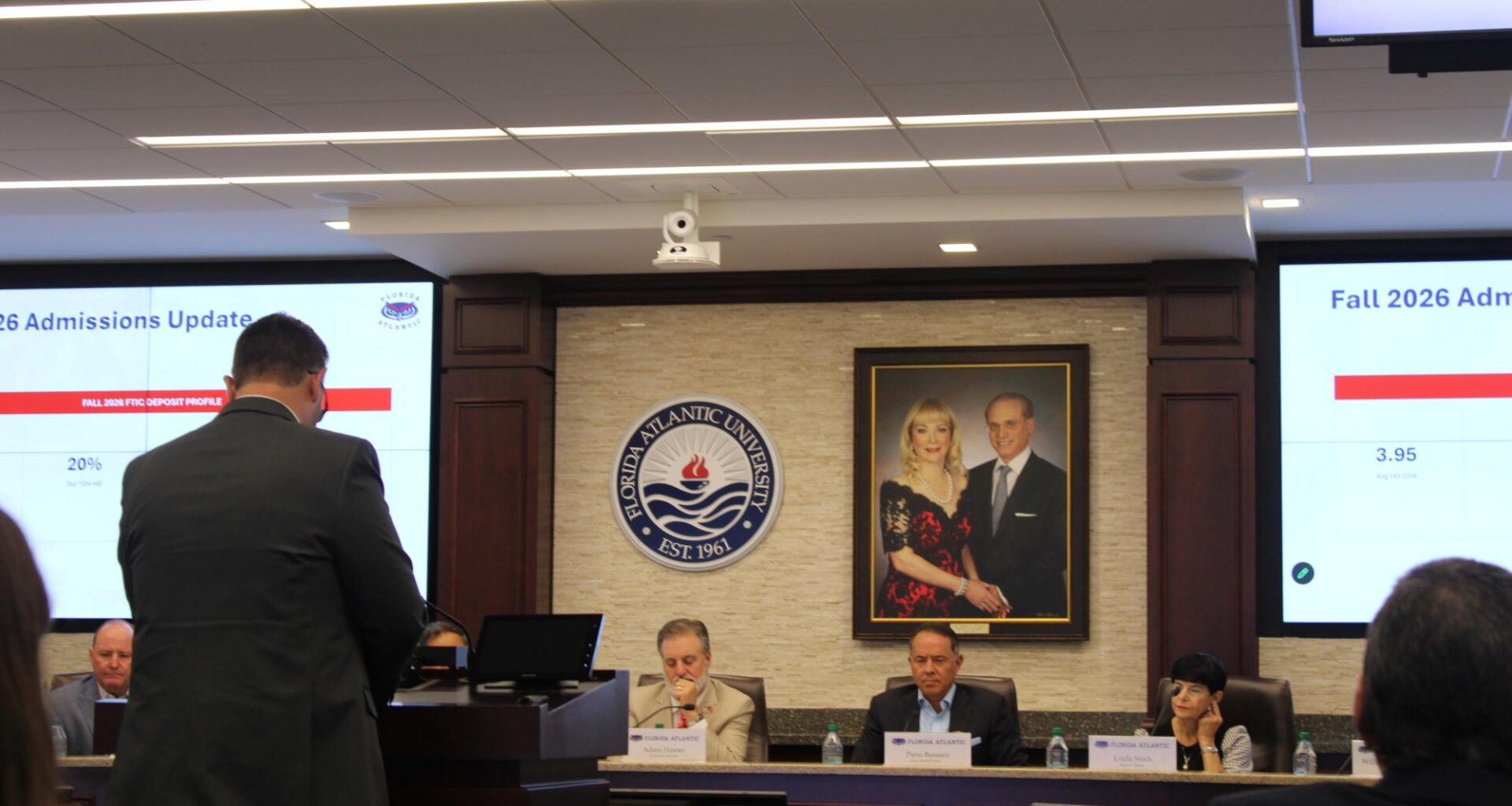
University leaders reported continued growth in student interest and enrollment during a new business and admissions update.
FAU received 59,477 first-time-in-college applications and admitted 32,314 students. Officials also reported transfer enrollment growth of 1,366 students.
Student Body President Lance Moore addressed trustees on Tuesday during his first meeting sitting on the board, outlining his administration’s priorities for the coming year. “My mission is to create a student experience and build a campus worth belonging to,” Moore said, defining that through four main goals: campus culture, access, opportunity, and advocacy.
Ava Hilton is the Editor-in-Chief of the University Press. For information regarding this or other stories, email [email protected] or direct message Hilton on Instagram @a.vahilton10.