
ORANGE COUNTY, Fla. — A class of 27 firefighters graduated from the Seminole State College Fire Academy Thursday afternoon, and the cadets are now ready to enter the workforce and serve their communities.
This comes as the state of Florida is facing a statewide shortage of firefighters, making it difficult for different departments in the area to recruit and keep firefighters and EMTs.
In the last few years, the Florida Fire Service has identified recruitment and retention challenges affecting the state. In June 2023, the Florida Fire Chiefs’ Association, in partnership with the Florida State Fire Marshal’s Office, published a White Paper on recruitment and retention.
It highlighted the causes attributed to the current labor shortages, citing better opportunities, changes in demographic population, fire industry culture, generational ideologies and values, increasing medical risks related to cancer, the COVID-19 pandemic, and mental health, among others.
“There is a shortage of newly trained firefighters throughout the state of Florida,” said Mike Wajda, deputy fire chief of operations for OCFR.
“One of the innovative things we’re doing at Orange County Fire Rescue is what we call our non-certified firefighter program. Essentially, what that does is give our citizens, local citizens here in Orange County, an opportunity to be trained as firefighters. They are hired, they are employees, and their full-time job is to become a firefighter emergency medical technician.”
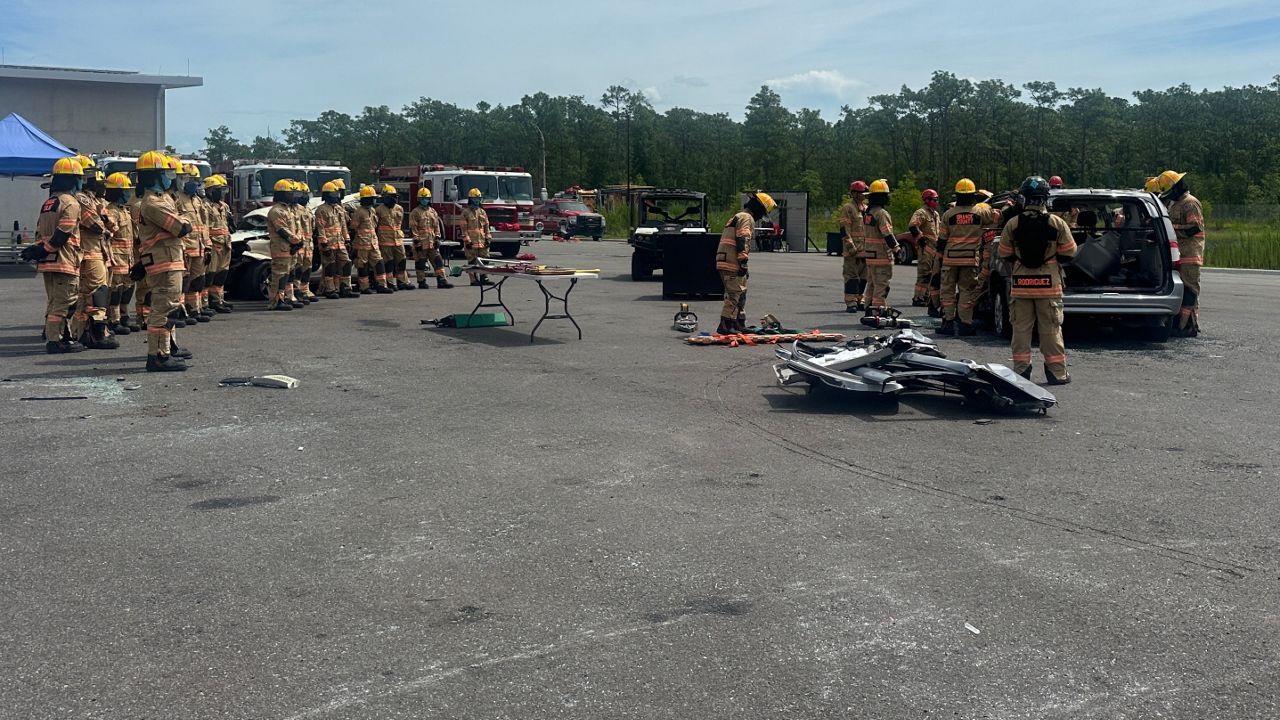
At the Orange County Fire Training Facility, the next generation of firefighters receives training with real-life scenarios to be ready to enter the workforce.
“This has everything needed to train firefighters, specialty trained technicians for building collapse, hazardous chemicals, all the way down to basic firefighters and basic emergency medical technicians who are just starting out in their career,” Wajda said.
In addition to the non-certified firefighters, they also have several other recruit programs, including a non-certified dispatcher program in which they take local citizens and train them to be 911 dispatchers, as well as a non-certified program for fire inspectors.
But as the population continues to grow in the state of Florida, there’s a greater need for qualified firefighters across fire departments statewide.
In order to stay competitive and recruit new firefighters, OCFR has had to negotiate their wages and benefits.
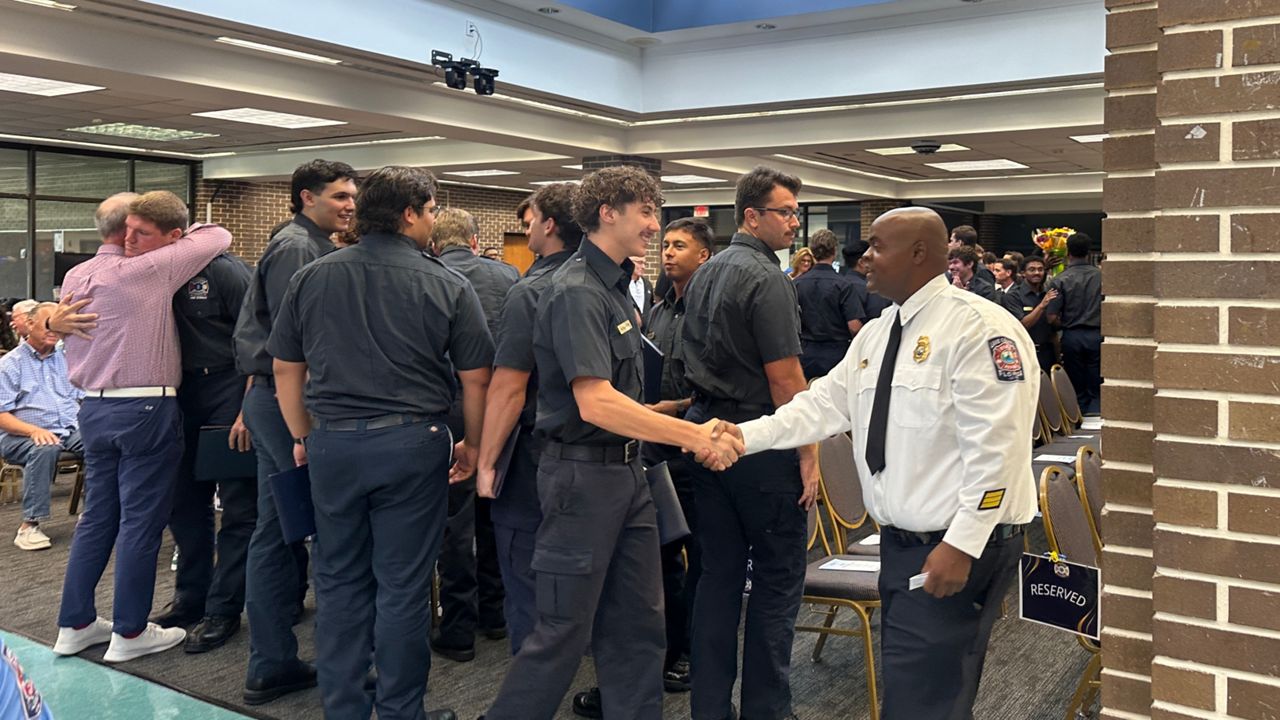
Thursday was a day for celebration, as Class 26-01 graduated 27 cadets ready to enter the workforce. (Spectrum News/Massiel Leyva)
Just recently, Orange County Mayor Jerry L. Demings and the Board of County Commissioners voted unanimously to resolve three articles at impasse in the Orange County Firefighter Union negotiation process.
The agreement increases firefighter starting pay from $47,258 to $59,072, with salaries rising to $62,025 after completion of a 10-week orientation. Additionally, firefighters who are certified as paramedics will receive an increase in incentives, bringing them from $70,956 to $73,909 after a 10-week orientation.
“That puts us at the top of the pay scale and the top of the market for firefighters,” Wajda said.
Over in Seminole County, Seminole County Fire Chief Matt Kinley says they’ve also seen the shortage of trained professionals. He said they just went through a hiring process where they filled all the positions they had. They do that about twice a year, and as of now they are getting ready for their next recruitment as they look to fill five additional firefighter positions.
“Recruiting is very competitive in Central Florida and really across the state. One of the main reasons for that is there is a deficit in firefighters,” Chief Kinley said.
Just last year, the Orange Technical College Mid-Florida campus facility on Oak Ridge Road ceased operations as a fire training facility. Following that closure, Valencia College has continued to offer Firefighter Minimum Standards and Advanced Training programs.
Many of the local fire departments, including SCFD, rely on partnerships and programs like the Fire Academy at Seminole State College to get the vast majority of their candidates, but even with those graduates, Kinley says is not enough to supply the demand for firefighters.
“If all of the colleges in the state of Florida produced the maximum amount of firefighters that they possibly can, we’re still at a deficit. So, we’re working off of a deficit no matter what. And then when you have colleges that closed down their programs, that’s just adding to the competitive nature of recruitment,” Kinley said.
Thursday was a day for celebration, as Class 26-01 graduated 27 cadets ready to enter the workforce. Orange County Fire Chief Anthony Rios was the keynote speaker at the graduation ceremony, congratulating the new graduates and sharing three words that have helped his career: “Curiosity, Character and Compassion,” he said.
Families filled the room to accompany the cadets and cheered them on as they crossed the stage and received their diplomas.
“Words can’t explain this past year,” graduate Alessandro Sciagata said. “Getting into the whole entire fire program has been a big change for me. I knew, kind of graduating regular college, that I wanted to take this step. And then actually putting it into reality, it kind of made the huge difference. And, you know, we’re at the end of the tunnel and get a start the rest of my career, which I can’t wait for.”
The Seminole State College Fire Academy is a 6-month-long program, 492 clock hours where instructors teach cadets everything need to know to become firefighters.
“We’ve had cadets come from The Villages, you know, as a sponsor cadet, or City of Orlando or Orange County. So, it’s a state college and we pride ourselves on putting out the best product we can locally and statewide,” director and chief of the fire academy at Seminole State College David Hilliard said.
They run five academies a year, graduating about 150 students annually.
“This is a very physically, taxing, and demanding job. But I remember years ago, one of the Central Florida chiefs saying that the state of Florida needed 6,000 firefighters, and the state of Florida doesn’t put out 6,000 firefighters a year. We’re trying, we’re doing our best. We’re trying to fill each academy that we have,” Hilliard said. “A drop in the bucket.”
Newly graduated firefighters say as they enter the workforce, they seek employment with departments that can provide more opportunities, increased benefits, compensation and upward mobility.
“The world is our oyster. You have so many different opportunities and places to look for,” Sciagata said. “What I’m looking for is just to stay in this area. You know, I’m a Central Floridian. I want my kids to grow up here. So, I want to stay here, whether it be, you know, over coastal side, as long as I’m in Central Florida, I can stay in this area and serve my community.”