

An agency partner of Harry Chapin Food Bank donates food to people in need.
Courtesy of Harry Chapin Food Bank
PORT CHARLOTTE — A Southwest Florida family of four with two children must earn more than $104,000 a year to afford basic necessities and childcare, according to a new report from United Way.
For years, United Way and other aid organizations have been using the term ALICE, which stands for Asset Limited, Income Constrained, Employed populations in the United States. The threshold for ALICE families are above the Federal Poverty Level, but below the basic cost of living.
The ALICE report, which comes out each year, highlights counties in Southwest Florida that experience financial hardship, including Sarasota County’s family survival budget of $108,900 and Charlotte County’s at $104,400.
DeSoto County’s at $80,556, however income in that county is lower as well.
Pull Quote
“Economic burdens that continue to
get worse will continue to affect mental health.”
Angie Matthiessen,
CEO, United Way of
Charlotte County
Doug Griesenauer, United Way Suncoast’s vice president of Community Impact, said DeSoto County has the highest percentage of population under the threshold.
“Rural communities do tend to have higher ALICE populations than urban communities.” Griesenauer said. “It’s cheaper to live in Arcadia than it is to live in Tampa — but the job prospects tend to be significantly fewer.”
The report highlighted population demographics and household numbers in Southwest Florida that struggle under the ALICE threshold.
WHAT THE NUMBERS SHOW
The 2026 ALICE report highlighted that more households 65 and older fell under the threshold. Griesenauer said older adults have fixed incomes, but not fixed expenses. Inflation takes a toll on weekly and monthly expenses.
“What we see is a lot of these older adults may not be in poverty, because we do have social safety nets like Medicare and Social Security,” Griesenauer said. “But those supports do not help our older adults get to a level of self-sufficiency based on the cost of housing that we see in our communities.”
Resource Navigator Danya La Rotta, left, and CEO Angie Matthiessen advise anyone who needs assistance to visit unitedwayccfl.com.
SUN PHOTO BY NICOLE DROEGER
Angie Matthiessen, United Way of Charlotte County’s CEO, said the number of families struggling are rising due to natural disasters.
“We’ve just come off of a pandemic and three major hurricanes,” Matthiessen said. “Our community is in a vulnerable place. The recovery for one major hurricane can be over seven years, so we’re seeing the evidence of a community that’s still trying to recover.”
According to UnitedForALICE’s 2019-24 data, more than three million Florida households were under ALICE, and more than one million were under the poverty level in 2024.
Florida’s rising ALICE household population. Data from unitedforalice.org.
SUN GRAPHIC BY NICOLE DROEGER VIA DATAWRAPPER
Including population reports from the U.S. Census Bureau, the 2024 ALICE data for Southwest Florida show:
Charlotte County, (population 217,212):
ALICE: 28,978Poverty: 9,729
DeSoto County, (population 36,744):
ALICE: 4,330Poverty: 2,882
Sarasota County, (population 479,958):
ALICE: 73,865Poverty: 20,968
Rates of ALICE and FPL households in Charlotte, DeSoto and Sarasota counties. Created with DataWrapper. Source: unitedforalice.org.
NICOLE DROEGER
The 2024 demographic report highlighted single households without children, married with children, single female and single male households with children. They also include multiple age ranges.
Percent of demographics below the ALICE threshold. Source: unitedforalice.org.
SUN GRAPHIC BY NICOLE DROEGER VIA DATAWRAPPER
UNITED WAY OFFERS ASSISTANCE
In 1887, United Way started as a charity organization in Denver, Colorado. Expanding across the globe, the organization responds to the needs of local communities with fundraising and collaborative efforts with other philanthropic organizations.
United Way Suncoast serves five counties: Pinellas, Hillsborough, Manatee, Sarasota and DeSoto. The nonprofit does community impact investments with philanthropic organizations such as All Faiths Food Bank. They also provide financial coaching and volunteer income tax assistance.
Community programs for summer childcare are funded by donations from United Way Suncoast. They are involved with the Quality Childcare Initiative, which works with childcare providers to assist ALICE households with access to early education.
“We know that 80% of the brain development happens between ages zero to five,” Griesenauer said. “Making sure that our children can be learning and building those supportive relationships that are valuable to themselves later on in life.”
Summer care programs are also funded through United Way Suncoast. Its 2026 numbers tout 25 partners, 54 campsites and the nearly 1,000 scholarships children receive across the region.
“If you don’t have a strong summer involvement, you may actually forget a few things,” Griesenauer said. “Summer care is designed to provide safe locations for our early school children and the ability to participate over the summer, so that their parents can keep working.”
United Way Charlotte is separate from United Way Suncoast, but part of the larger network. It also provides assistance to ALICE households and supports a VITA program and partners with local banks to provide financial empowerment classes.
“We’re small and mighty,” Angie Matthiessen said. “So we provide financial assistance directly to the person in the home who’s struggling.”
Matthiessen said that households under the ALICE threshold struggle with property damage following hurricanes and storms.
“The economic burdens that continue to get worse have and will continue to affect mental health,” Matthiessen said.
The interactive map provides access to data from the Federal Emergency Management Agency and ALICE that show communities that are still struggling from natural disasters.
“In blue skies or gray skies, we always want to be ready to help,” Matthiessen said.
WHERE DOES HELP COME FROM?
Alongside the rising number of households under ALICE, food insecurity concerns increase. As a response to Southwest Florida’s food problems, nonprofits and community food drives provide families with meals.
All Faiths Food Bank partners with local agencies in Sarasota and DeSoto counties to distribute food. The nonprofit’s headquarters in Sarasota contains a food storage facility with quality inspectors and nutrition experts.
CEO Nelle Miller said the majority of food comes from their national agreement with Feeding America. Retail stores such as Walmart and Publix donate truckloads of food for distribution. Food types range from refrigerated produce to bakery goods.
All Faiths has more than 870 points of distribution. It partners with more than 1,000 agencies, including school pantries, wellness centers and hospitals.
All Faiths Food Bank Communications Coordinator Kyle Hunter, left, and CEO Nelle Miller said they can receive up to five million pounds of food a year.
SUN PHOTO BY NICOLE DROEGER
All Faiths also accepts monetary donations through virtual food drives. The nonprofit will order food and organize items for distribution themselves. One of their distribution efforts is to fill backpacks of snacks for students returning to school.
The organization has noticed an increase in the number of people visiting food distribution locations. 2025 had a 26% increase of visits and, as of March 2026, there has been a 14% increase.
Containers of donated snacks for students at All Faiths Food Bank in Sarasota.
SUN PHOTO BY NICOLE DROEGER
“We know that every little thing that happens, whether it’s a hurricane, a tropical storm, COVID, government shut down … all of that trickles down to the most basic needs,” Miller said. “The cuts to SNAP and Medicaid — as well as a decrease in coverage through the government marketplace for health insurance — are some of the reasons why more people are needing this food.”
Fresh produce is refrigerated and go through quality checks at All Faiths Food Bank in Sarasota.
SUN PHOTO BY NICOLE DROEGER
All Faiths does not turn people away. More information about food distribution can be found at: allfaithsfoodbank.org
To the south, Harry Chapin Food Bank started distributing food in 1983.
Named after the late singer-songwriter, the organization serves Charlotte, Collier, Hendry, Glades and Lee counties. They are also a part of Feeding America and partner with local agencies, farms and churches to distribute food.
President and CEO Richard LeBer has led the food bank for 10 years. He’s noticed a significant increase of people with food insecurity that mirrors the growth from the pandemic.
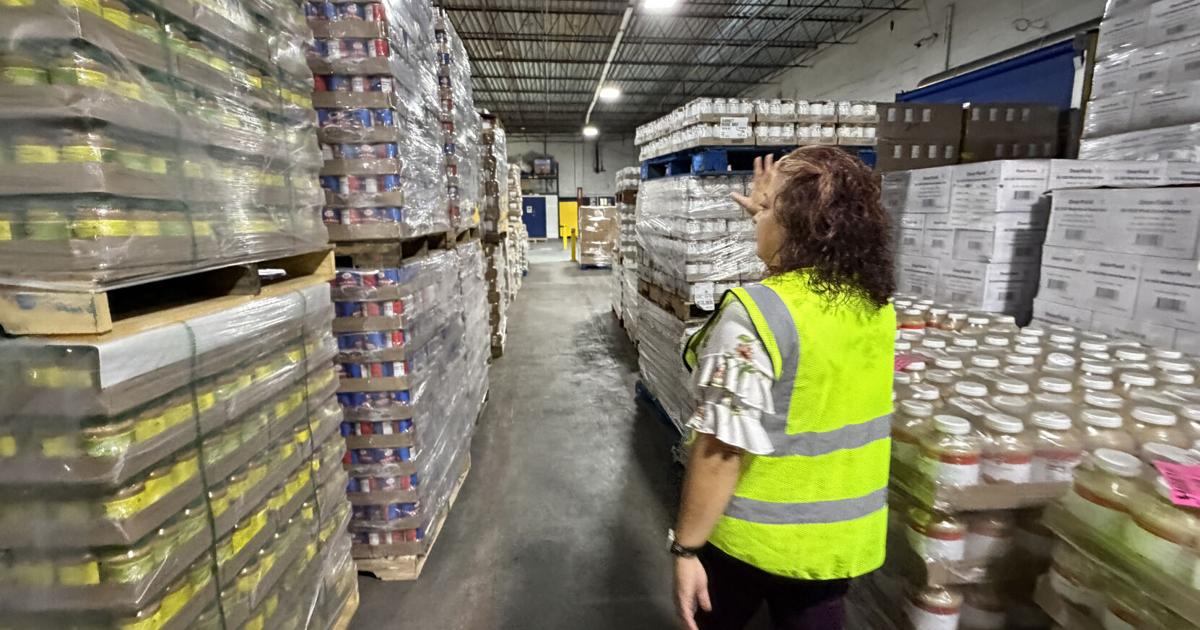
Irma Lancaster, director of communications and marketing for the Harry Chapin Food Bank, walks through the organization’s sprawling Fort Myers Warehouse recently. She said food donations are immediately catalogued in their system.
SUN PHOTO BY NICOLE DROEGER
“People figure out ways to make ends meet, and they often involve sacrifices,” LeBer said. “It works until something goes wrong and there’s no extra money left over.”
Last year, Harry Chapin distributed a total of 38.5 million pounds of food. As a nonprofit, 80% of its food is donated from private sources, primarily retail. Of that, 35% are perishable produce and 15% falls under meat and protein. The rest are nonperishables.
Their headquarters in Lee County include volunteer rooms, a large storage area and a packing room. Food that is deemed unfit for human consumption are donated to pig farms in the region.
A separate room is designated for volunteers to bag and weigh food at the Harry Chapin Food Bank in Fort Myers.
SUN PHOTO BY NICOLE DROEGER
Harry Chapin has more than 4,000 volunteers involved with food distribution. People in need are welcome to attend a food drive hosted by an agency. More information can be found at: HarryChapinFoodBank.org
“We promise we will make it as painless and pleasant of an experience as we possibly can,” LeBer said. “We know the people who are hungry are not having a good day. It’s not our job to make that any worse; it’s our job to help them.”