
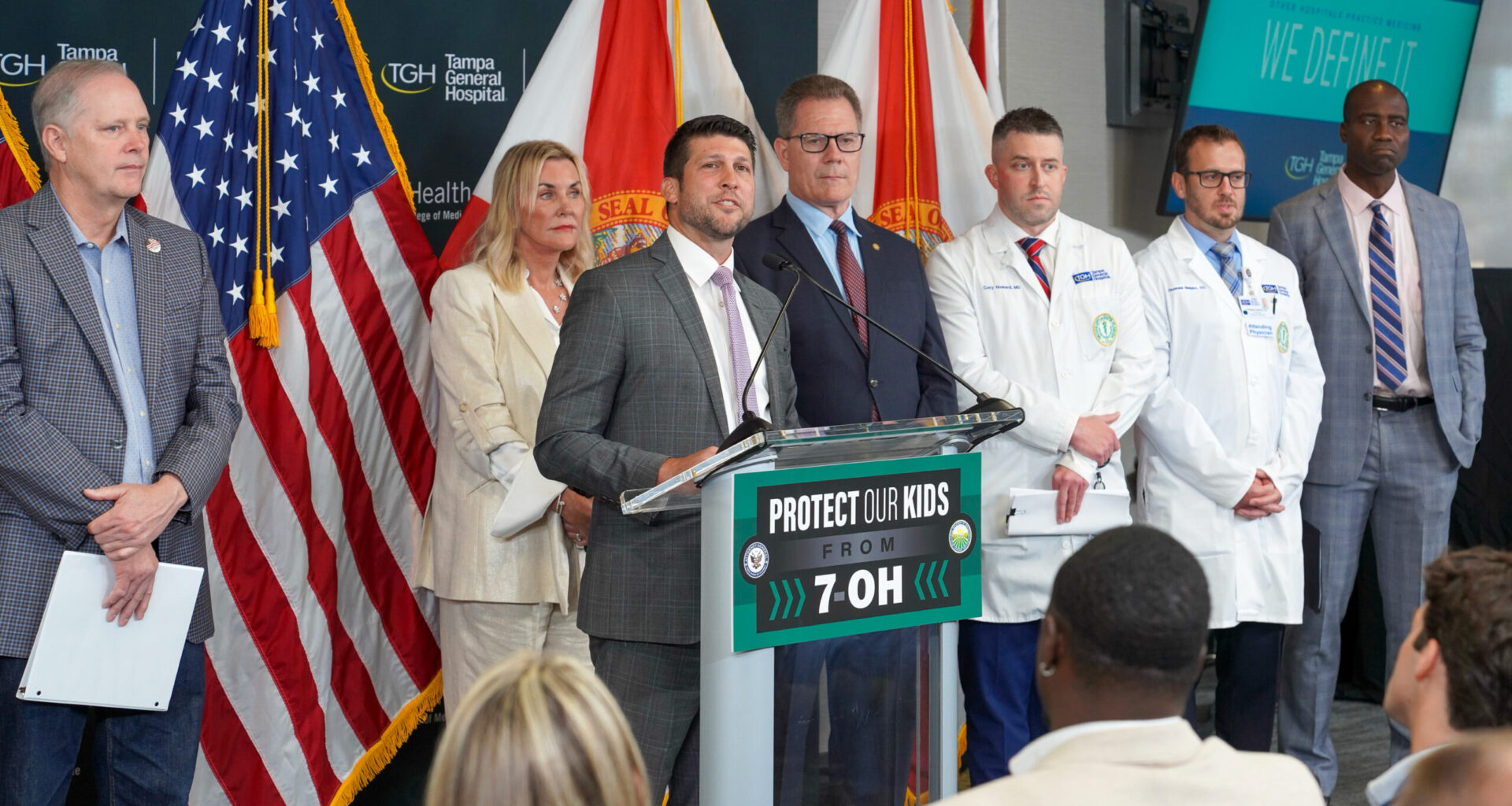
Florida Attorney General James Uthmeier announced Monday that the state is expanding a 7-hydroxymitragynine (7-OH) emergency ban at a Tampa General Hospital media event. The substance has been sold at gas stations and retail stores.
“Our chemists have analysed that it can be 13 times or more potent than morphine,” Uthmeier said at the gathering. “Since 2013, Florida medical examiners have linked at least 587 overdose deaths to 7-OH and related chemical compounded drugs.”
In August 2025, the state classified 7-OH as a Schedule 1 controlled substance. The emergency rule made it illegal to sell, possess or distribute any isolated or concentrated form of the drug.
According to the Attorney General’s website, 7-OH is “a chemical compound found naturally in the kratom plant.” A plant native to Southeast Asia, kratom is commonly used to reduce pain, opioid withdrawal and anxiety. Isolated or concentrated forms of 7-OH “are much more potent.”
These products are “frequently marketed as natural or wellness supplements but can lead to addiction, overdose and other serious health effects.”
While the state was able to “shut down a lot of these dangerous drugs,” Uthmeier added, individuals tried to “skirt the system” and “dodge, deviate and come up with new ways to profit over public safety.”
With the expansion, the state will “make sure that new chemical compounds that are being used to blend or substitute 7- OH derivatives are included.”
Forms such as 7-hydroxymitragynine, mitragynine pseudoindoxyl, 7-acetoxymitragynine, 9-hydroxycorynantheidine, 10-hydroxycorynantheidine, MGM-15 and MGM-16 will now be impacted.
“No product may contain more than 1 milligram of these dangerous chemicals per gram,” he explained. “Any product containing any amount of 7-OH or its related compounds must also contain at least 100 times more regular mitragynine by mass.”
People who disobey the expansion rule can receive up to 30 year prison sentences. Uthmeier added that 7-OH products have not been authorized for medical purposes in Florida.
“Too often we see in our emergency room patients coming through experiencing overdose,” said Tampa General Hospital executive vice president and president Melissa Golombek at the Monday event. “With access to 7 – OH at every convenience store, we are having kids and teens purchase this without understanding the true addiction and highly lethal ability that this drug has.”
Tampa General Hospital emergency medicine physician Dr. Cory Howard added that “we have seen a rising trend of exposure to these 7 – OH products.” The substance is often found in “consumer-friendly formats,” such as gummies, tablets, drink mixes, teas and capsules.
He explained that “7-OH is deliberately designed to hide its dangers.” Frequently, it “is marketed as a remedy for pain and anxiety.” Additionally, the substance “appeals to children with bright packaging and fruit flavors.” Brand names include Hydroxy, 7Tabz, 777 Jackpot Alkaloids, Roxy 7-OH and 7OHMZ.
Patti Wheeler has experienced the negative impacts of kratom concentrates firsthand. Her son Wyatt lost his life in October 2022.
She explained at the Monday gathering that he initially purchased a powder as an alternative to alcohol. Six weeks later, Wyatt “died in his brother’s arms having a seizure” after consuming a kratom product.
“People deserve to know what they’re putting in their body,” she said. “They deserve proper labeling. They deserve honest information and families should not find out about kratom when it’s too late.”