
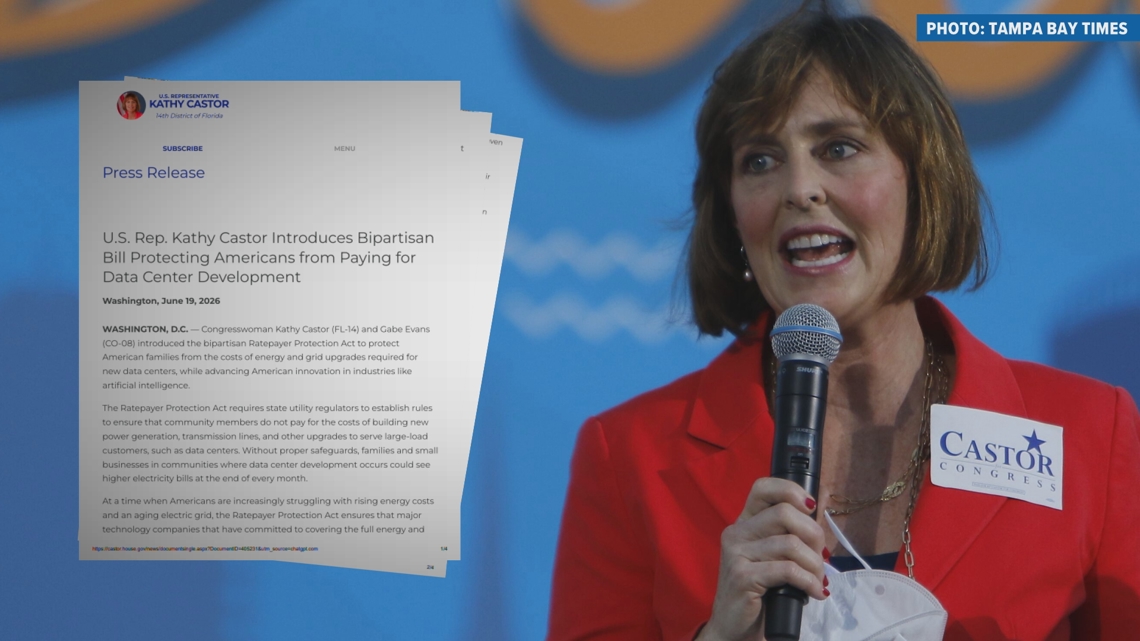
The bill is aimed at preventing residents and businesses from paying for the growing energy demands of data centers in their area.
ZEPHYRHILLS, Fla. — The debate over data centers is moving from local city halls to Capitol Hill.
U.S. Rep. Kathy Castor of Tampa has introduced the bipartisan Ratepayer Protection Act, legislation aimed at preventing residents and businesses from bearing the costs associated with the growing energy demands of data centers.

This story continues below.
The proposal comes as communities across the Tampa Bay region continue grappling with whether — and where — data centers should be allowed.
“My neighbors across Florida are grappling with skyrocketing electric bills. Ratepayers should not have to subsidize wealthy corporations’ growing energy demands, especially from AI data centers,” Castor said in a statement. “The Ratepayer Protection Act safeguards consumers by ensuring these data centers pay for the energy and grid upgrades they need so hardworking families and local businesses are not stuck paying more.”
If approved, the legislation would direct states to establish rules requiring large electricity users, including data centers, to pay the full costs of new power plants, transmission upgrades and other infrastructure needed to serve their facilities.
The federal proposal comes as local governments throughout the region consider restrictions on data centers amid concerns over energy consumption, water use and land-use compatibility.
In Pinellas County, a data center has been proposed at 10700 76th Court North in Pinellas Park, near Bryan Dairy Road and Belcher Road. Pinellas Park City Council member Ricky Butler said city leaders are still evaluating how a standalone data center would fit within existing zoning regulations.
RELATED: Which cities and counties in the Tampa Bay region are considering data center moratoriums?
“There’s no precedent in city code for the use of a parcel for a data center,” Butler said. “It’s not in our code in the city of Pinellas Park as a general use. So I think anything like that that’s new, we have to look at it.”
Butler added that he hears many residents’ concerns center on the facilities’ significant energy demands.
“The concern that people generally have is just what that consumption does to everyone else,” he said.
Meanwhile, the city of Zephyrhills is expected to vote Monday evening on a proposed one-year moratorium on new data centers. The measure would temporarily halt data center development while city leaders study potential impacts and determine whether additional regulations are needed.
The proposed moratorium comes despite no data center currently being proposed within Zephyrhills city limits.
Zephyrhills is not alone. Similar discussions have taken place in Hernando, Pinellas, Citrus and Pasco counties as local governments weigh how to manage the rapid growth of data centers driven largely by artificial intelligence demands.