
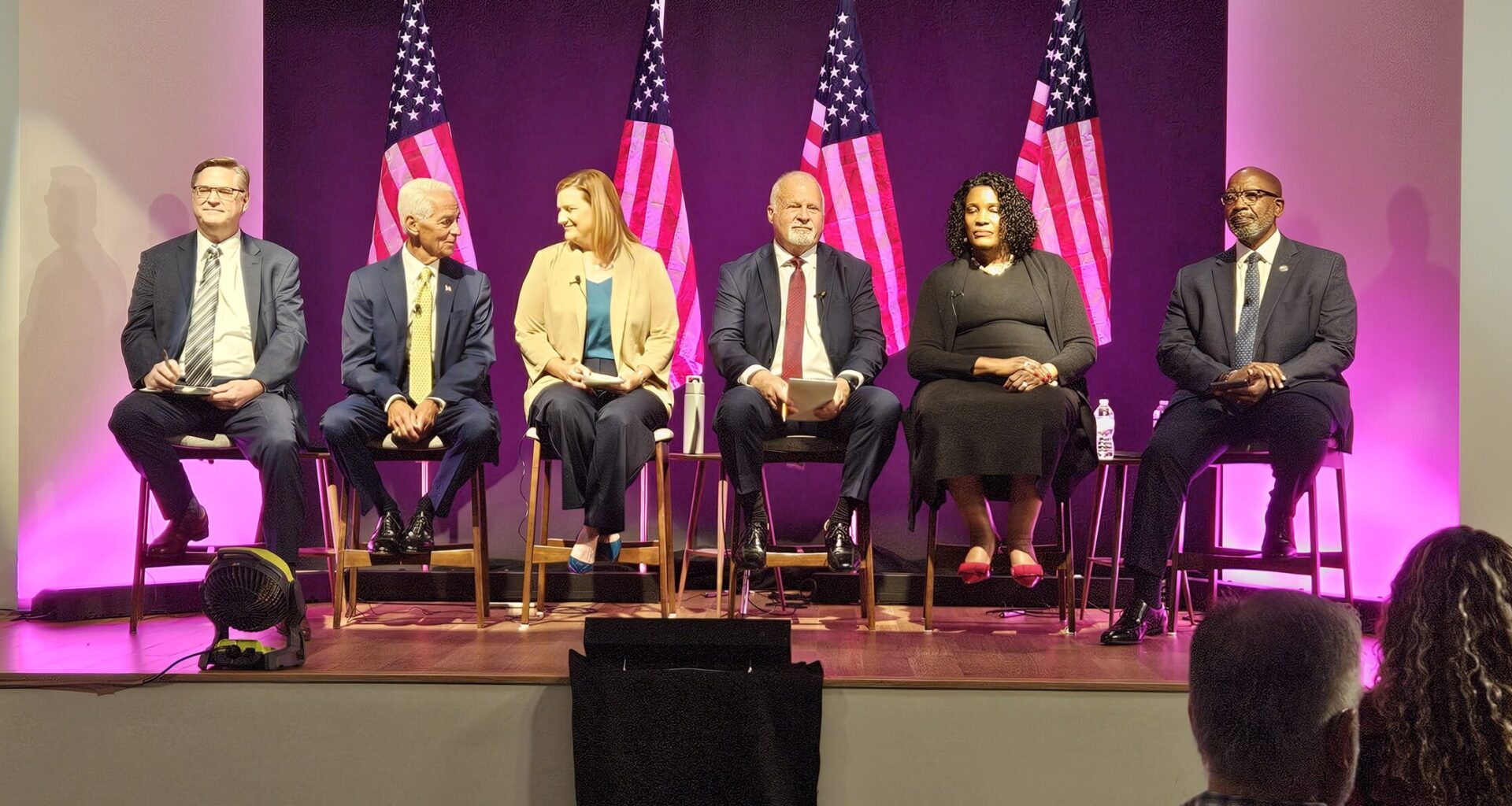
Former Gov. Charlie Crist opened the St. Petersburg mayoral forum Wednesday evening by making his pitch to keep the Tampa Bay Rays in town, arguing the city should not move forward with plans for the Historic Gas Plant District until it makes another attempt to keep the team on this side of Tampa Bay.
Crist called it tragic when talks with the previous Rays ownership fell apart, and said the city needs to revisit that issue first, given how much it affects redevelopment in the area.
“I think what we need to do is try to keep the baseball here,” Crist said. “It’s important to me, and it’s important to a lot of our residents who worked very hard to get that team here in the first place.”
Crist’s comments came during the Residents of West St. Pete Mayoral Forum, sponsored by the Stronger Together St. Pete Foundation and Spectrum Bay News 9 at the President Barack Obama Library on Wednesday evening.
The event was billed as a conversation rather than a debate, with candidates asked to avoid personal attacks. But the first question of the night quickly exposed one of the sharpest divides in the race, and the distinctions only mounted as the night moved along.

All of the candidates have taken aim at incumbent Mayor Ken Welch for his handling of negotiations with the previous Rays ownership, which collapsed after an initial deal was struck.
Welch has pushed back on the premise, arguing that it was the Rays that pulled out of the agreement. He said Wednesday the promise made was never to the Rays, but to the former Gas Plant community that he grew up a part of. He also vowed to choose a developer for the site before the upcoming election.
“This notion of keeping baseball here, that was never the promise, that was never the goal,” Welch said. “I’m a descendant as well. I know the promises that were made to the community when churches and businesses and homeowners were asked to move in the name of progress. It wasn’t for baseball; that was for inclusive economic development. That was the promise I made in 2021.”
All six mayoral candidates took part in Wednesday’s event, including City Council Member Brandi Gabbard, former Fire Chief Jim Large, community activist Maria Scruggs and former Shore Acres Neighborhood Association President Kevin Batdorf, in addition to Welch and Crist.
Crist stood alone in calling for renewed efforts to keep the Rays in St. Petersburg, though all the candidates criticized Welch’s approach to redeveloping the Historic Gas Plant District.

Candidates also broached a variety of topics, including how to accommodate growth without erasing neighborhood character, affordability, utility costs, their stance on possible property tax cuts, storm recovery approach, plans for resilience, permitting delays and transparency at City Hall.
Candidates urge caution on Gas Plant District
Most candidates pushed back against the current pace of redevelopment for the Historic Gas Plant District under Welch, though they offered different ideas about how the city should hit the reset button.
Gabbard said the city should pause the current developer-selection process and complete an expedited study before deciding whether to sell the land at all. She argues the city still needs to decide whether to sell the land, retain some of it for future public use, or take another approach.
“I’ve brought forward a plan for us to do a study that will actually tell us exactly what we need to have on that site,” Gabbard said.
Large also called for caution, arguing that residents are far from united on what they want for the property, making it too soon to settle on a final plan.
Scruggs, who said she has family ties to the Gas Plant community, framed the decision as one of the city’s greatest opportunities to make good on promises to residents displaced from the neighborhood.
Batdorf said the city should step back and consider updated appraisals for the property, and argued that there are also other locations more appropriate for affordable housing.
“Right now, the plans that have been out there were based on a valuation premise from 2023. The valuations that came in this year put the value of that property at $390 million. We need to leverage that property to maximize the benefit for the entire city,” Batdorf said.
“So, if we need housing, low-income housing does not belong on that parcel. There’s plenty of opportunity in a city to create housing. We need jobs. You want to be able to afford homes? You need jobs that pay you enough.”
Growth and neighborhood character
Candidates also addressed questions about how St. Petersburg should handle new development while addressing concerns that growth could lead to a loss of neighborhood character.
Candidates generally agreed that growth has to be managed more carefully, but they differed on their approach.
Welch defended the city’s approach, saying much of the growth residents see now was planned for in areas such as downtown, Gateway, Tyrone and Skyway Marina.
“Neighborhood character is vitally important. We all love our neighborhoods, but I’m so excited and glad that we have the St. Pete that we have today versus when I was growing up. There was literally nothing to do in St. Pete when I was growing up,” Welch said.
“My fear was that my daughter, my youngest, who just turned 24, wouldn’t want to come back to St. Pete because we were called ‘God’s waiting room.’”
Meanwhile, Large has been vocal on development issues throughout his campaign. He said the city’s character is already changing as older homes are replaced with larger houses, and called for smart zoning and permitting to keep one hand on the wheel without threatening private property rights.
“I see it changing all over the city as I’m driving around, you see house after house being bulldozed and being replaced with a mini mansion,” Large said. “It’s No. 1, not affordable to the average homeowner, so that creates a problem, but it changes the character too of the neighborhood because they start looking a little more cookie-cutter, and that is not part of the character of the neighborhood.”
Gabbard argued that the city’s coastal neighborhoods are directly connected to the pressure on inland communities and said streamlining the city’s permitting process would help address the issue.
“We have 60 miles of coastline around our city, and all of that is neighborhoods that are feeling increased pressure to be able to sustain and maintain. If we don’t help them build better and recover faster from storms, what that does is force them to look to move into the interior of our city,” Gabbard said.
“It’s called climate gentrification. It is a real challenge for communities all over the world, all over the country, and if we’re not looking at how we sustain our neighborhoods along the coasts, the interior will continue to feel that pressure. What happens in a built-out city? We go up.”
Crist said development should continue, but warned that downtown development can be “overdone” and should be managed to protect the city’s quality of life.
“Development doesn’t need to run away, you need to have smart development,” Crist said.
Scruggs argued the city needs to define neighborhood character by the people who live there.
“We start with protecting the culture and character of a neighborhood by investing in the people that are in the neighborhood,” she said.
Batdorf said the city should focus on helping residents modernize existing homes, rather than allowing redevelopment pressure to displace them.
“What we need to do is go in and find a way for the people who are living in these neighborhoods to rebuild their home and modernize their existing home and give more opportunities for home ownership, because that’s the way that you build generational wealth,” Batdorf said. “That’s how you keep people in neighborhoods.”
Affordability and utility costs
Candidates also addressed questions about affordability, with answers ranging from housing and wages to utility bills and whether St. Petersburg should continue to rely on Duke Energy.
Gabbard argues the city cannot build its way out of the affordability crisis alone and needs better-paying jobs, stronger workforce partnerships and broader efforts to reduce household costs.
She is also the candidate who has been the most vocal in calls to “dump Duke” as an energy provider, arguing that the city could find more affordable alternatives, including a city-run utility. She and other City Council Members approved a study that could cost nearly $600,000 to understand the city’s options better as the city’s contract with Duke expires this Summer.
Welch highlighted his administration’s affordability work, pointing to affordable housing projects already completed or in the pipeline. He said he supports getting the information from the feasibility study, but warned that a city-run utility could be expensive and may not lower residents’ bills.
Large and Batdorf were more openly skeptical, arguing the city should prove it can operate its existing water utility before considering operating its own electrical grid. Batdorf suggested a short-term extension to give the city time to find a company interested in competing with Duke for the city’s contract, rather than to manage the utility itself.
Crist said Duke does “a pretty decent job,” but said he would remain open-minded about what the study shows.
“They’ve been around a long time, they do a pretty good job. I’m open-minded about whether or not the results of this study are going to tell us that maybe we need to go in another direction. Being a good leader means that you have to be able to be flexible, you have to be a good listener and understand the new data, and what the best path forward might be,” Crist said.
Property taxes expose budget divide
Questions about a looming property tax referendum exposed one of the night’s sharpest budget divides, with candidates split over whether sweeping tax relief would force painful cuts to city services or relieve pressure on residents.
Welch said he opposes the proposal, arguing it would create a tax shift and force cuts to services residents regularly ask the city to expand. He said the city faces a $35 million loss in the first year of the cut, and $50 million in the second.
“I can’t remember one person over four years that’s come in and asked us to cut. It’s always been an increase for public safety, for neighborhoods, for the (Community Assistance and Life Liaison) program, for arts, for home services, for how they want us to fill gaps from state and federal cuts to SNAP and arts funding,” Welch said.
Crist said the city should cut property taxes regardless of what happens with the statewide proposal, repeating his pledge to return about $15 million a year to St. Petersburg residents.
“If it doesn’t pass, I’ve already proposed that what we should do is reduce your property taxes anyway by .4 millage,” Crist said. “What does that mean to you in terms of dollars? About $15 million a year back to you, the residents of St. Petersburg.”
Gabbard argued the referendum would force difficult decisions, noting that property taxes help support police and fire services.
“We’re going to have to ask ourselves some really hard questions about what we don’t want to fund,” Gabbard said. “The honest truth is that ad valorem taxes fund police and fire, so by not having those funds available to fund those critical core services, we’re essentially defunding them.”
Large and Batdorf both said the city government needs to take a harder look at spending. Large said the city should refocus on core services such as public safety, infrastructure and storm resiliency, while Batdorf said the city has been overspending as property values rose.
“The city has been overspending for too many years because the values of properties went up during COVID substantially higher than the population growth in the city and inflation. They’ve just been overspending. I’d start, right off the bat, cutting some of the 250 salaries that are over $150,000,” Batdorf said.
Scruggs said the city should prepare as if the measure will pass and start by having elected officials and top administrators consider cuts to their own salaries.
Storm recovery and resilience
The need for infrastructure investment and its ties to storm recovery and resiliency also dominated much of the forum, with candidates repeatedly returning to permitting, infrastructure and whether City Hall was prepared for the scale of damage caused by hurricanes Helene and Milton overnight.
Gabbard, whose City Council District is almost entirely within the coastal high-hazard area, said every neighborhood she represents was touched by the storms, including her own home.
“While we will never keep back 7 feet of storm surge out of our city, we have to do better to make sure that we are helping people build faster, build higher and build stronger for the future,” Gabbard said. “We have to help people recover faster, and what that looks like first of all is making sure that we get our permitting system under control.”
Large also focused on permitting, saying he repeatedly hears about delays from residents across the city. He said that when he served as Fire Marshal, the city was able to move permits quickly under previous administrations.
“When I was Fire Marshal for the city we went over permitting along with the building official, we were given by the Mayor at the time 14 days to get the permit out and we were able to do it,” Large said. “I don’t know what’s going on with the system now, but it’s definitely broken.”
Welch defended his administration’s response by saying the storms exposed infrastructure and technology systems that were not built for today’s level of extreme weather and highlighted the St. Pete Agile Resilience (SPAR) plan, federal recovery dollars and technology upgrades meant to address permitting and billing problems.
Funding for the SPAR plan will be on the ballot in November, “asking the community for one millage that will fund $600 million in improvements to fix our plants, to have neighborhood programs to prevent flooding, and to pay for pipes and pumps to move water from where we don’t want it to where it should be.”
Crist said the city needs to modernize its infrastructure and prepare before storms arrive.
“We have to modernize our infrastructure so that we can address the issue of flooding, keep the sewage in a proper place and make sure that when storms hit St. Petersburg, we’re prepared,” Crist said. “The best way to do that is to prepare before the storm is coming.”
Transparency and neighborhood voice
The forum also gave candidates a chance to respond to residents who said they feel disconnected from local government.
Welch defended his administration’s outreach, pointing to City Hall on Tour, budget open houses and meetings with neighborhood associations, nonprofits and community groups.
Gabbard said transparency, accountability and responsiveness cannot simply be buzzwords, nor exclusive to certain guests. She highlighted communication efforts, such as a community newsletter and other initiatives she’s maintained during her time on the City Council.
Crist said he would create an open government and transparency office, similar to what he said he did after being sworn in as Governor.
Scruggs proposed a community dashboard that would allow residents to track whether city leaders are following through on promises.
Batdorf said he would be more directly present in neighborhoods as Mayor.
Meanwhile, Large argued that the proof is in the pudding.
“The real answer … is we don’t see the results,” Large said. “Results are what make me feel that you’re no longer disconnected, when what you’ve asked for gets accomplished, what the need is in your neighborhood finally gets addressed.”