
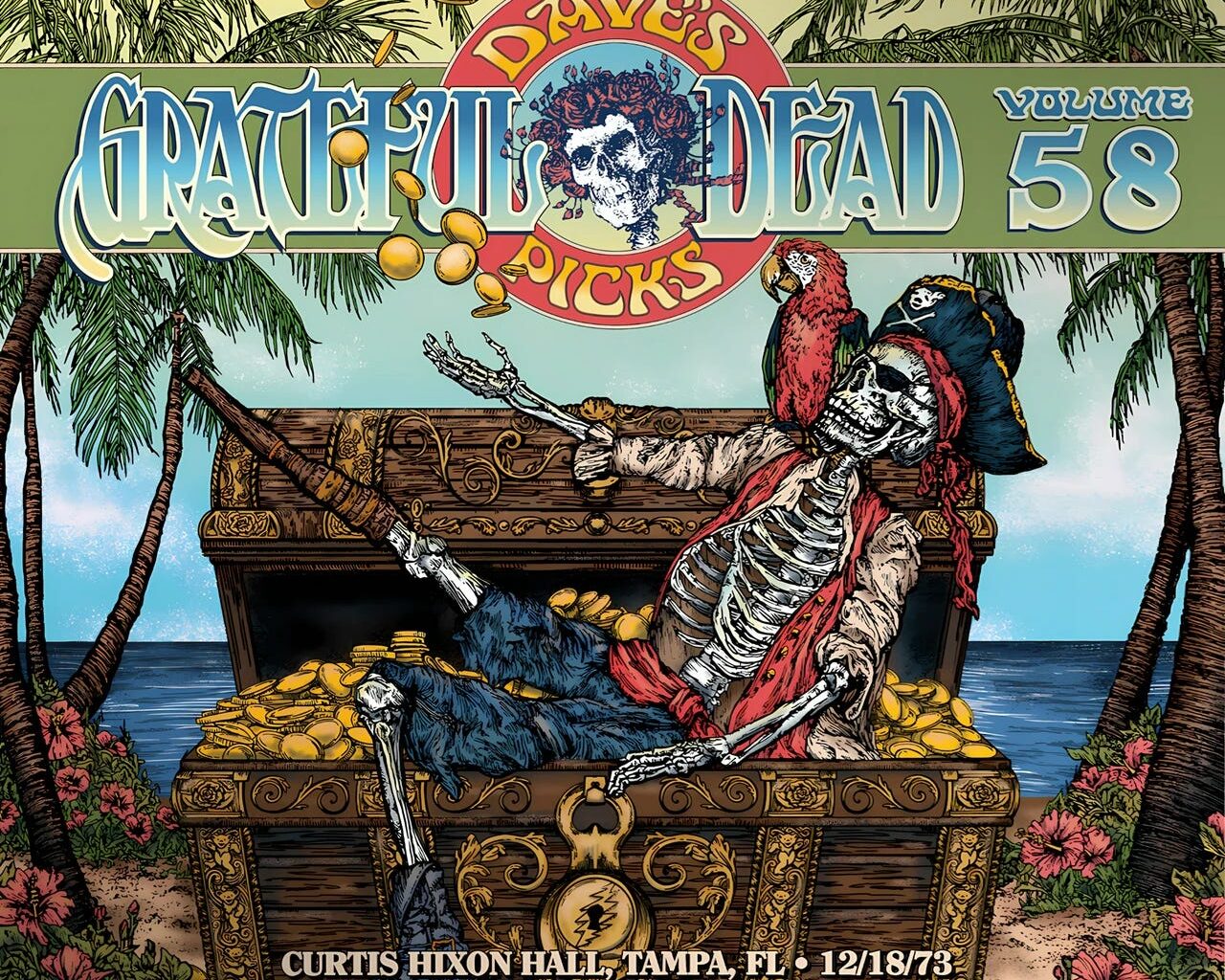
The late Bob Weir extolled the virtues of the Grateful Dead as a five-piece band, and sure enough, Dave’s Picks Volume 58 boasts musicianship absolutely sublime in both its unity and intricacy.
As is the recorded sound, captured by Kidd Candelario and subsequently mastered by Jeffrey Norman. Granted, the quintet leaves ample space between instruments on tunes both languorous (“Tennessee Jed”) and spirited (“Me And My Uncle”), but the band is deliciously patient in wending its way through both tempos and their variations.
There’s a quiet confidence suffusing the Grateful Dead’s playing here, suggesting the group was still flush with the satisfaction from the tour of the continent the previous year. Indeed, the band was in such command of its career at this time that it only makes sense that its overall surety of direction became manifest throughout its instrumental interactions.
Having satisfied its contractual obligation to Warner Bros. Records the previous autumn with the famous triple-LP Europe ’72, the psychedelic warriors had inaugurated their own record label the fall of this year with the release of Wake Of The Flood. And, those operational accomplishments were also an adjunct to the wealth of original material at the band’s disposal: at this juncture, the Grateful Dead repertoire was arguably at its most expansive in its history.
The breadth of reach, all the way back to “Dark Star” late in these three-plus hours, follows newer tunes such as “Bertha” and “Wharf Rat.” And those distinctive originals introduced on the Grateful Dead’s live album from two years prior are interwoven with multiple cover songs. traditional (“Don’t Ease Me In”) and otherwise (Chuck Berry’s “Promised Land”).
On top of those are “They Love Each Other,” culled from Jerry Garcia’s second solo LP Reflections, and “Greatest Story Ever Told,” a reworked cull from Mickey Hart’s Rolling Thunder project of 1972 (at the time of the tour from which this release comes, the percussionist was still on leave from the band).
“Row Jimmy” is just one of a small handful from the total twenty-five that reaffirms the understated poise of the fivesome is rooted in the graceful authority of the rhythm section, comprising sole drummer Bill Kreutzmann and indefatigable bassist Phil Lesh. The twinkling colors Keith Godchaux coaxes from his acoustic and electric pianos rise from the other end of the tonal spectrum on, for instance, “Brown-Eyed Women”; closely in tandem with both guitarists, the keyboardist regularly adds to the dynamic range of this streamlined Grateful Dead ensemble.
It thus only makes sense that the music created by this particular grouping of personnel would benefit from the mythic ‘Wall of Sound.’ The audio wonder of Owsley Stanley’s massive apparatus would make its debut roughly three months after this concert, contained in its entirety on the three CDs of Volume 58, and would further magnify the detailed nuance of the sound(s).
The logic in the pairing of technical wizardry and instinctive instrumentation is as inescapable as the progression from comparatively compact arrangements like that of “Deal” to the ambitious stretches such as “China Cat Sunflower”>”I Know You Rider.” Contrasting passages of that kind mirror the dense yet evocative artwork by Chelsea Housand on this triple-fold Dave’s package.
And, if the overall impact that is this installment of the ongoing vault initiative is not quite the euphoric experience chief archivist David Lemieux describes in his essay in the sixteen-page booklet–alongside some shadowy stage shots and replications of tour documents–it nevertheless comes pretty close.
In fact, in yet another occurrence of near-mystical Grateful Dead serendipity, the out-of-order placement of the main show’s encore, “Uncle John’s Band,” due to disc space limitations, renders the content immediately following and on CD three as an elongated, suspenseful closing. The ensuing drama becomes especially vivid based on the sequencing of two more excerpts from the same source as this bonus disc’s seven tunes, The Omni in Atlanta, roughly a week prior to the show at Curtis Hixon Hall in Tampa, FL, December 18, 1973.
Juxtaposing “Morning Dew,” another vintage number that keynoted 1969’s Live/Dead, with a second rendition of “Eyes Of The World,” the alternately sprightly and elegiac half-hour or so magnifies the profundity of Robert Hunter’s lyrics on the latter in such a way that a deeply stirring momentum ultimately suffuses the whole of this latest installment in the Dave’s Picks archival series.